








How to Combine TRIZ and Artificial Intelligence

Artificial intelligence can generate 20 possible solutions in a minute. Or 200. As ideas become easier to produce, the quality of the problem definition, the selection criteria and accountability for the result matter more than ever. Without them, AI does not accelerate innovation. It simply creates more untested hypotheses.
Oleg Feygenson, PhD in Engineering, TRIZ Master and President of MATRIZ Official, shared his experience of applying TRIZ and artificial intelligence to innovation and operational challenges. His approach rests on a clear division of roles. TRIZ provides the logic and structure for solving the problem. AI accelerates analysis, broadens the search for alternatives and helps process large volumes of information. People define the problem, verify the findings and make the decision.
AI Works Quickly, but It Does Not Know What Is True
A language model can produce an answer that sounds convincing and is still wrong. In practice, this may take the form of references to papers or patents that do not exist, or recommendations that cannot be implemented.
The reason is straightforward. A large language model does not read and understand a text in the way a subject-matter expert does. It identifies statistical patterns and predicts the most likely continuation of a response.
For an everyday query, an error may be irritating but manageable. In technical, scientific or business work, it can mean wasted time and resources, the selection of an unsuitable technology and a loss of confidence in the wider AI implementation programme.
Many teams follow a predictable path. Their first experience with AI produces a large number of ideas at remarkable speed. A few weeks later, enthusiasm gives way to disappointment when closer examination shows that many of those ideas cannot be used.
The answer is not to avoid AI. It is to engage with it as critically as one would with a human colleague: point out errors, ask follow-up questions, test the reasoning and never treat the first response as definitive.
It can also be useful to reverse the conversation and ask the model to question the user. This allows the expert to see whether the system has understood the problem correctly and which points require further explanation.
TRIZ Provides a Route Through the Search
TRIZ, the Theory of Inventive Problem Solving, was developed through the analysis of large bodies of patent information. One of its practical strengths is that it offers structured algorithms for working through problems.
That structure is particularly valuable when using AI. Clear boundaries do not necessarily narrow the search. They reduce random generation and direct the model towards a specific function, set of constraints and selection criteria.
One of the most effective TRIZ tools is function-oriented search, often abbreviated as FOS. During 12 years of work at Samsung Electronics, around 80% of projects used this method. Over the past two or three years, AI has increasingly supported the search process.
The idea is to look beyond the company’s own industry for technologies that already perform the required function well.
This changes the logic of innovation. Instead of immediately trying to invent something new, the team asks where the required function is already performed effectively and which technologies or underlying principles could be adapted.
A genuinely new idea requires experiments, time, people and funding. A technology borrowed from another industry will not transfer automatically either, but the underlying principle has already been demonstrated in practice.
From Product Name to Function
Function-oriented search does not begin with a prompt to an AI model.
First, an individual or working group selects the key problem. The team then defines the function that needs to be improved and sets the relevant performance requirements, such as cost, speed and safety.
The next step is to generalise the function in terms of the action and the object involved.
Instead of asking how to “split firewood faster”, for example, the task can be expressed as “separate a solid material”. This wording opens the search to solutions from mechanical engineering, semiconductor manufacturing and many other fields, rather than limiting it to forestry.
The team then identifies a leading field — an area in which this particular function is performed especially effectively.
That field does not have to be the most technologically advanced or modern. It is selected solely because of how well it performs the function in question.
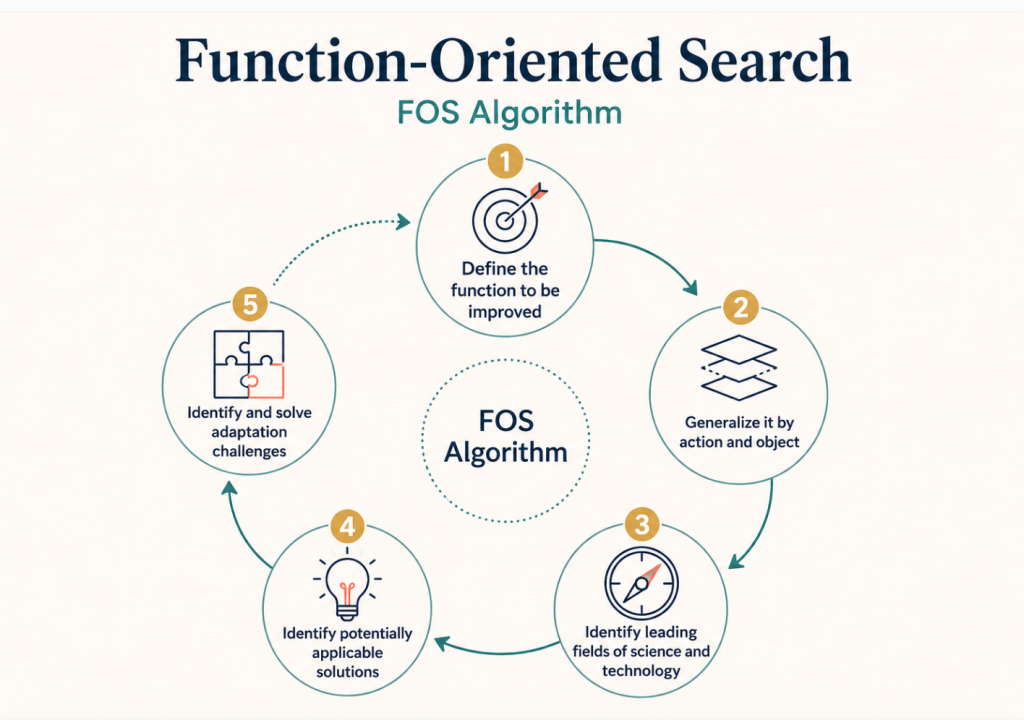
Once the problem has been generalised, AI can help to:
- identify fields in which the same or a similar function is already performed;
- find the technologies used in those fields;
- compare them against the chosen criteria;
- define the challenges involved in adapting them.
Finding an interesting technology is only the beginning. The team still needs to understand the conditions under which it could work in the new system and the constraints that may prevent its transfer.
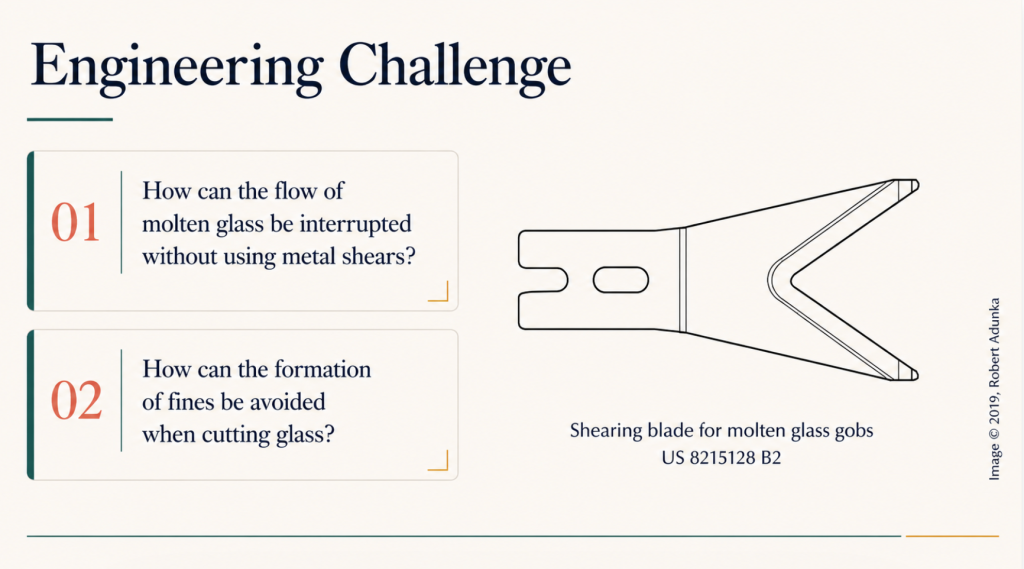
An example of function-oriented search: one project examined a process used in glass container manufacturing. A stream of molten glass was cut with metal shears. Contact with the blades caused local cooling and defects, while small splashes contaminated the equipment.
A search for a “better way to cut glass” would keep the team within the glass industry. A functional formulation opens the problem up: the task is to separate a stream of viscous material.
A similar function appears in chocolate manufacturing. A stream of molten chocolate is not cut. Once the required portion has been dispensed, the nozzle rises sharply and inertia breaks the stream.
This was not a ready-made solution for glass production. But the underlying principle, acting on the nozzle rather than directly on the material, gave the engineers a promising direction.
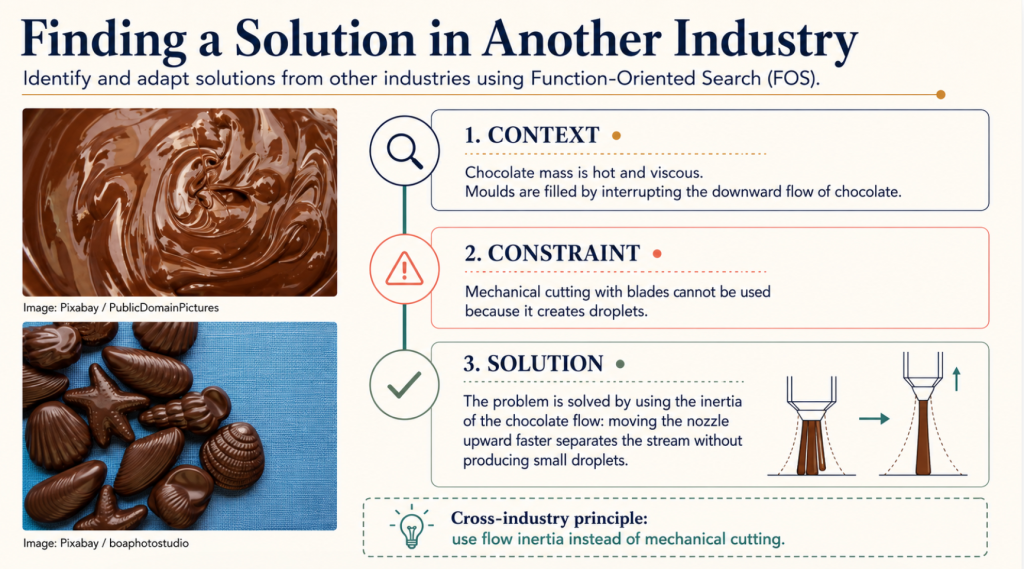
The value of the example lies less in the outcome than in the search method. A specialist may spend decades in one industry without knowing how a similar function is performed in food production, medicine or oil and gas.
AI Does Not Remove the Need for Preparation
Before a language model can work effectively with function-oriented search, it needs to be introduced to the method.
The model is first given a definition of FOS, its algorithm and several examples based on known solutions.
It is then asked to pose questions about the method. This helps the expert assess whether the model has understood the approach correctly.
Next, the model receives a test problem for which the expert already knows the answer. If the result is unsatisfactory, the instructions are adjusted. Only after this calibration does the team move on to the real problem.
The preparation typically takes 20 to 25 minutes. It does not eliminate errors, but it allows the team to test the model’s reasoning before entrusting it with a live assignment.
The model can also be provided with verified patents, research papers and conference materials. This becomes particularly important when the search extends into a field where the user is not a specialist.
Another option is to assign the model the role of an expert from the relevant industry and ask it to explain the technology in plain language. The role prompt, however, does not make the response reliable by itself. Every material fact and reference still needs to be checked.
The Time Saving Comes from Broadening the Search
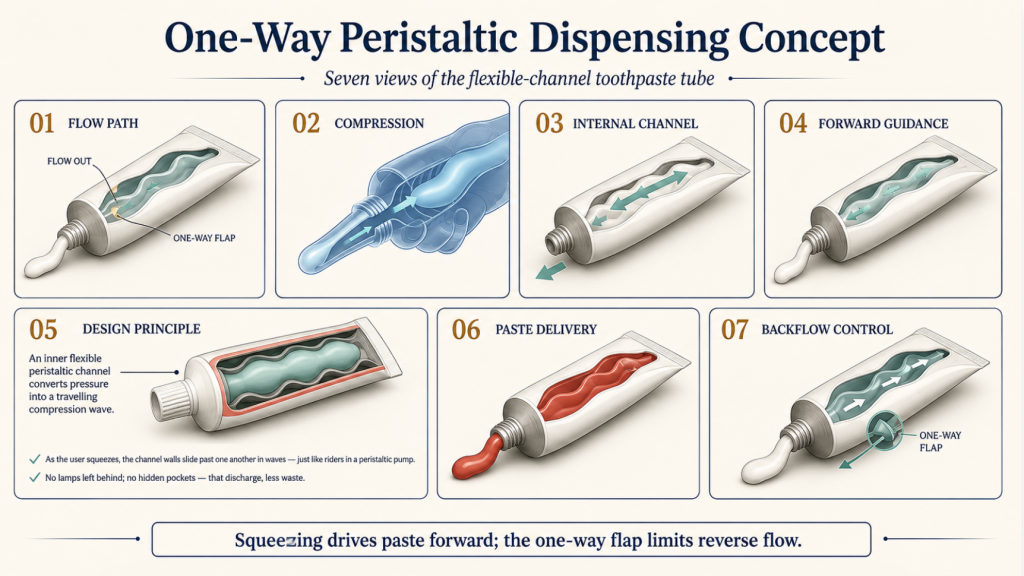
Another function-oriented search project examined toothpaste left inside its packaging.
Between 5% and 10% of the product may remain in the tube. The original function, “remove toothpaste from a tube”, was generalised as removing a sticky, viscous substance from flexible packaging.
The team also set several requirements: low cost, safety, simplicity and a compact mechanism.
The language model then helped identify and evaluate potentially relevant leading areas that a packaging developer might not naturally investigate first. These included fuel tanks, dispensers, paint-handling technologies, medical devices, peristaltic pumps and specially coated oil and gas pipelines.
The search identified more than ten technologies from engineering, medicine and nature. AI did not solve the problem on its own. It rapidly expanded the search space and highlighted fields that would have taken the team much longer to explore manually.
How to Use AI Without Disclosing the Real Problem
For companies using external language models, there is an obvious tension.
The more detail they provide, the more precise the answer may become. But those details may reveal sensitive information about a product, process or technology.
Functional generalisation can help reduce that tension.
During the first stages, the working group defines the problem, requirements and constraints without involving an external model. The model receives only the generalised function, not the original business or technical context.
One Samsung Electronics project concerned heat dissipation from a smartphone processor. One possible approach was to apply a metal layer to the processor.
High-temperature methods could damage the components. Low-temperature vacuum deposition technologies were expensive and offered low throughput.
The full problem statement could have included the smartphone architecture, processor design, temperature limits and other sensitive parameters. But the technology search required a much simpler formulation: deposit a metal layer onto a substrate without overheating it.
This wording did not reveal the product, but it allowed the team to search across other industries.
The project identified cold gas dynamic spraying, also known as cold spray, a technology previously used to repair metal components. The resulting solution was patented in 2015.
A functional formulation is not a substitute for an information security policy. It can, however, prevent teams from sharing details that an external system does not need in order to search for relevant analogues.
AI Should Not Be Introduced Without a Specific Problem
One of the most common mistakes is to introduce TRIZ or AI as a universal solution.
A technology agent that can be asked any question does not automatically improve productivity, quality or financial performance. The starting point must be a specific problem the company wants to solve.
Giving employees access to a model or teaching everyone how to write prompts is not enough. Financial value comes from solving defined business problems, not from deploying the technology itself.
It is usually better to begin with small, clearly framed tasks whose results can be verified. The level of complexity can then increase gradually.
Knowing When to Stop Optimising
For operational efficiency, one question is particularly important: when has optimisation gone far enough?
A company may spend years improving an existing system by reducing costs, removing waste and raising productivity. At some point, however, each additional effort produces a smaller return.
The S-curve of system development provides a useful way to think about this.
If an organisation continues to invest more money, time and human effort while performance barely improves, the system may be approaching saturation.
At that point, further optimisation may be less rational than changing the operating principle itself.
The camera market provides a familiar example. Kodak remained a leader in film photography and continued to improve the existing system. Early digital photography offered visibly inferior image quality, but it was at the beginning of its own development curve and had much greater room to improve.
The question for management is not simply how well the current system performs. It is whether that system still has meaningful development potential.
When the returns from optimisation begin to decline, the company needs to consider whether resources would be better directed towards a system based on a different principle.
Cost Reduction Does Not Always Require a Replacement Component
When companies face a crisis or need to reduce costs, TRIZ offers another tool known as trimming.
Rather than focusing on the component itself, trimming looks at the function that component performs.
If a component is expensive, complex or redundant, the question is not “What can replace it?” Instead, the team asks whether another element of the system could perform its function, or whether both the component and its function can be removed.
This can simplify the system, reduce the number of components and make the overall design more flexible.
What Companies Should Check
First, is there a specific problem that justifies the use of AI or TRIZ? A goal such as “improve efficiency” is too broad for the result to be measured.
Second, who owns the problem definition and verifies the answer? Without clear ownership, a language model becomes a source of untested ideas.
Third, which data does the external tool genuinely need? In many cases, the original context and sensitive parameters can remain inside the company while the model receives only a generalised function.
Fourth, is there a defined verification process? Teams should test the model on problems with known answers, ask it to pose clarifying questions and provide it with verified source materials.
Fifth, can the team manage adaptation? Finding a technology in another industry is not enough. Most of the work begins after the idea has been identified.
Sixth, has the existing system reached the limits of its development? The company may no longer need another incremental improvement. It may need a different operating principle.
Combining TRIZ with artificial intelligence does not automate innovation. It helps teams move through a wider solution space more quickly while retaining a structured search process and clear human accountability.
The faster a model generates answers, the more important it becomes to recognise whether the company has asked the right question, and whether it is using a new tool to keep improving a system that should already have been replaced.

Internal Communication as a Driver of Team Performance
Internal communication is not simply the exchange of information. It shapes how employees understand objectives, make decisions, delegate work, resolve disagreements and build trust. Aigul Sandalova explains how managers and employees can communicate more clearly, manage emotions and reduce the misunderstandings that undermine team performance.

Operational Efficiency in China: Turning a Business Tour into a Management Project
A visit to one of China’s leading manufacturers can easily become little more than an impressive factory tour. Executives see robotic production lines and digital dashboards, take photographs and then return to the same problems and ways of working. For a business tour to deliver real value, the focus needs to be on the processes, performance measures and management decisions behind the technology.