









Operational Efficiency in China: Turning a Business Tour into a Management Project

Why do some companies return from China with ideas they can put to work, while others come back with little more than photographs of modern factories? Drawing on her experience of organising business (GEMBA) tours and working with Chinese manufacturers, Anastasia Valova explained what makes the difference. A worthwhile visit requires serious preparation before departure, focused work on site and a clear process for turning lessons into action afterwards.
The principle is simple: do not travel merely to see a factory. Travel to find an answer to a specific problem in your own business. That problem should shape the programme, the composition of the delegation, the questions asked and the decisions made after the team returns.
Seeing Is Not the Same as Understanding
China is an obvious place to study operational efficiency, not least because of its scale. It has some of the world’s largest manufacturing operations, dense industrial clusters and extensive networks of suppliers across machinery, electronics and digital systems.
But seeing the result is not the same as understanding how it was achieved.
A visitor may look at a robot without learning how the underlying process changed before it was installed. Perhaps eight people previously worked at that stage, or perhaps there were only three. The operation may not even have existed before the process was redesigned.
The same applies to digital screens, traffic-light systems and management dashboards. Their presence tells visitors very little unless they understand which decisions are made using the information displayed. This is the difference between touring a factory and learning from it.
Before choosing a programme, a company should therefore ask one central question: will the host explain the process that produced the results being shown?
The delegation needs to understand:
- which processes led to the chosen solution;
- which performance indicators the company tracked;
- which management and workforce decisions it made;
- which problems arose during implementation;
- what happened when performance missed the target.
A host that shows only the finished system is offering a showcase. A host willing to explain how that system developed offers something far more useful: the basis for serious benchmarking.
Look at the Operating System, Not Just the Factory
A factory cannot, by itself, explain how another company might achieve a similar result. The real answer lies in the operating system behind it.
On site, the delegation should look beyond individual machines. The more revealing questions concern processes, performance indicators, deviation management, supplier relationships, quality control, data and the routines that shape day-to-day management.
Quality control is a particularly useful example. When assessing a Chinese manufacturer, it is important to see how the technical quality function actually works. At one factory, two employees may check packages with flashlights before sending them for dispatch. At another, a dedicated quality team may run its own laboratory, work with defined standards, retain test samples and use clearly specified tolerance ranges.
Having the equipment is not enough. The real issue is whether the company has the rules and processes needed to produce the same result every day.
Consistent actions produce consistent results. If a company has established a reliable operating standard, visitors need to find out what has been standardised, which steps are mandatory and what employees do when something falls outside the expected range.
Seven Areas to Examine During a Factory Visit
Time on site is nearly always limited. A delegation will usually have two or three hours, and occasionally four. That is not enough to study every part of the operation in equal depth.
Priorities therefore need to be agreed before the visit. The assessment can be organised around seven main areas.
Production Flow
Follow the movement of materials from raw inputs to finished products. Look for bottlenecks, downtime and manual operations.
The links between production stages often reveal more than the stages themselves. How does material move through the plant? Where do delays occur? What happens when performance slips or incoming materials fail to meet quality requirements?
Planning
Find out how the production plan is created and how sales, procurement, manufacturing and warehousing work together.
It is particularly useful to understand how the business matches demand with production capacity, manages inventory and responds when customer orders change.
Quality Control
Look at where and how quality is checked, what happens when a defect is found and who decides how the problem should be handled.
Final inspection is only part of the picture. The more important question is how the company prevents errors from occurring in the first place.
Equipment
The equipment itself may be the main focus of the visit. Relevant questions include who made it, why it was selected, how downtime is managed, how preventive maintenance is organised and how overall equipment effectiveness is measured.
Some companies deliberately visit several similar factories to compare equipment and understand why different manufacturers selected different solutions.
Warehousing and Logistics
Chinese manufacturers often handle very large product flows. This makes them useful places to study location-based storage, inventory accuracy, packaging, dispatch and the relationship between warehousing and production.
Data and Management
Find out which data is collected automatically, which indicators managers see and what decisions they make as a result.
It is also worth observing how daily meetings are run and how the company identifies, escalates and resolves deviations.
People and Accountability
Automation does not replace organisational structure. Someone still needs to own each process and result.
The delegation should understand which employees are responsible for specific activities, why some operations have been automated and why others are still performed by people. Workforce and management choices often explain the success of a technology more clearly than its technical specifications.
There is no need to examine all seven areas in equal detail. But without a clear priority, the delegation is likely to return with plenty of impressions and few usable conclusions.
How to Tell a Working Factory from a Showcase
The first sign of a worthwhile visit is the host’s willingness to discuss difficulties as openly as successes.
When a visit is limited to a corporate presentation, the delegation usually meets people whose role is to show the factory in the best possible light. Visitors see the facade, hear reminders not to take photographs or touch the equipment, and receive polished explanations. Once the questions become more technical, it often turns out that the relevant specialist is not in the room.
A well-prepared visit gives the delegation access to the people who actually worked on the problem. They can explain what happened during implementation, which decisions proved effective and where the original plan had to change.
The second sign is a discussion based on numbers. A useful host can explain the starting position, what changed, what impact the company achieved and how long it took.
The third sign is a willingness to show how the company manages deviations. What happens when something goes wrong can be more informative than watching a production line run smoothly.
A famous company will not necessarily provide the most valuable visit. A regional manufacturer that financed its own development may offer more relevant lessons than a flagship site operating with an investment budget that few visitors could ever match.
Not Everything That Works in China Can Be Replicated
After visiting an advanced factory, the immediate temptation is often to buy the same system or reproduce the entire operating model.
But a solution that works in China cannot automatically be transferred elsewhere.
Many practices depend on production scale, dense supplier networks, ready access to equipment and substantial investment. If another company operates under different conditions, copying the solution directly may deliver disappointing results.
Before adopting any practice, management should ask:
- Do we understand the context in which it works?
- Is the impact measurable?
- Do we know what is required to scale it?
- Can it be transferred to another country and organisation?
- Are the investment requirements realistic for us?
- Is our own operating system ready for it?
A good practice is not simply one that produces strong results. It is one whose results can be understood and reproduced under clearly defined conditions.
Preparation Starts Long Before Departure
A successful GEMBA tour does not begin at the airport. The essential work starts much earlier.
The first step is to define the problem. “We want to see something interesting” is not a business objective. The company needs to decide what it wants to improve or resolve.
The next step is to select the indicators that will be used to judge whether a solution is valuable. These might include productivity, manufacturing lead time, planning accuracy, inventory levels or defect rates.
The best starting points are usually the bottlenecks in the company’s own operations. If something is not working well at home, that is what the delegation should study at a benchmark site.
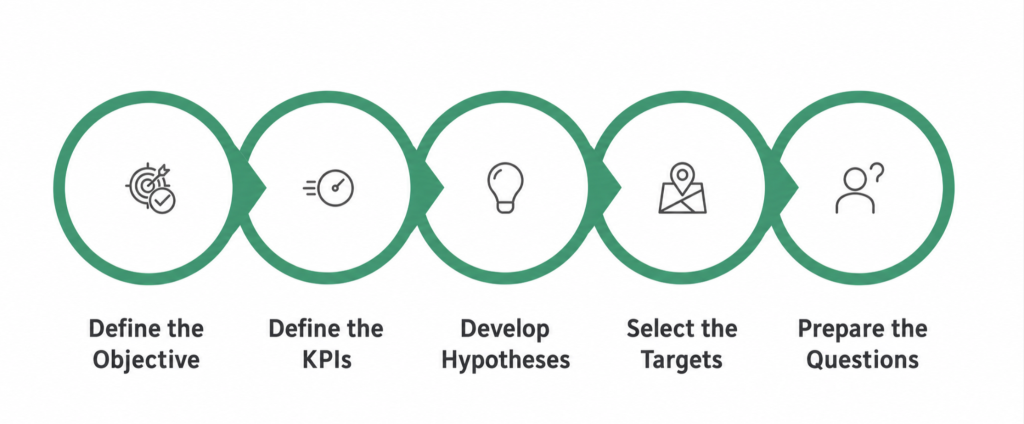
Once the objective and metrics are clear, the company can develop hypotheses, select suitable factories and prepare its questions. In China, these questions are normally sent to the host in advance, ideally at least a month before the visit. The company needs time to understand the scope and technical depth of the discussion
The questions should be specific:
- What did the process look like before implementation?
- Why did the company choose this solution?
- Which problems arose?
- Which constraints had to be considered?
- How did the performance indicators change?
- How were employees prepared?
- Who was responsible for the result?
The delegation itself should reflect the purpose of the trip. If the company is assessing equipment or preparing to modernise a facility, senior managers should be joined by engineers and process specialists. While executives discuss performance, an engineer can assess the layout, distances, walkways and installation requirements.
Interpretation also deserves careful attention. Its quality affects both the substance of the discussion and the host’s perception of the delegation. The interpreter needs to understand industry terminology, the technical side of the business and Chinese business culture. The job is not to compress a detailed question into two vague sentences. It is to convey the meaning accurately and adjust the tone where necessary.
Record the Findings While They Are Fresh
After several factory visits, details begin to blur. Findings should therefore be captured during the trip, not reconstructed from memory afterwards.
After each visit, the delegation should record:
- which problem the observed practice addresses;
- which solutions appear useful;
- how relevant they are to the company;
- whether they could be reproduced;
- which possible initiatives have emerged;
- which follow-up actions are needed with the host.
The format is less important than the timing. It could be a shared table, notes taken by one of the managers or an audio recording of the discussion on the way to the next factory. What matters is that the team does not wait until it gets home.
The Real Work Begins After the Delegation Returns
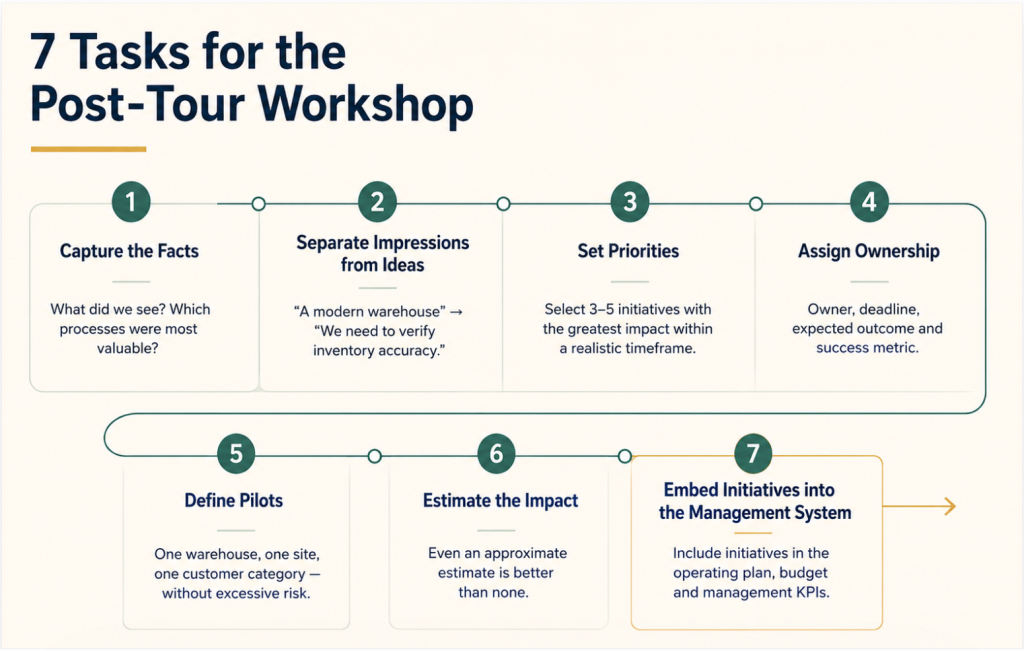
Once the trip is over, the company needs to separate what was impressive from what is genuinely useful.
Several questions need to be answered:
- Which processes offered practical value?
- Which new priorities emerged?
- Who will be responsible for implementation?
- Which pilot should be launched first?
- How will the impact be measured?
- How will the solution fit into the existing management system?
The value of the trip can be assessed only against the original business objective.
If the company travelled to address a production, procurement, management or quality problem, it should compare the selected performance indicators with the original baseline once the new practice has been implemented.
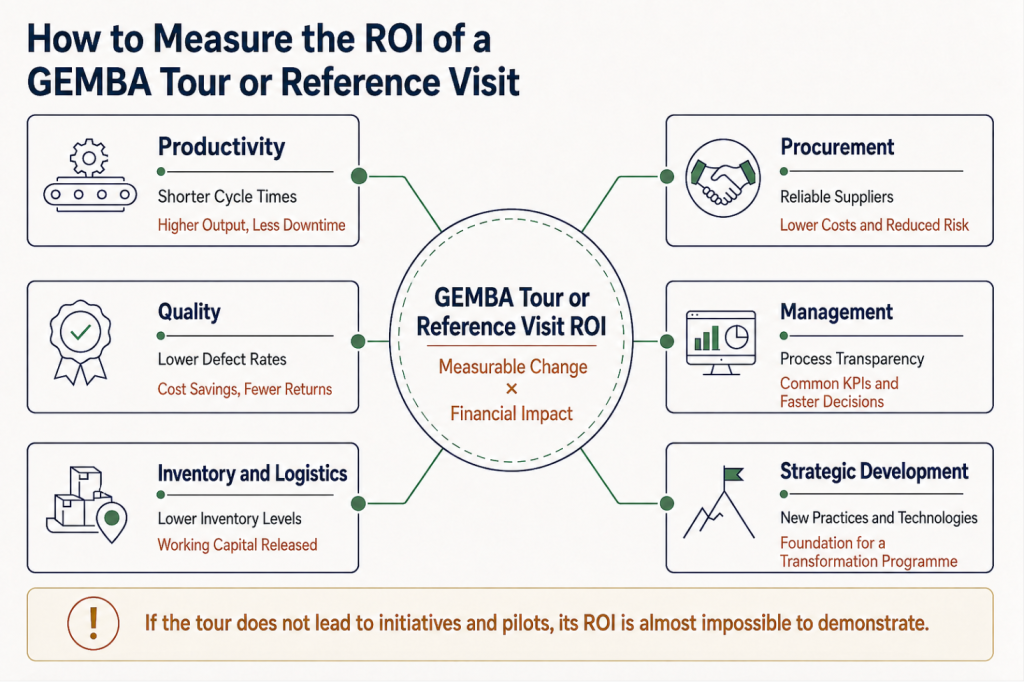
If a GEMBA tour or Reference Visit does not lead to concrete initiatives, pilot projects or changes embedded in the management system, its impact is almost impossible to assess. It remains an expense when, with the right approach, it could have become an investment in the company’s operational development.
One question should remain front of mind throughout the tour: What, specifically, will change in our company as a result of what we have seen?
To generate practical value, a business tour must be approached systematically. Selecting well-known companies and creating a busy itinerary is not enough. The objectives and performance indicators should be defined in advance. Questions need to be prepared, the right people included in the delegation, roles assigned and a common method agreed for capturing observations. After the team returns, those observations must be translated into specific initiatives, with clear ownership and decisions on which ideas should be tested through pilot projects.
We have prepared a practical checklist for planning and conducting Gemba tours and reference visits. It will help you structure the preparation, stay focused on the most important issues during each visit and retain valuable insights after returning home.
To receive the checklist, please complete the request form.

Ready to walk the floor and see operational excellence in action?
Join a Gemba Tour and get inspired by the way top companies operate day-to-day.

How to Combine TRIZ and Artificial Intelligence
Artificial intelligence can produce dozens of possible solutions in minutes, but speed says little about their quality or practical value. This article examines how TRIZ can bring structure to AI-assisted problem-solving, help companies find technologies beyond their own industry, protect sensitive information and recognise when a system has reached the limits of optimisation.

Bank Cost Allocation: Five Methodology Questions That Shape Profitability
Which costs genuinely belong to the bank as a whole? Should branch idle time be charged to products? And what changes when Treasury or the problem asset management unit is treated as a Profit Center rather than a Cost Center? Georgy Zemitan examines five methodology choices that shape cost allocation and profitability analysis in banking.