






What Makes a Smart Factory Genuinely Smart?

Manufacturers are having to operate with less certainty. Demand moves quickly, forecasts lose relevance sooner and product life cycles continue to shrink. At the same time, customers expect better quality and shorter lead times.
Many production systems were not designed for these conditions. They still depend on a relatively stable sequence of events: materials arrive when expected, equipment remains available and production follows the plan.
This helps explain the current interest in the Smart Factory. Yet the term is often applied too loosely. A site installs robots, automates several lines and introduces real-time dashboards, then assumes it has become smart.
What it may actually have done is accelerate its existing processes, including the weak ones.
Gulshan Kumar, Senior Director of Smart Factory Development at Samsung Electronics India, takes a more demanding view. For him, a Smart Factory is not a collection of advanced technologies. It is a production system that can learn from what is happening, anticipate what may happen next and adapt accordingly.
Automation is not the same as intelligence
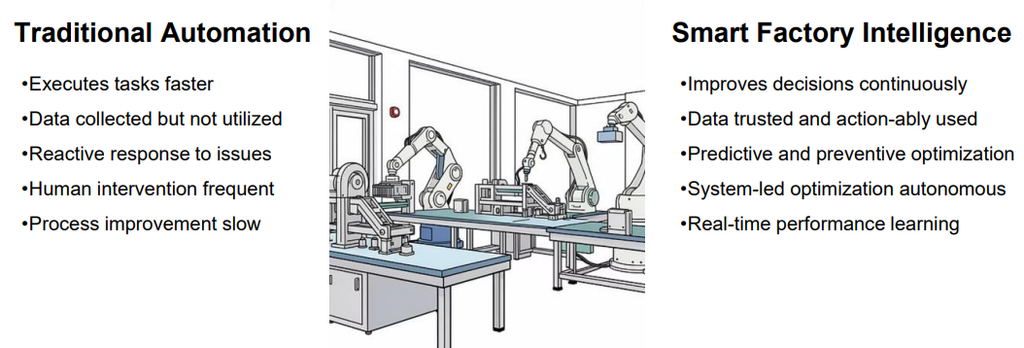
Automation is good at performing a defined task quickly and consistently. Robots improve precision. Automated lines reduce variation. Digital systems give managers and engineers greater visibility over production.
None of this automatically improves the quality of the decisions being made.
The distinction becomes apparent when something unexpected happens. A supplier is late. Equipment performance begins to deteriorate. Quality starts to drift. Demand changes during the production cycle.
If the response depends entirely on an employee spotting the problem, interpreting the information and intervening before output is affected, the factory is still reactive. Its machinery may be highly automated, but its management system is not particularly intelligent.
A Smart Factory should help people recognise a developing problem earlier. In more advanced environments, it can recommend a response or make a controlled adjustment itself.
That is the real step forward. Automation changes how efficiently work is performed. Intelligence changes how the production system responds.
Why expensive technology can produce disappointing results
Smart Factory programmes are often introduced with ambitious expectations for productivity, quality and cost. Those gains are possible, but they do not come from installing technology alone.
A new system inherits the conditions around it.
Automating an unstable process can make the instability harder to correct. Applying AI to unreliable data produces confident but questionable recommendations. Adding more platforms to an already fragmented architecture may create extra reporting without improving operational control.
The work therefore starts before the technology selection. Processes need to be stable enough to measure. Data must be sufficiently accurate to support decisions. Responsibilities must be clear.
Once those foundations are in place, the company can add automation, system integration and more sophisticated analytics with a far better chance of achieving a commercial return.
A dashboard does not close the loop
Factories now collect large volumes of information, but collection is not the same as control.
Data becomes useful when it influences what happens next. Equipment, sensors and operational systems capture conditions on the line. The information is analysed, a potential issue is identified and someone or something acts. The result of that action then becomes part of the next decision.
This feedback loop is central to smart manufacturing.
Suppose a process begins to move outside its permitted range. Displaying the deviation on a screen is only the first step. The signal may need to be connected with equipment condition, material quality, the production plan and downstream logistics. The operating response should arrive before the deviation turns into scrap, downtime or missed output.
In practice, this requires five capabilities to work together: physical equipment, reliable data, analytical intelligence, operational execution and feedback.
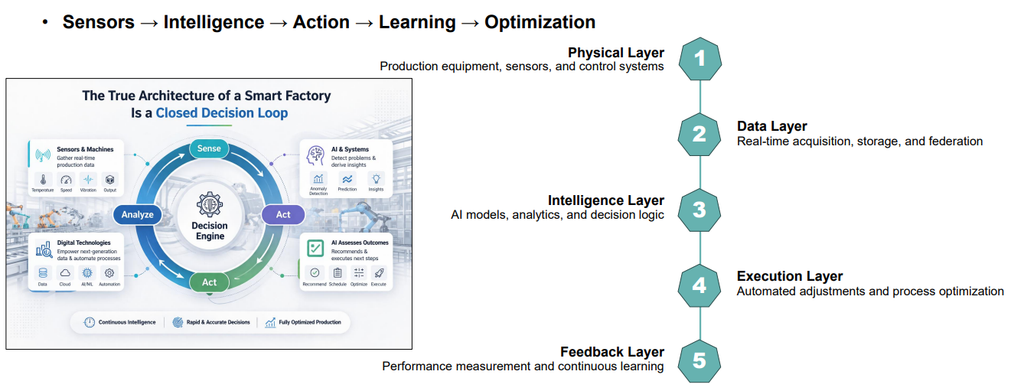
A factory may have strong technology in each area and still fall short if the connections between them are weak.
The capabilities behind a Smart Factory
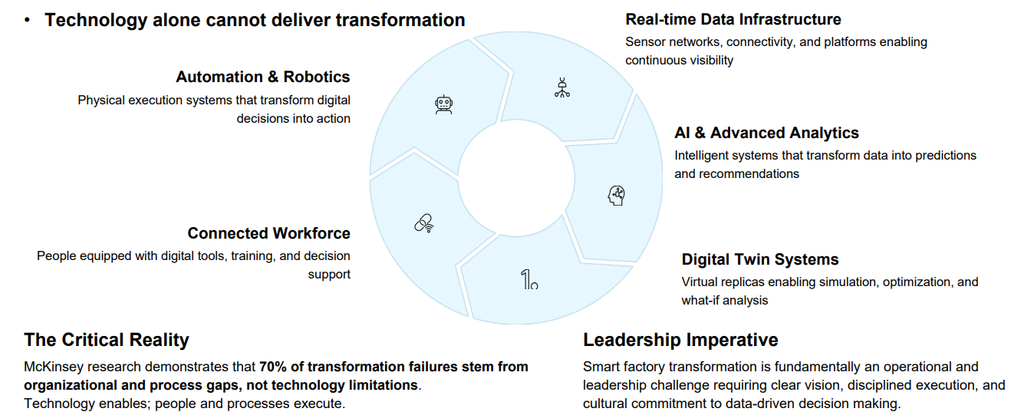
Automation and robotics provide the physical foundation. They improve consistency, speed and precision in activities such as assembly, inspection and material handling.
Real-time data provides situational awareness. It shows where production is drifting, which assets are becoming unstable and where a constraint is beginning to form. Without this visibility, the factory is managing yesterday’s position.
AI and advanced analytics add another level of interpretation. They can identify anomalies, support predictive maintenance, improve inspection and help engineers understand patterns that would be difficult to find manually.
Digital twins allow teams to explore changes before applying them to the physical process. Depending on their sophistication, they can be used to test layouts, settings, schedules and operating scenarios.
None of these capabilities can be separated from the people using them. Operators, engineers and managers must understand the information, trust it where appropriate and know what action is expected. Otherwise, the technology remains adjacent to the operating system rather than part of it.
Where the transformation usually stalls
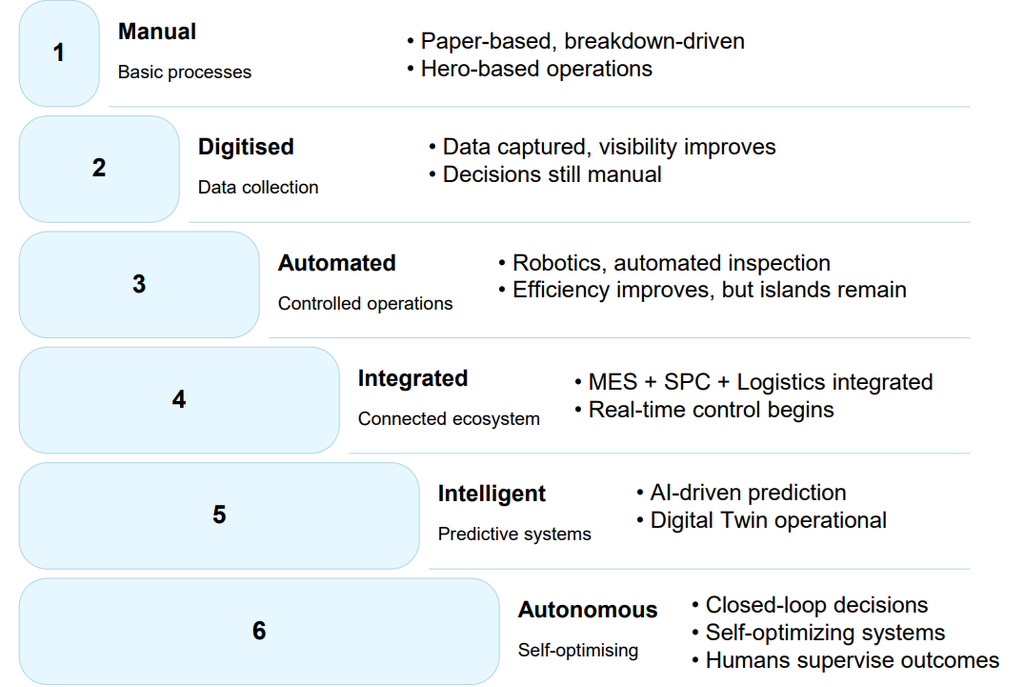
The development of a Smart Factory is gradual. Most manufacturers move from manual processes towards digitisation, automation, integration and increasingly intelligent control.
The difficult point often comes after digitisation.
A factory may already have MES, statistical process control, automated lines, quality systems and operational dashboards. Each platform works, but each sees a different version of the operation. Data exists without forming a coherent picture.
This becomes costly when a problem crosses functional boundaries.
A serious quality issue, for example, may require production to stop. That decision should also affect material flows, planning, procurement and logistics. If every function responds separately, the factory loses time and may create further disruption elsewhere.
A genuinely connected operation behaves differently. Information travels with the decision, and the relevant parts of the factory respond together.
Digital twins are moving closer to operational control
A digital twin begins as a virtual representation of a physical process. It can combine data from machinery, inspection systems, production platforms, warehouses and internal logistics.
Its role changes when it is linked to AI and live decision-making.
Instead of being used only to simulate an improvement, the twin can help anticipate equipment failure, compare alternative settings or recommend an operational adjustment. In more mature applications, it may become part of a controlled autonomous system.
Most manufacturers are not yet operating at this level across an entire plant. Adoption is likely to remain uneven because the business case, data quality and technical feasibility vary from one process to another.
The useful question is not whether the company has a digital twin. It is what decisions the twin improves.
AI still depends on sound engineering
AI does not remove the fundamentals of manufacturing. Quality, reliability, process capability and cycle time remain just as important.
What AI can do is accelerate analysis. It can examine more variables, identify subtle relationships and draw attention to a problem earlier than a conventional review might.
Its value depends heavily on the quality of the system beneath it. Weak sensor data, inconsistent definitions and poorly controlled processes limit what any model can achieve.
For this reason, broad promises to “introduce AI across the factory” are rarely a useful starting point. A better approach is to identify a costly operational problem and determine whether AI can improve the decision around it.
Frequent equipment failures may justify predictive maintenance. Persistent quality losses may call for automated inspection or earlier detection of process drift. Excess stock and schedule instability may point towards better planning and material-flow optimisation. High energy consumption requires a different set of data and models.
The technology should follow the problem.
Autonomy does not mean removing people
Autonomous manufacturing is often presented as the final stage of the Smart Factory. It may involve self-adjusting lines, predictive maintenance, automated scheduling and closed-loop process control.
This does not necessarily lead to a factory without people.
As systems take on more routine operational decisions, employees move towards setting objectives, defining constraints and handling exceptions. Engineers validate system behaviour and improve the underlying logic. Managers remain accountable for performance, risk and investment.
The balance of work changes. Responsibility does not disappear.
Why pilots struggle in live production
A successful pilot is encouraging, but it is not proof that a solution can scale.
Test environments are easier to manage. There are fewer variables, more direct support and clearer boundaries. Live production introduces legacy systems, inconsistent practices, competing priorities and people who must use the solution while still meeting daily targets.
This is where many programmes lose momentum.
Sometimes no one clearly owns the process after the pilot team leaves. In other cases, the solution cannot integrate with existing systems or relies on data that is not consistently available. Management may support the idea but hesitate when implementation requires changes to operating routines.
These are not merely change-management issues. They are part of the production design.
Technology becomes useful only when the organisation changes the way it acts on information.
Trust determines whether the system is used
Operators and engineers will not abandon experience simply because a new dashboard has appeared.
They need to understand where the data comes from, how reliable it is and what the system expects them to do. If recommendations repeatedly prove unhelpful, employees will create workarounds. If signals are credible but responsibilities are unclear, nothing will happen quickly enough.
Training is therefore only part of the answer. Managers also need to make the new system part of normal operating routines. Teams should review its signals, record the decisions taken and examine whether the intervention produced the expected result.
Trust develops through use and evidence, not through launch presentations.
A practical route to smart manufacturing
A manufacturer does not need to start with a plant-wide transformation.
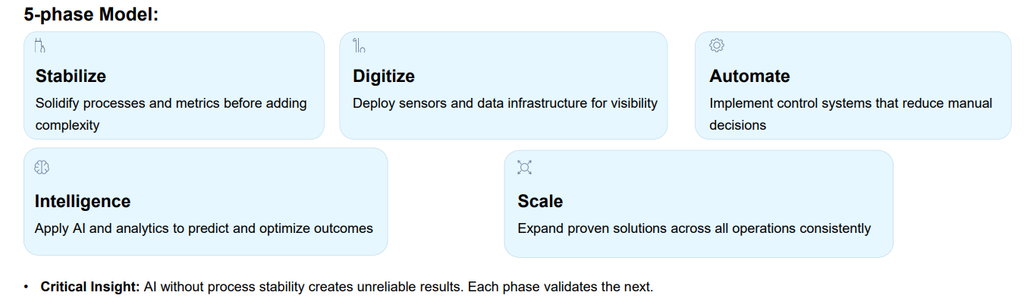
The more reliable route is to stabilise a process first and then establish accurate digital visibility. Automation can follow where the work is repeatable and the economics make sense. Analytics and AI can then improve specific decisions. Once the result has been demonstrated under normal production conditions, the solution can be extended elsewhere.
This sequence may appear slower than launching several technologies at once. In practice, it reduces rework and makes value easier to measure.
There is little benefit in applying AI before the data is dependable. Autonomy remains unrealistic while systems are disconnected. Scaling a pilot that employees do not use simply spreads the problem.
Where to begin
The right starting point is usually not a technology. It is a production problem with a meaningful financial or operational cost.
Look for decisions that are consistently made too late or with incomplete information. They may sit behind recurring downtime, repeated defects, excess line-side stock, manual schedule changes, logistics delays or unstable new-product introductions.
Then examine three questions.
Can the factory see the problem clearly and in time? Does it have the infrastructure and data required to act? Is management prepared to change the process, rather than simply add another tool?
Choose one issue. Confirm the data. Stabilise the underlying process and connect the systems needed to support the decision. Test the solution during an ordinary production shift, not only under pilot conditions.
If it works there, the factory has something worth scaling. That is a more credible sign of progress than the number of robots, dashboards or AI models it has installed.

Anti-Fraud, AML and Cybersecurity: Why Digital Fraud Requires a Unified View
Digital fraud is increasingly more than an isolated incident. It is often the first stage in a longer chain designed to move and launder illicit funds. For banks and fintech companies, this changes the approach to risk management: anti-fraud, AML, cybersecurity and customer operations need to work as an interconnected system.

CLTV in Banking: Linking Customer Behaviour to Profitability
A P&L statement shows what a bank has already earned. CLTV looks ahead: which customers are likely to create value in the future, and what behaviour will drive it? Bereke Bank’s experience shows why banks need to move beyond the idea of an “average customer”, how they can work with incomplete data and where CLTV can sharpen decisions on acquisition, retention and customer development.