






Anti-Fraud, AML and Cybersecurity: Why Digital Fraud Requires a Unified View
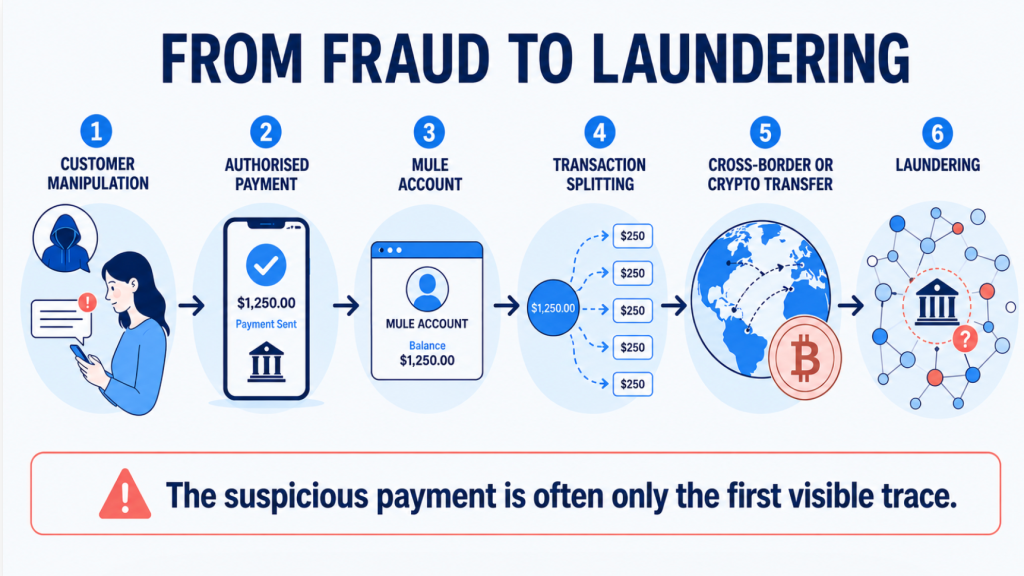
A suspicious payment is not always the end of a fraud scheme. Often, it is the first visible trace of a much longer chain. The money may be transferred to an intermediary account, split into smaller amounts and moved through other banks, payment providers, overseas platforms or digital assets. Banks and fintech companies need to understand where the funds went, who sits behind the chain of transactions and whether their infrastructure is being used to move or launder illicit proceeds.
This shift is explored in an IMF working paper on the rise of cyber incidents and digital fraud in the financial sector. Research from FATF, Europol and INTERPOL reinforces the same point: financial fraud is increasingly connected to cross-border digital channels, money-laundering networks and virtual assets.
This article examines why anti-fraud, AML, cybersecurity and customer operations now need to be treated as parts of the same system, and which questions banks and fintech companies should be asking about their own processes.
Why Fraud Can No Longer Be Separated from AML
Anti-fraud teams typically focus on a specific event: a payment, an account login, a change of device, an unusual amount or a new beneficiary. In today’s fraud schemes, however, that event is often only the first visible fragment.
A customer may be manipulated into transferring the money personally. On the surface, the transaction looks legitimate. It has been authorized by the account holder, the device is familiar and the activity may not trigger conventional fraud rules. The funds are then moved to an intermediary account, divided into smaller amounts and transferred through other banks, payment services or digital platforms.
At this point, fraud becomes an AML issue. The relevant question is no longer limited to whether the original payment was suspicious. The institution also needs to determine where the money went, who controls the chain of transfers and whether the accounts involved are being used to move or launder criminal proceeds.
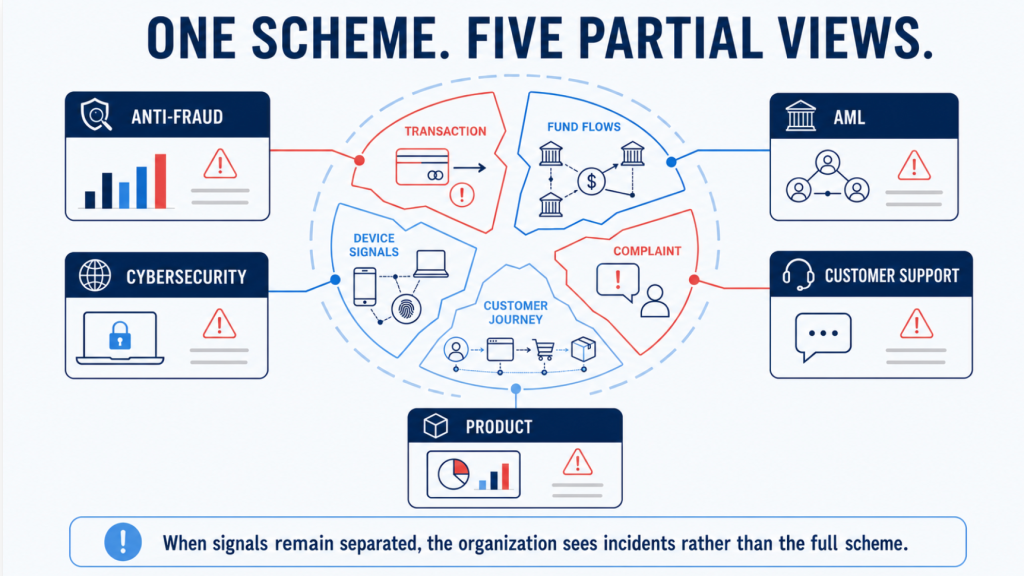
This is where gaps often emerge. The anti-fraud team sees the transaction. The AML team sees suspicious flows of funds. Customer support receives the complaint. Cybersecurity identifies technical signals. If these data points are not connected, the organization responds to individual events without seeing the wider scheme.
The IMF working paper highlights the same shift. Cybersecurity and digital fraud in financial services are becoming increasingly interconnected. According to the paper, the financial sector accounted for approximately 10 percent of reported cyber incidents across 20 industries and 162 countries over the past decade, while cyber-enabled fraud nearly tripled. The true scale may be even greater because of underreporting and inconsistencies in data collection across jurisdictions.
Crypto Risk Is an Extension of the Fraud Chain
Virtual assets do not replace conventional fraud channels. They extend them, particularly when criminals need to move funds quickly or obscure their origin and destination. The IMF paper notes that credit transfers and cards remain the main payment methods used in scams. At the same time, several jurisdictions are seeing simultaneous growth in payment fraud, crypto-related fraud and cyber incidents.
For banks and fintech companies, the presence of cryptoassets is not, in itself, the central issue. What matters is the underlying pattern: the amount may be split across multiple transactions, routed through a chain of intermediaries, sent to recurring beneficiaries, transferred to a high-risk service or moved rapidly beyond the customer’s normal financial activity.
Other research published in 2026 supports this view. FATF examines cyber-enabled fraud through the lens of money laundering, terrorist financing and proliferation financing risks. Its guidance specifically addresses financial institutions and virtual asset service providers.
In its 2026 assessment, INTERPOL describes financial fraud as a rapidly evolving transnational threat linked to organized crime, cybercrime and specialized money-laundering networks. Europol’s IOCTA 2026 also points to the use of crypto infrastructure to obscure the movement of funds across blockchains.
Organizations need to know whether they can identify the point at which an ordinary payment begins to develop into a crypto-related risk. Equally important is whether that signal reaches both anti-fraud and AML processes in time to support a decision.
Why Organizations See Incidents Rather Than the Full Scheme
The problem is often less about technology than about how responsibilities and processes are structured. Anti-fraud, AML, cybersecurity, product teams and customer support typically see different parts of the same scheme and work to different performance metrics. During a real incident, their objectives may conflict.
Tighter controls can damage the customer experience. More permissive controls can allow fraudulent activity to pass undetected. Faster payments reduce the time available for review. Automation accelerates processing, but if the underlying data are weak, it can also scale errors more quickly.
The data themselves are often fragmented. Some sit in the anti-fraud platform, some in the CRM system and customer complaints, and some in payment monitoring, AML cases, cybersecurity logs or external intelligence sources. The challenge is to determine which signals genuinely improve decision-making.
The IMF working paper specifically notes that the scale of digital fraud is underestimated because of incomplete reporting and differences in data collection across countries. The same problem exists within individual organizations. When the data are not connected, the institution sees separate events but misses the broader scheme.
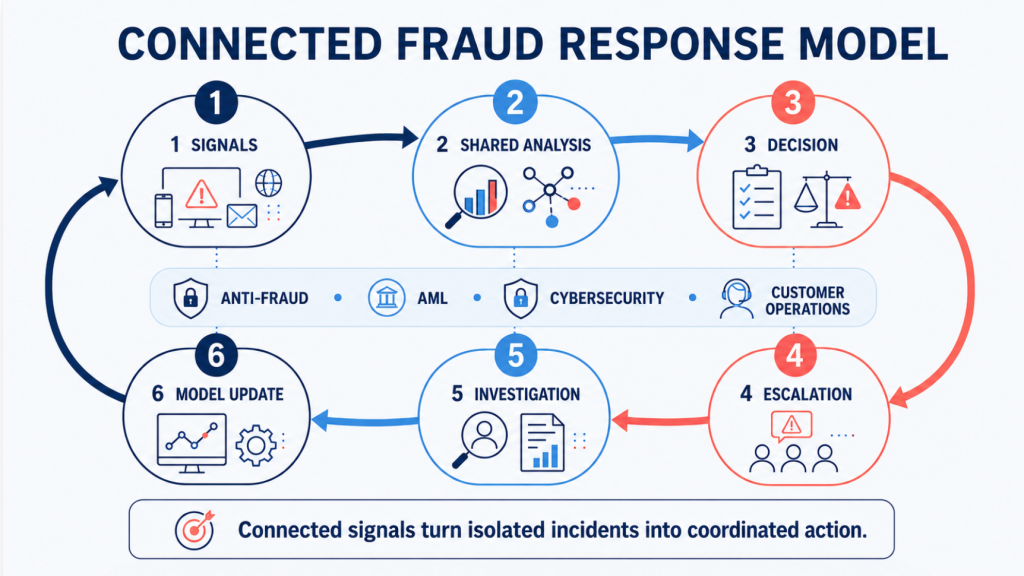
Addressing digital fraud is therefore a matter of process architecture. Who identifies the risk? Who makes the decision? How quickly are signals shared across functions? Where is accountability recorded? And how are investigation findings fed back into rules, models and customer journeys?
Blockchain Analytics Adds Visibility, but Cannot Replace the Process
For organizations that serve customers involved with virtual assets, or that regularly encounter crypto-related fraud, on-chain analytics can provide an important additional layer of intelligence. It can help identify links to high-risk addresses and services, trace the movement of funds and flag connections to known criminal schemes.
The value of the tool, however, should not be overstated.
Blockchain analytics does not replace KYC, transaction monitoring, anti-fraud models, mule-account detection, customer communication or internal escalation. It provides additional visibility where conventional banking data end.
Its practical value emerges only when external intelligence is embedded in operational workflows:
- Which events increase the customer’s or transaction’s risk level?
- Who receives the alert?
- How does the signal affect the status of the customer or transaction?
- When is manual review required?
- How are investigation findings fed back into the model?
Without these connections, the organization simply acquires another source of data without improving its ability to manage the risk.
What Banks and Fintech Companies Should Review
Banks and fintech companies need to assess whether their operating models can keep pace with the speed and complexity of modern fraud schemes. A practical review can begin with five questions.
Where is the boundary between anti-fraud and AML?
If the two teams exchange information only in exceptional cases, the fraud scheme may move faster than the institution’s internal processes. Anti-fraud may stop an individual transaction but fail to identify the network of beneficiaries. AML may detect suspicious flows only after the funds have already moved through several accounts.
Which crypto-related scenarios can the organization actually detect?
The risk is not limited to a direct transfer to a crypto platform. It may appear through a chain of intermediaries, recurring beneficiaries, transaction splitting, exposure to high-risk services or behavior that is inconsistent with the customer’s usual activity. External analytics can help, but only when its signals are integrated into the decision-making process.
How does escalation work?
When a transaction appears suspicious, it should be clear who makes the decision. That may be the anti-fraud team, AML, cybersecurity, the risk function, the product owner or several functions working together. The institution must do more than decide whether to block or release a payment. It must also document the basis for that decision for the customer, the regulator and internal audit.
How is the total impact measured?
Direct financial losses are only part of the cost. The full impact also includes pressure on contact centers, investigation time, customer claims, manual processing and the resulting reputational and regulatory consequences.
What changes after an incident?
An investigation should not end when the case is closed. Its findings should be fed back into fraud rules, analytical models, transaction limits, customer journeys and escalation procedures.
The broader implication for financial institutions is clear: digital fraud can no longer be managed effectively within the boundaries of a single function. Banks and fintech companies will be better positioned to control the risk when anti-fraud, AML, cybersecurity and customer operations work as one connected system.

Inside Phishing Attacks: How Threat Intelligence Exposes the Infrastructure
A phishing campaign involves far more than an email and a cloned login page. Behind it sits an infrastructure of servers, databases, control panels, bots and notification channels. Romano Ramanti explains how analysing that infrastructure can reveal attackers’ mistakes and help banks intervene before customers lose money.

What Makes a Smart Factory Genuinely Smart?
A factory can install robots, deploy MES and collect real-time data without becoming genuinely smart. Gulshan Kumar of Samsung Electronics India explains where Smart Factory programmes tend to stall and what manufacturers need to move from isolated automation to an integrated production system.