






Financial Planning in Banking: From Forecasts to Decisions
A bank’s profit outlook has worsened. The finance team updates its model, explains the variance and presents a revised forecast. But what happens next? Should the bank reconsider its funding arrangements, scale back lending growth, shift resources elsewhere or abandon an initiative that is no longer delivering?
This is where financial planning needs to go beyond forecasting. Knowing that the numbers have changed is only the starting point. Management needs to understand what is driving the change, what options are available and how quickly it needs to act.
These questions were at the heart of a roundtable discussion on collaboration between finance and risk functions at the Eurasian Financial Management Forum 2026. Banking executives shared their experiences of budgeting, risk assessment, performance monitoring and crisis management. We have drawn together the practical lessons from that discussion, focusing on how finance teams can turn financial analysis into decisions.
Forecast, Budget or Strategy: What Actually Needs to Change?
How often should a bank revisit its plans?
When participants were asked this question during the roundtable, opinions were split. Some said once a year; others argued for continuous review. As the discussion developed, however, it became clear that they were not necessarily talking about the same thing. Some were referring to the formal budget approval process. Others meant updating the financial forecast as conditions changed.
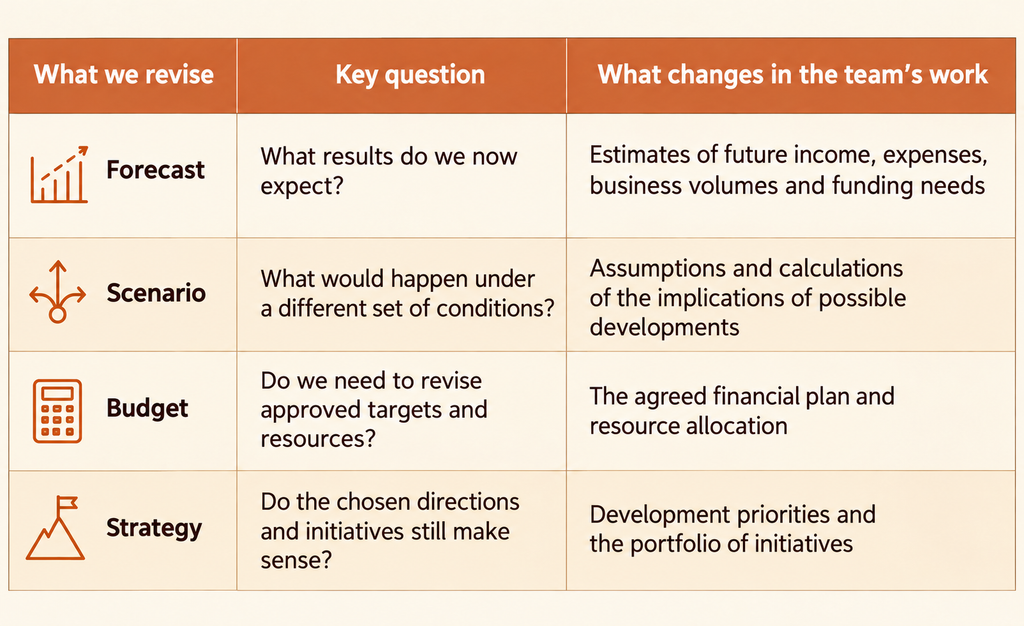
The distinction matters:
- A forecast reflects the bank’s latest expectations of future financial performance.
- A budget sets agreed financial targets and allocates resources for a defined period.
- A strategy establishes the bank’s longer-term priorities and direction.
A revised forecast does not automatically call for a new budget. And changing the budget may achieve little if the underlying strategy no longer makes sense.
Before starting another round of calculations, finance teams need to be clear about what they are trying to establish.
The roundtable offered several examples of how this works in practice.
When launching a business from scratch, one participant had to revisit the budget every quarter. New activities brought additional costs, while their potential revenues were still uncertain.
In another case, a bank returned to its three-year strategy less than a year after approving it. Some initiatives had fallen short of expectations, others were performing better than anticipated, and new opportunities had emerged.
The Eurasian Development Bank provided a different example. Its annual budget was supported by a monthly financial forecasting model covering business volumes, portfolio developments and funding needs. The forecasts, in turn, informed the next budget.
There is no single review cycle that works for every bank. Much depends on the business model, the level of uncertainty and, above all, the decisions that need to be made.
For CFOs, the question is straightforward: what should change as a result of the review? Is it the expected outcome, the assumptions behind the forecast, the allocation of resources or the initiatives the bank chooses to pursue? If the answer is unclear, another forecasting exercise may simply produce another set of numbers.
Turning Risks into Financial Consequences
Macroeconomic and geopolitical risks are familiar features of bank planning. But identifying a risk is not the same as understanding what it could cost the business.
During the discussion, participants highlighted different sources of exposure across the region. For banks in Tajikistan, remittance flows and movements in the Russian rouble were important considerations. In Kazakhstan, attention focused on sanctions-related restrictions and the effects of geopolitical developments on banks and their customers. Banks cannot prevent external shocks. They can, however, work out how those shocks might affect their business.
Will transaction volumes fall? Could funding become more expensive? Will margins come under pressure? Might restrictions on international payments change customer behaviour or reduce fee income?
Each question points to a different financial consequence and potentially a different management response. Higher funding costs, for instance, may put pressure on net interest margins and product profitability. Restrictions on cross-border payments could affect transaction volumes, customer activity and fee income.
The finance team’s job is to connect the dots: from the external event to the business driver, from the business driver to the financial result, and from the financial result to a possible course of action.
It is equally important to distinguish between how serious a risk might be and how much influence the bank has over it.
A bank can adjust product terms, improve customer service or change internal processes to help retain clients. But none of these measures guarantees that deposit outflows or falling profitability can be avoided.
This is where finance and risk teams need to work together. They must establish both the potential financial impact and the options available to manage it. The result should be more than a list of threats. It should be a set of scenarios that can inform decisions about liquidity, funding, profitability and resource allocation.
Finance Transformation: Can the Bank Deliver What It Has Planned?
A financial plan can look convincing on paper and still be impossible to deliver. One concern raised during the roundtable was the gap between the pace of business development and the capacity of back-office operations to support it.
Banks may plan to grow transaction volumes, launch new products or attract more customers. But these ambitions depend on more than the sales and business development teams. Operational processes, IT systems and support functions all need to keep pace. If a financial model assumes that a new product will launch on a particular date and reach a certain volume of business, the bank needs to know whether the organisation is ready to deliver.
Before including the expected benefits in the plan, finance teams should discuss several practical questions with process owners:
- How much additional transaction volume will the bank need to handle?
- Can existing systems and processes cope with the increase?
- What back-office changes must be completed before launch?
- What additional people, technology and operating costs will be needed?
- What happens to the financial case if implementation is delayed?
These questions go to the quality of the assumptions behind the financial model.
A business unit’s sales target is not the same as confirmation from operations that the bank can support the expected volume.
Where the necessary resources are not yet in place, the financial forecast needs to reflect that uncertainty.
Otherwise, the bank risks building its plan around benefits it may not be able to realise on schedule.
Performance Monitoring: Knowing What to Watch
Keeping a forecast up to date does not mean rebuilding the entire model every day. What matters is spotting changes in the indicators that have the greatest influence on the business, early enough to do something about them.
One bank discussed at the roundtable used dashboards to track a range of business drivers, including migrant remittances, fuel prices, incoming loan applications, approval rates and foreign exchange margins. FX margins were reviewed weekly.
At first glance, these indicators may seem an unusual combination. But they reflected the factors that mattered to that particular bank’s business model. Another institution would almost certainly need a different set of measures. The useful principle is to connect each indicator to a question that could lead to a decision.
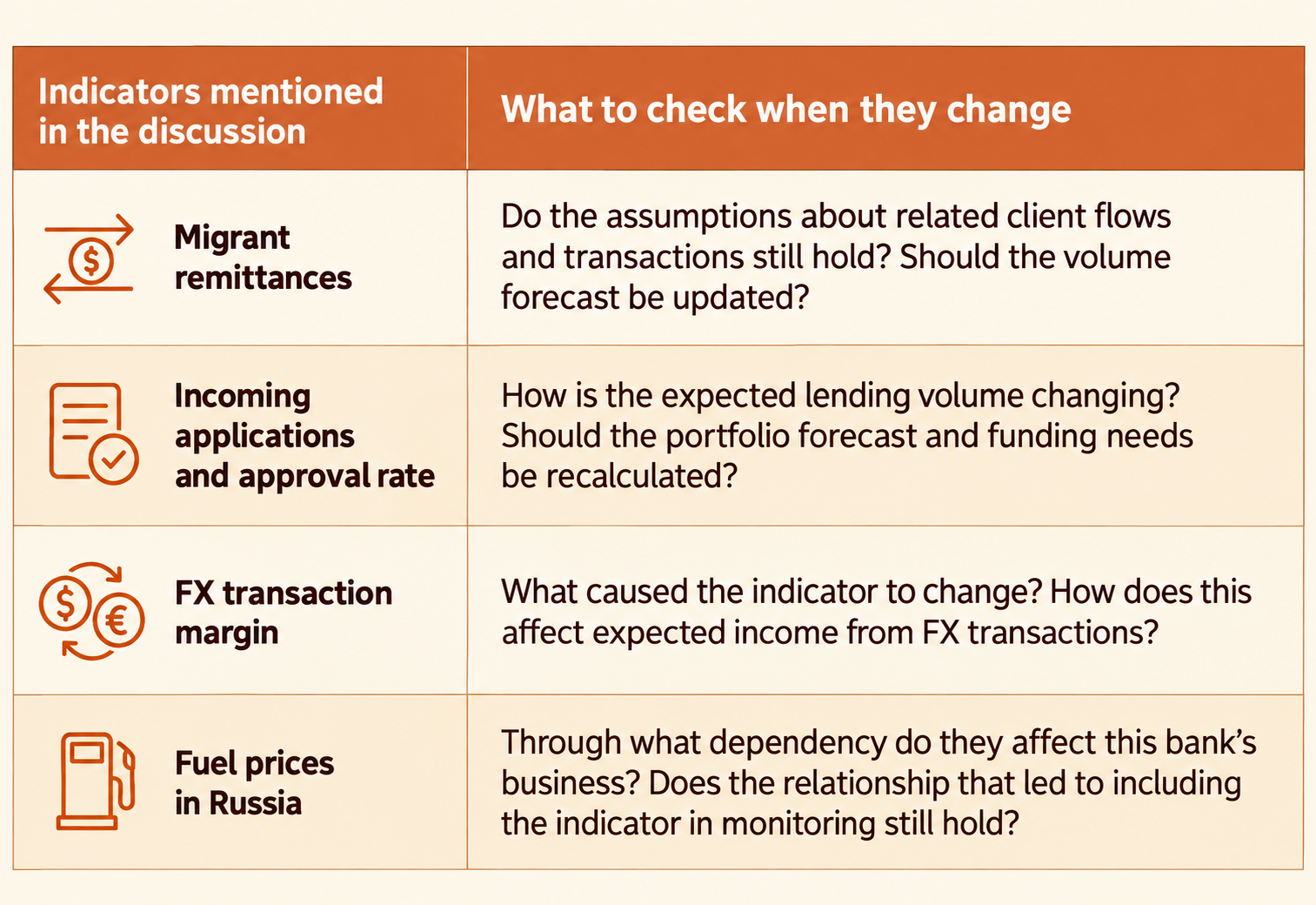
A decline in loan applications, for example, might prompt a review of lending forecasts. Rising funding costs could call for a reassessment of expected net interest margins. A fall in FX profitability might warrant a closer look at the underlying causes.
There is no universal dashboard for banking finance teams. The right indicators depend on the bank’s customers, products, revenue streams and risk exposures.
What matters is that each significant measure has a reliable data source, a person responsible for analysing it and a clear trigger for further review.
The thresholds and frequency of monitoring should reflect the bank’s own circumstances. The roundtable participants did not suggest a standard set of benchmarks.
One way to test whether monitoring is working is to look at the last meaningful change in a key indicator.
Who noticed it? Who investigated the cause? Was the forecast revised? And did the analysis lead to a recommendation?
If nobody can answer those questions, the dashboard may be providing information without helping the bank make decisions.
From Financial Reporting to Management Action
Banks produce large amounts of financial and operational data. Daily reporting can show how revenues, costs, transaction volumes and other measures have changed.
But knowing what happened is not the same as knowing what to do.
Suppose profit is below forecast. Is the shortfall due to higher funding costs, weaker lending volumes or rising operating expenses?
Each explanation could call for a different response.
The variance tells management how far performance has moved from expectations. It does not, on its own, explain what needs to change.
When bringing an issue to the Asset and Liability Committee (ALCO), or another authorised decision-making body, finance teams can make the discussion more useful by addressing five questions:
- What has changed? Which measure has moved away from expectations, and by how much?
- Why has it changed? What are the main drivers, and what evidence supports the explanation?
- What can the bank do? What options are available, and what are the likely consequences of each?
- What do we still not know? Where are the gaps in the data, and how do they affect the analysis?
- What decision is needed? What action is recommended, who will carry it out and when will the result be reviewed?
This gives decision-makers a clearer picture of the problem and the choices available.
It also makes uncertainty visible. Where information is incomplete, the assumptions and limitations of the analysis should be stated rather than hidden behind a precise-looking forecast.
For a CFO, the real value of financial analysis lies not only in getting the calculations right, but in helping management understand what has changed and decide how to respond.
Crisis Management: When Decisions Cannot Wait
In a crisis, the balance between speed and detailed analysis changes as events unfold.
An example from the 2008 financial crisis illustrates the point.
One bank established a five-member crisis committee to deal with urgent operational and financial issues. During the most intense phase, the committee focused on liquidity, branch operations and limits.
Decisions often had to be made that day and implemented the next.
Once the immediate pressure eased, the bank still faced serious problems, including overdue loans, illiquid assets and continuing liquidity needs. Addressing those issues required a more detailed assessment of internal information and market conditions.
The experience points to two different modes of crisis management.
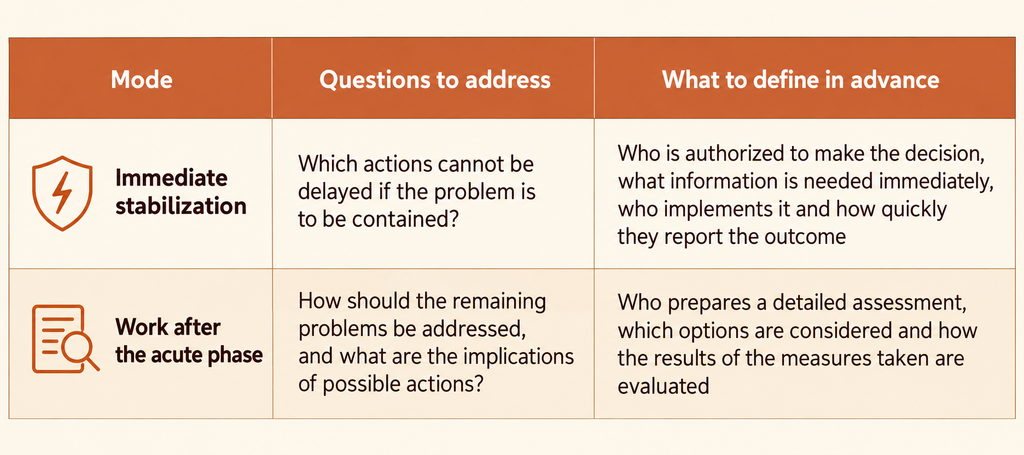
In the first, the priority is to act quickly on the information available. In the second, there is more room to examine the underlying problems and develop longer-term responses.
Both require clear decision-making authority.
A crisis committee is of limited use if its members must spend valuable time establishing who can approve a particular action.
Banks need to know in advance what the committee can decide, which matters must be escalated and who is responsible for implementation.
Another example discussed at the roundtable involved a reputational crisis that triggered deposit outflows and severe liquidity pressures. External funding helped the bank manage the situation.
The lesson is not simply that emergency funding may be available. It is that banks need to understand their options before they need them.
Which liquidity sources could actually be accessed under stress? On what terms? What restrictions apply? And who would be responsible for arranging the funding?
In a crisis, good financial management is measured less by the amount of analysis produced than by the bank’s ability to understand the situation, set priorities and act in time.
Where CFOs and Finance Teams Can Start
Improving the link between financial planning and management decisions does not necessarily require a major transformation programme.
A useful first step is to take one significant variance from the plan and trace what happened from the first warning sign to the final decision.
When did conditions begin to change? When did the bank notice? Who investigated the cause, revised the forecast and proposed a response?
How long did it take to make a decision? And what happened after the action was taken?
Following that sequence can reveal where time is being lost.
Perhaps the data arrived too late. Perhaps the analysis took longer than necessary. Or perhaps the team had a clear recommendation but no straightforward route to approval.
The next step is to address one of those weaknesses.
That might mean assigning someone to investigate a particular indicator, agreeing when a forecast should be reviewed or clarifying who has authority to make a certain decision.
The objective is not simply to produce more accurate forecasts. It is to reduce the time between a change in business conditions and a decision the bank can act on.
For CFOs, this is also what it means to move beyond reporting the numbers and become a genuine business partner: helping management understand the consequences, weigh the alternatives and respond before the opportunity to act has passed.
Editorial Note
This article was prepared by the B2B Events editorial team following a roundtable discussion at the Eurasian Financial Management Forum 2026. The analysis and conclusions reflect our interpretation of the discussion and do not necessarily represent the views of individual participants or their organisations.
AI tools were used to help analyse the discussion materials, organise the content and prepare the article. The final version was reviewed by our editorial team, which takes full responsibility for the published content.

AI in the Finance Function: Faster Doesn’t Always Mean Cheaper
AI can speed up financial processes and reduce repetitive work, but it does not always lower costs. Drawing on examples from Kcell, Freedom Life and EA Group Holding, we explore how to assess the impact of AI implementation, address data quality challenges and determine which decisions should remain under human control.

ESG in Banking: Connecting Finance, Risk and Business Decisions
ESG can open up new funding opportunities, but it does not automatically mean cheaper finance. For banks, the bigger question is how environmental, social and governance factors affect risk and portfolio decisions. We explore why reporting alone is not enough, where banks can start integrating ESG into credit processes, and how better data can support business strategy.