






KPIs in Banking: Aligning Strategy, Business Objectives and Employee Incentives

Introducing KPIs is relatively straightforward. The real challenge is ensuring that employees, while meeting their individual performance targets, are also contributing to the bank’s overall success.
A bank can develop detailed strategy maps, establish performance measurement systems and link bonuses to specific targets — yet still find that individual employees are delivering strong results while the bank’s strategic objectives remain unmet. This is why it is essential to understand where KPIs come from, which business objectives they support and what behaviours they encourage.
Viktor Shpringel, Deputy Chairman of the Management Board at Asman Bank, has more than 20 years of experience designing and restructuring KPI frameworks in the banking sector. His experience suggests that KPIs should not be treated simply as an employee incentive mechanism, but as an integral part of the bank’s wider management framework.
KPIs Start with Strategy
One of the most common mistakes in designing a KPI framework is to begin by asking which performance indicators should be assigned to individual employees.
The process should work the other way around.
First, the bank defines its strategic objectives. These provide the basis for a strategic roadmap outlining the projects required to deliver them, alongside a financial model that establishes the parameters for budgeting.
The bank then develops its annual project plan and budget. Only after these are in place should it define KPIs for departments and individual employees.
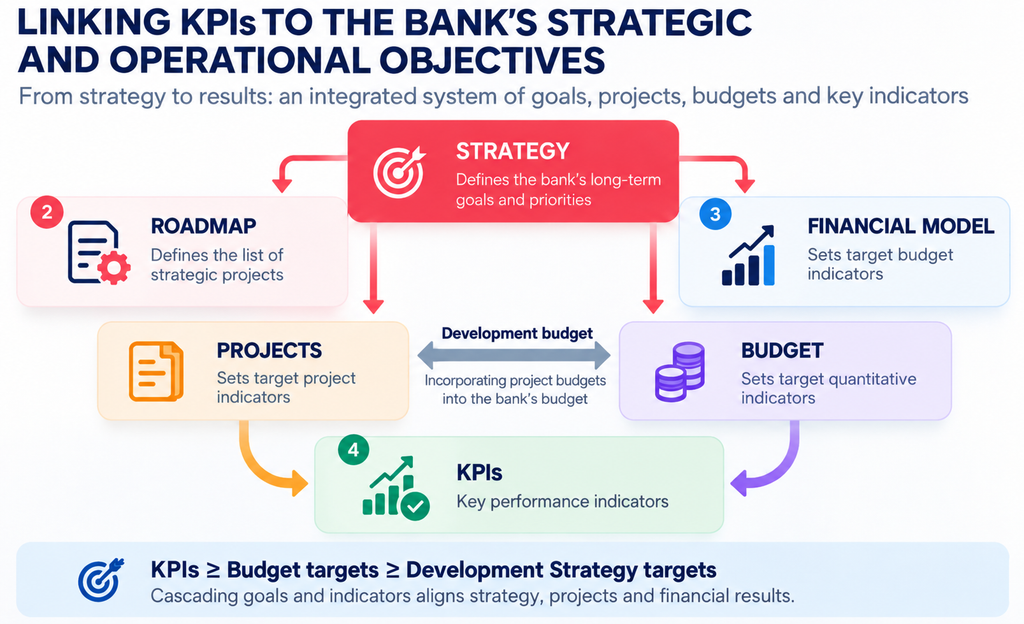
Following this sequence turns KPIs from a collection of metrics into a tool for executing strategy. Performance targets should not be set below the levels established in the bank’s budget and strategic plan. Otherwise, employees may meet their KPIs and receive bonuses while the bank itself falls short of its objectives.
One way this can happen is through a focus on local performance.
The Risks of Local Optimisation
KPIs have an unintended consequence: people naturally focus more attention on the activities for which they are rewarded.
This is understandable, but it creates risks. When targets are defined too narrowly, an employee may perform exceptionally well against their own KPIs while doing little to support colleagues, contribute to shared objectives or avoid creating difficulties for other departments.
The result is that an individual or business function may appear successful, while the benefit to the bank as a whole remains limited.
This is why incentive frameworks need to recognise not only individual performance, but also departmental and organisation-wide results. The aim is to encourage employees to look beyond their immediate responsibilities and consider how their work contributes to the bank’s overall performance.
Team-Based or Individual KPIs?
Employees contribute to business outcomes in different ways, so a single, standardised approach to KPIs is unlikely to work across every role.
In most departments, results depend on the collective efforts of the team. Team-based targets are therefore often more appropriate, as individual employees rarely deliver the final outcome entirely on their own.
However, some roles allow individual contributions to be measured more directly. Relationship managers, credit specialists and sales staff, for example, often work towards individual performance targets.
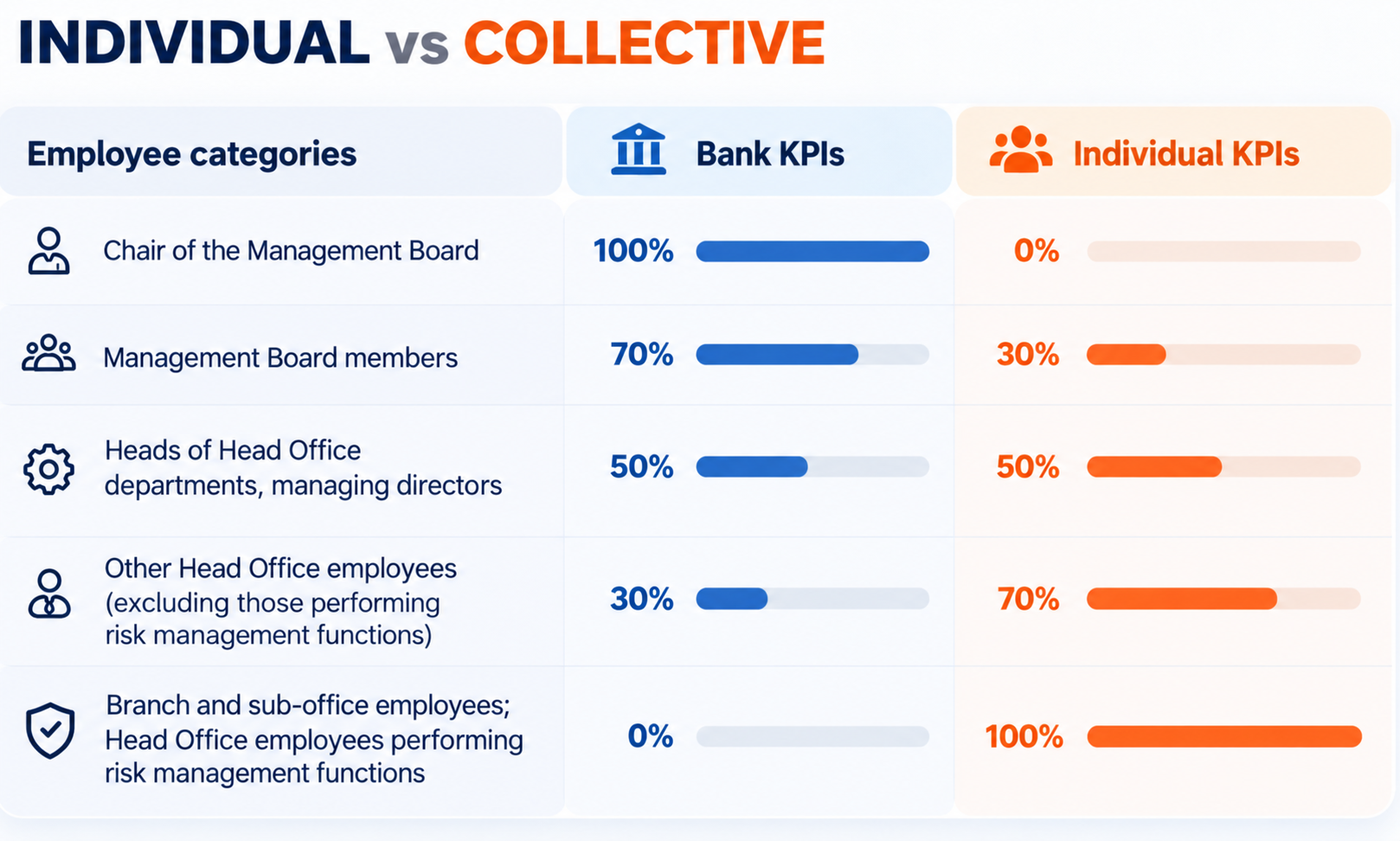
A consistent KPI framework does not mean assigning the same performance indicators to everyone. Team-based KPIs may be appropriate for most of the organisation, while individual targets may work better for certain roles. The key is not to impose a single approach across the bank, but to tailor performance measurement to the nature of each department’s work.
Employees Quickly Learn to Deliver Exactly What Their KPIs Measure
Even a well-designed KPI can encourage unintended behaviour.
A case from MTS Bank illustrates this challenge. Initially, employees working with lending products were rewarded based on the number of loan applications they processed. The result was predictable: employees focused on maximising application volumes, regardless of their quality.
The incentive structure was then changed, with rewards linked to the number of loans disbursed. But this created a different problem. Employees were incentivised to issue loans, while the subsequent performance of those loans had little bearing on their remuneration.
The bank eventually adopted a blended approach, taking into account both loan disbursement volumes and the quality of the resulting loan portfolio.
This example illustrates why a KPI framework cannot simply be designed, implemented and left unchanged. Once it is in place, banks need to monitor not only performance against targets, but also the behaviours those targets encourage.
Not Everything That Can Be Measured Should Be Linked to Bonuses
Another common pitfall is trying to make the KPI framework as comprehensive as possible.
When a bank tracks dozens of performance metrics, it can be tempting to incorporate most of them into its bonus scheme. But this makes the incentive structure overly complex and harder for employees to understand.
In practice, the number of performance indicators directly linked to remuneration should be limited.
A more effective approach is to use no more than five or six KPIs to determine an employee’s bonus in most cases. Additional metrics can still be used to monitor departmental performance without necessarily affecting individual rewards.
This highlights an important distinction between two management tools.
KPIs help focus employee incentives and attention on a limited number of priorities.
The Balanced Scorecard (BSC) provides a broader framework for assessing business performance and monitoring strategy execution.
Attempting to link every management metric to financial rewards adds complexity without necessarily improving performance.
KPIs Cannot Work Without Clear Organisational Accountability
Another important consideration is that responsibilities must be clearly defined before performance indicators are assigned.
Who is accountable for the outcome? Where does one department’s responsibility end and another’s begin? Which management reports provide the actual performance data? And who validates the results?
Without clear answers, KPIs will simply expose existing ambiguities. A well-defined organisational structure and reliable management reporting are therefore essential foundations of an effective KPI framework.
A useful analogy is a football team. It is difficult to assess players’ performance without knowing who is a defender, who plays in midfield, who is a striker and who is sitting on the bench. The same principle applies within a bank: define responsibilities first, then establish the performance indicators.
A KPI Framework Needs Clear Rules and Ownership
Developing KPI scorecards is not enough to ensure that the system works effectively over time.
Banks also need a clear methodology that defines:
- how KPIs are established;
- who reviews and approves them;
- how performance against targets is calculated;
- how performance results translate into bonus payments;
- how disputes are resolved;
- when KPIs can be reviewed or revised.
Clearly defined responsibilities are equally important.
HR may coordinate the process, maintain the methodology and administer bonus calculations. However, KPIs are closely linked to budgets, management reporting and strategic objectives.
Finance and strategy teams therefore have a critical role to play. They are well placed to understand how targets and actual performance figures are determined, and how individual indicators contribute to the bank’s broader objectives.
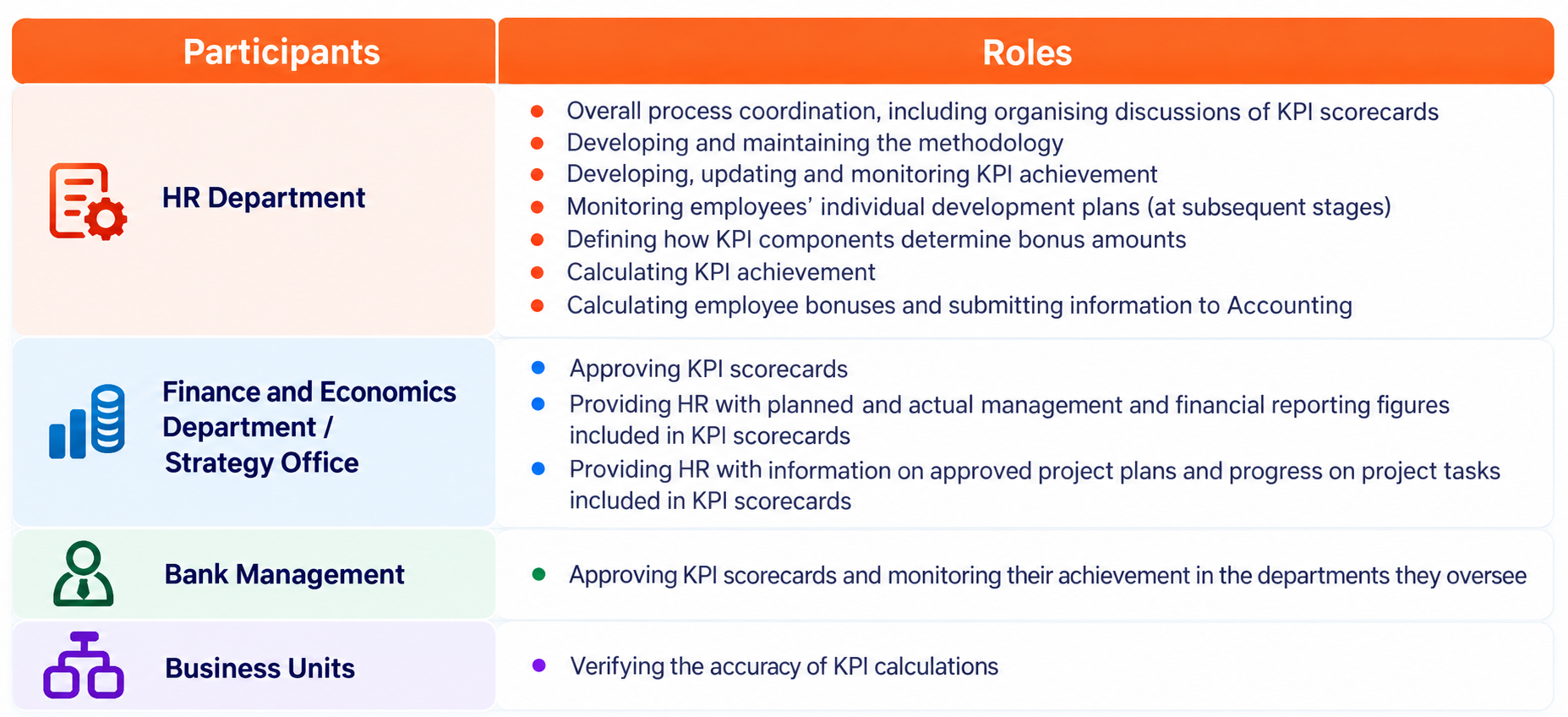
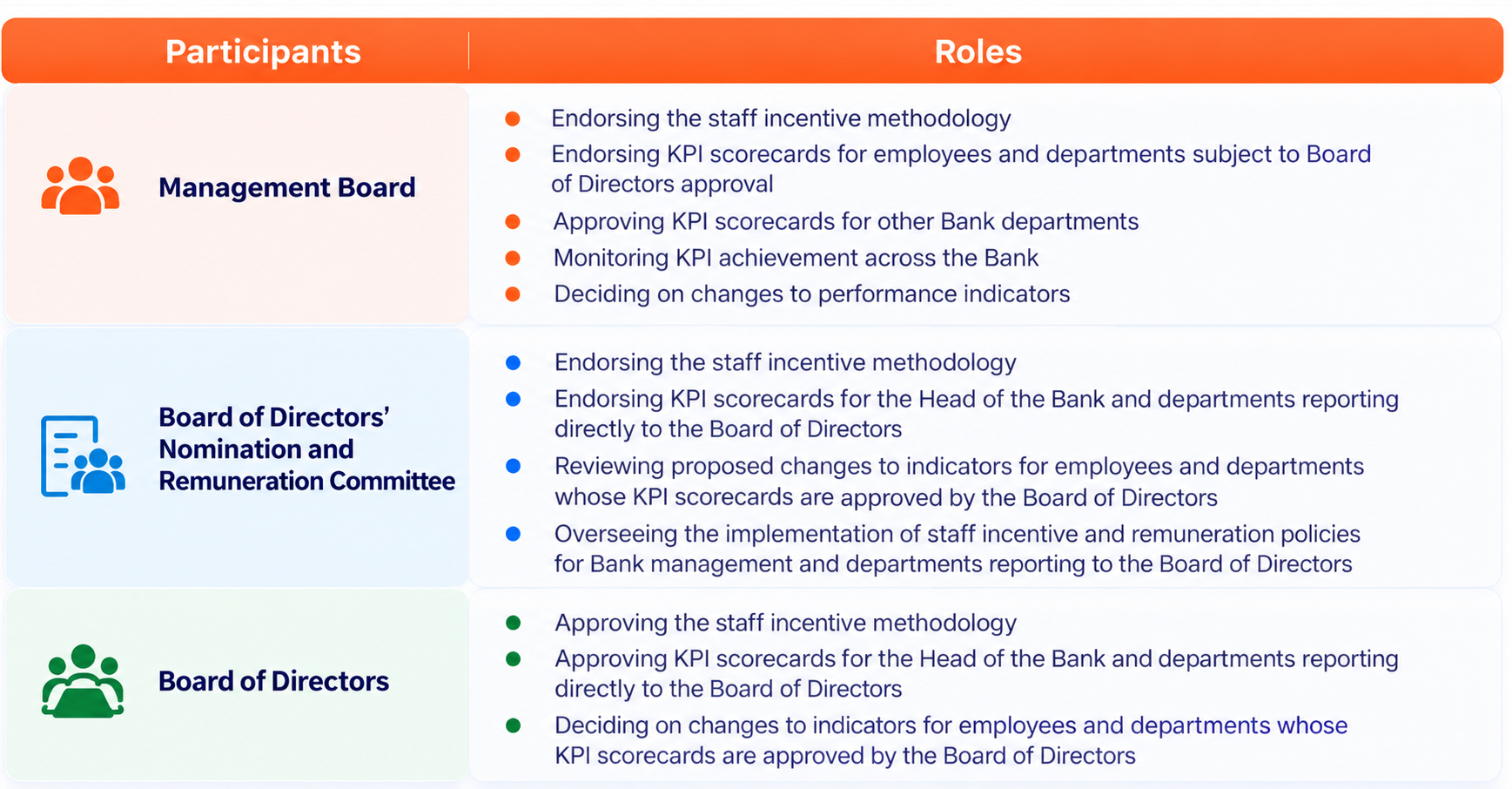
Department heads are responsible for defining the objectives within their areas of accountability. The Management Board and Board of Directors are involved in reviewing and approving KPIs at the appropriate levels.
In other words, KPI management is not solely an HR responsibility.
Why KPIs Should Not Simply Be Imposed from the Top
Formally, a KPI framework follows a top-down structure. Bank-wide and senior management KPIs are established first, then cascaded down to individual departments.
However, leaving the development of every KPI scorecard entirely to the finance or strategy function, or to external consultants, is unlikely to produce the best results. A more effective approach is to involve departments in defining their own performance indicators.
The reason is straightforward: functional managers have the clearest understanding of their teams’ day-to-day priorities and actual responsibilities.
This does not mean giving departments complete freedom. Their proposed indicators must fit within the overall KPI framework and be aligned with higher-level objectives.
The result is a two-way process. Senior management sets the strategic direction and establishes the parameters, while departments propose indicators that reflect how their work contributes to those objectives.
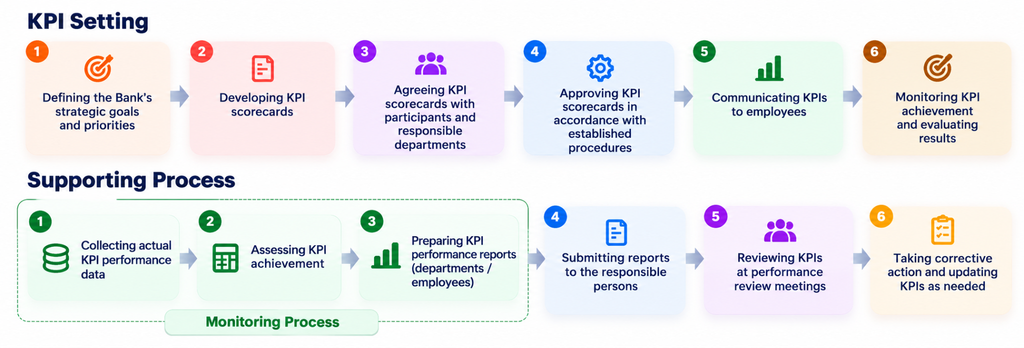
This approach can also help address another challenge: resistance from employees who do not understand why their performance is being assessed against particular criteria.
When a KPI Needs to Be Reassessed
Even a well-designed KPI framework will encounter situations where performance results are disputed. A department may miss its target not because of poor performance, but because external conditions have changed or another function has failed to deliver.
One approach used in practice is a mechanism that could be described as a KPI exemption.
This does not mean automatically removing accountability. Rather, it involves a formal review and a management decision on whether the reasons for missing the target were genuinely beyond the control of the employee or department concerned.
Such a mechanism is particularly important in complex organisations, where the performance of different functions is closely interdependent.
When KPI Management Becomes Difficult Without Automation
Smaller organisations can manage KPIs manually. But as the number of employees, departments and performance indicators grows, so does the volume of calculations, approvals and monitoring required.
Based on practical experience, automation becomes almost essential once an organisation has more than approximately 20 departments or 100 employees. Without it, organisations face two potential outcomes: errors and lost information, or a disproportionately large administrative team dedicated to managing the process.
The choice of software is secondary. What matters is that the system allows the organisation to set objectives, record performance indicators, monitor progress against targets and obtain the data needed for regular performance calculations.
KPI Management Is a Continuous Cycle, Not an Annual Exercise
Another common mistake is treating KPIs as something that needs attention only once a year.
In practice, KPI management follows a continuous cycle. During the first quarter, banks review the previous year’s performance and establish targets for the new financial year, aligned with the approved budget.
Performance is then monitored throughout the year.
Reviews should take place at least quarterly, or monthly where resources and the level of automation allow.
KPIs may also need to be adjusted when circumstances change — for example, following a budget revision, new priorities set by shareholders or significant changes in the external environment.
A KPI framework is not a one-off implementation project. It is an ongoing management process that requires continuous oversight and refinement.
What to Review in Your Existing KPI Framework
The most important diagnostic question is straightforward: Can you explain where each key performance indicator comes from?
If there is no clear link between an employee’s KPIs and the bank’s strategic or financial objectives, the organisation risks measuring activity for its own sake.
There are several other questions worth asking:
- Do team-based and individual KPIs genuinely reflect the nature of each role?
- Are any KPIs encouraging behaviours that compromise the quality of outcomes?
- Do departments understand why their particular performance indicators were selected?
- Is responsibility for performance data and calculations clearly assigned?
- Is there a formal process for reviewing KPIs when circumstances change?
- Has the framework become so complex that employees no longer understand what determines their bonuses?
Meeting KPI targets is not, in itself, evidence of an effective performance management system.
A bank could achieve 100% of its KPI targets and still fail to deliver its strategic objectives. The true measure of a mature KPI framework is therefore neither the number of metrics it contains nor the precision of its calculations.
What matters most is whether the behaviours rewarded by the KPI framework are aligned with what the business actually needs to achieve.
Editorial Note
This article was prepared by the B2B Events editorial team following a speaker presentation at the Eurasian Financial Management Forum 2026. The analysis and conclusions reflect our interpretation of the presentation and do not necessarily represent the views of the speaker or their organisation.
AI tools were used to help analyse the presentation materials, organise the content and prepare the article. The final version was reviewed by our editorial team, which takes full responsibility for the published content.

Beyond the Financial Model: The Hidden Risks of Misaligned Values
Can an investment project with attractive financial returns face closure because its partners do not share the same values? Madina Ayukhanova, CFO of EA Group Holding, examines a real case from the holding company's experience in which a project passed its financial stress tests but still encountered a management crisis. What risks lie beyond the financial model, and what else should CFOs consider when making investment decisions?