






Beyond the Financial Model: The Hidden Risks of Misaligned Values

A financial model can withstand rigorous stress testing, yet the project itself may still come close to being shut down. The underlying problem is not necessarily market risk or inaccurate forecasts. Sometimes, the decisive factor is something that cannot be quantified in a spreadsheet: a fundamental misalignment of values between business partners.
EA Group Holding faced precisely this challenge. Drawing on a real investment project, Madina Ayukhanova, the holding company’s CFO, explores how disagreements between shareholders can affect financial performance — and why investment decisions need to consider more than the numbers. Corporate culture, reputation and partners’ long-term objectives can be just as important to a project’s success.
When Financial Models Fail to Capture the Biggest Risk
Before making an investment decision, companies typically assess the market, analyse macroeconomic indicators, evaluate financing costs and develop financial models. They also need to understand how changes in market conditions, inflation or increased competition could affect the investment.
This is an essential part of a CFO’s work. But it has its limitations.
A financial model reflects assumptions about how a business is expected to develop. It allows companies to assess different scenarios, but it cannot always predict how the people making critical decisions will behave.
This was the challenge EA Group Holding encountered with DR1VE, a digital platform investment.
At the outset, the project appeared promising. Its projected internal rate of return (IRR) was 32%, with an estimated payback period of 3.5 years and target market growth of approximately 25%. The financial model had also passed stress tests covering inflation, currency devaluation and increased competition.
The technology partner was responsible for software expertise, while EA Group Holding provided financing and supported the project’s expansion. However, when additional funding became necessary, fundamental disagreements emerged. The partner refused to accept dilution of its ownership stake, amend the company’s founding documents or contribute further capital. The dispute between shareholders also affected the management teams.
The project came close to being shut down or put on hold. Yet the market continued to grow, and EA Group Holding believed there was still strong demand for the product.
As the holding company examined what had gone wrong, it concluded that the underlying problem was a misalignment of values between the partners.
Misaligned Shareholder Values: The Hidden Cost of Partnership
For EA Group Holding’s technology partner, the priorities were aggressive growth, rapid financial returns and performance metrics that demonstrated a high rate of expansion.
EA Group Holding’s shareholders, by contrast, placed greater emphasis on long-term resilience, transparent governance and building a broader business ecosystem.
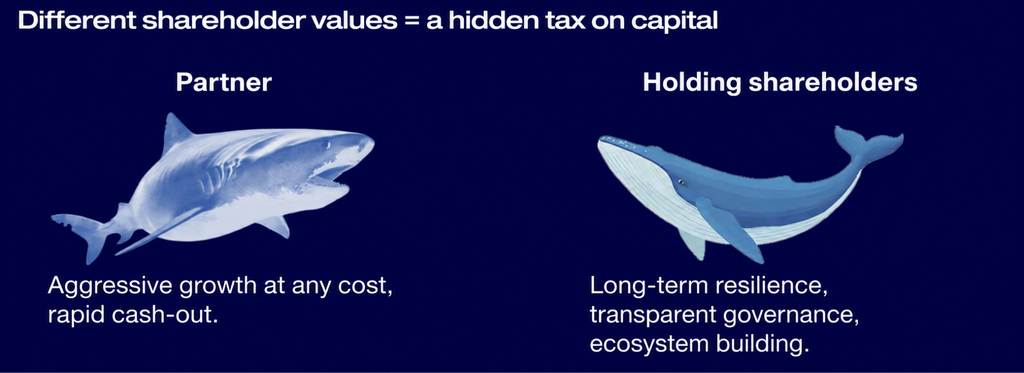
The question is not whose values are right, but whether they are compatible. Differences may remain unnoticed for a long time, only to become a source of serious conflict when additional investment is required or existing agreements need to be renegotiated.
For EA Group Holding, the consequences included lost time and a complete reassessment of its investment plan. As a result, the holding company now evaluates potential partners not only on their financial performance, but also on the quality of their corporate governance, the maturity of their shareholders and how they have responded to difficult situations in the past. The aim is to understand, before entering a partnership, who will be making critical decisions when things do not go according to plan.
Reputation: An Asset Whose Value Becomes Clear in a Crisis
Reputation is another factor that is difficult to capture in a financial model. For EA Group Holding, it is built primarily on a track record of honest and transparent dealings with the market, established over many years.
In financial management, there can sometimes be a temptation to present results in a more favourable light, whether through aggressive accounting practices or by concealing certain problems. Such decisions may deliver short-term benefits, but the long-term cost to the business can be far greater.
When relations with the technology partner deteriorated, its conduct went beyond what EA Group Holding had expected from a fellow shareholder. In situations like this, a reputation built long before the conflict can become particularly valuable. Partners with an established relationship with the holding company could assess the situation based on their own experience, rather than relying on what others said.
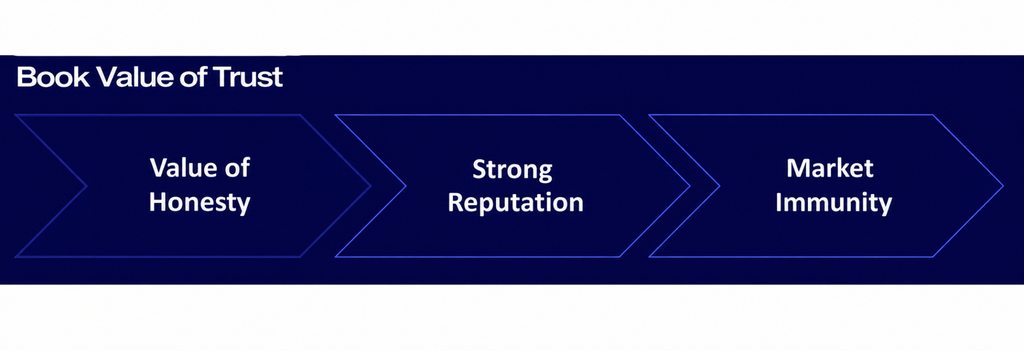
In stable times, the financial value of reputation is difficult to quantify. But during a crisis, it can influence whether investors and business partners are willing to maintain their relationships with a company and provide support.
How Conflicting Values Affect Teams
EA Group Holding places considerable emphasis on partnership and open communication. The technology partner’s management approach, by contrast, was more strongly focused on meeting key performance indicators (KPIs).
Corporate values and KPIs should not be seen as competing priorities: measurable performance targets are essential to any business. In this particular project, however, differences in management approaches led to serious conflict.
According to EA Group Holding’s observations, developers working for the technology partner faced considerable pressure, experienced burnout and left the project. The two sides began shifting responsibility onto one another. Employees within the holding company also found themselves in a difficult position, with some requesting transfers to other projects.
For a business, this is no longer an abstract question of corporate culture. The departure of skilled employees, communication breakdowns and difficulties executing tasks all affect project timelines and costs. A financial model may capture the consequences, but it does not necessarily explain their underlying causes.
Once it became clear that the existing partnership structure was no longer workable, EA Group Holding bought out its partner’s stake, revised the investment plan and rebuilt the team.
Making Values Part of Management Decisions
Discussing corporate values is considerably easier than applying them when difficult decisions need to be made.
When EA Group Holding was developing its corporate strategy, it held a series of dedicated workshops. Participants explored what each value meant, how it should influence day-to-day operations and what actions the holding company was prepared to take to uphold it.
One question was particularly challenging: Would we be prepared to part ways with an employee whose behaviour contradicts our values?
The purpose was to establish whether the organisation was genuinely prepared to stand by its stated principles when making decisions. Employees cannot reasonably be expected to demonstrate honesty and openness if shareholders and senior executives do not uphold those same standards.
The holding company also uses an exercise called the Values Bridge. Employees first identify their personal values and then explore how these connect with the organisation’s values.
The connection does not have to be literal. For example, an employee might value work-life balance, while the company emphasises honesty. The employee may recognise a connection between the two through a shared need for security and open relationships.
The exercise is intended to help individuals understand how closely they identify with the company’s culture.
Shared values do not replace KPIs or other management tools. Rather, they help define how the organisation intends to achieve its objectives.
Not Every Profitable Project Is Strategically Right
EA Group Holding considers another question when evaluating investment opportunities: does the project genuinely support the holding company’s long-term objectives?
Attractive investment opportunities regularly emerge in the market. But high potential returns alone do not necessarily mean that a company should pursue them.
The holding company’s guiding question is whether, three to five years later, it will still regard its involvement as worthwhile, even if it has already exited the investment. What kind of business will it pass on to the next owner, and what problems might it leave behind?
This perspective also influenced its decision regarding the technology platform. Rather than abandoning the troubled project, EA Group Holding assumed additional commitments, revised its investment plan and continued developing the business.
This is not a universal solution for every company or investment. For EA Group Holding, however, the decision was consistent with its strategy and corporate principles.
Four Questions CFOs Should Ask Before Making an Investment Decision
The experience led EA Group Holding to identify four questions it now considers before entering an investment. They do not replace market analysis, financial modelling or risk assessment. Instead, they help bring less easily quantifiable factors into the decision-making process.
- Are your long-term objectives aligned with your partner’s values and investment horizon? It is important to establish whether both parties share a vision for the project’s development and are prepared to make difficult decisions together, including decisions about additional capital contributions.
- Is your foundation of trust strong enough? How resilient is your company’s reputation, and can you rely on the confidence of investors, financial institutions and business partners during a crisis?
- Are your key teams and operational processes protected against clashes between corporate cultures? Consider how different management approaches could affect collaboration between employees and the execution of the investment plan.
- Does the project genuinely align with your strategy? Or are attractive potential returns drawing you away from your long-term objectives?
These questions add another dimension to conventional financial analysis: whether the company and its partners are prepared to act consistently with the principles they have chosen.
Ultimately, a CFO must assess not only investment returns and the cost of capital, but also the longer-term consequences of the decisions the company makes today.

CIS Economic Outlook 2026–27: Risks, Resilience, and Implications for Business
Economic growth and currency appreciation do not necessarily translate into a more predictable business environment. Dmitry Dolgin examines the forces shaping Armenia, Azerbaijan, Kazakhstan, and Uzbekistan, the vulnerabilities that remain, and what companies should consider when assessing their regional exposure and business plans. В статье - прогнозы на 2026–2027 годы и вопросы для проверки рабочих планов.

KPIs in Banking: Aligning Strategy, Business Objectives and Employee Incentives
KPIs can help banks execute their strategy — or encourage employees to perform exceptionally well at tasks that contribute little to strategic objectives. The difference lies in how performance indicators are linked to budgets, projects, departmental accountability and employee incentives. Viktor Shpringel examines how banks can build these connections and the most common mistakes made when implementing KPI frameworks.