






CIS Economic Outlook 2026–27: Risks, Resilience, and Implications for Business

For companies doing business with partners across the Commonwealth of Independent States (CIS), broad descriptions of the region as a growth market offer limited value for strategic planning. What matters is understanding the drivers of growth in individual economies, the factors supporting their currencies, and the conditions that could change.
The answers differ considerably across Armenia, Azerbaijan, Kazakhstan, and Uzbekistan. International investor interest in these markets has strengthened. Sovereign and corporate credit ratings have improved, while portfolio capital inflows have continued. Yet favorable market performance should not obscure persistent questions around fiscal discipline, inflation, and dependence on external financing.
Dmitry Dolgin, Chief Economist for the CIS region at ING Deutschland, analyzes these economies in his work with bank management, European investment funds, corporations, and regulators. His perspective offers a framework for examining the assumptions underpinning business plans and commercial relationships across the region.
All assessments and forecasts presented in this article reflect the outlook as of June 2026.
Armenia, Azerbaijan, Kazakhstan, Uzbekistan: Four economies, four distinct risk profiles
The region has experienced a notable improvement in international investor sentiment, reflected in stronger credit ratings and growing investment interest. However, similar financial-market trends conceal fundamentally different economic conditions.
Armenia: Strong economic momentum, supported by capital inflows
Armenia, the smallest of the four economies, continues to expand rapidly and remains highly integrated into international trade.
Nevertheless, the country faces twin deficits: a fiscal deficit and a current account deficit. The latter reflects a negative balance in current transactions with the rest of the world, creating an ongoing need for external financing.
The Armenian dram has appreciated significantly in recent years, while inflation has remained relatively subdued. The sustainability of both trends, however, remains uncertain.
Progress toward normalizing relations with Azerbaijan has helped strengthen investor confidence, although other aspects of the geopolitical environment continue to present risks.
Azerbaijan: Strong financial buffers, but subdued economic growth
Azerbaijan has the strongest financial position among the four economies. Higher oil prices support export revenues and government finances, while expanding trade and transport links create additional economic opportunities. Yet substantial financial reserves do not automatically translate into faster growth. Over the longer term, the current account balance will remain a critical indicator. A sustained current account surplus, together with the reserves held by the sovereign wealth fund and the central bank, underpins the manat’s fixed exchange rate. Preserving the external surplus will require greater diversification of both the economy and its export base.
Kazakhstan: A large and growing economy facing fiscal challenges
Kazakhstan is the largest of the four economies, with substantial trade and financial flows. Although the country is gradually diversifying its sources of growth, it remains heavily dependent on oil revenues. Government finances benefit from significant commodity-related income and strong investment returns generated by the sovereign wealth fund. Nevertheless, maintaining fiscal discipline, particularly in public expenditure, remains essential. There is also a potential trade-off: fiscal consolidation could reduce government foreign-exchange sales, removing an important source of support for the tenge.
Uzbekistan: Rapid growth and the strategic importance of gold
Uzbekistan continues to deliver strong economic growth while moving toward fiscal consolidation and a narrower budget deficit. Until recently, the combination of fiscal and current account deficits, together with elevated inflation, had placed persistent pressure on the Uzbek som. Since 2025, however, foreign-exchange market dynamics have improved. Rising global gold prices have contributed to currency appreciation, reflecting gold’s importance as one of Uzbekistan’s principal exports. Importantly, physical gold export volumes remain somewhat below historical levels and the country’s production capacity. This creates scope for additional export revenues through higher shipment volumes, even if international gold prices decline.
Economic growth outlook, 2026–27
Real GDP growth forecasts, % year on year | June 2026 estimates
| Country | 2026 | 2027 |
| Armenia | 5,0% | 5,0% |
| Azerbaijan | 2,0% | 3,0% |
| Kazakhstan | 5,0% | 4,8% |
| Uzbekistan | 7,5% | 6,5% |
These projections describe economy-wide performance. Applying them directly to the expected growth of an individual customer, supplier, or industry would be an oversimplification.
Furthermore, oil-sector growth in Azerbaijan and Kazakhstan is constrained by production capacity. Higher oil prices do not necessarily translate into greater output or export volumes.
Three macroeconomic forces that could reshape business conditions
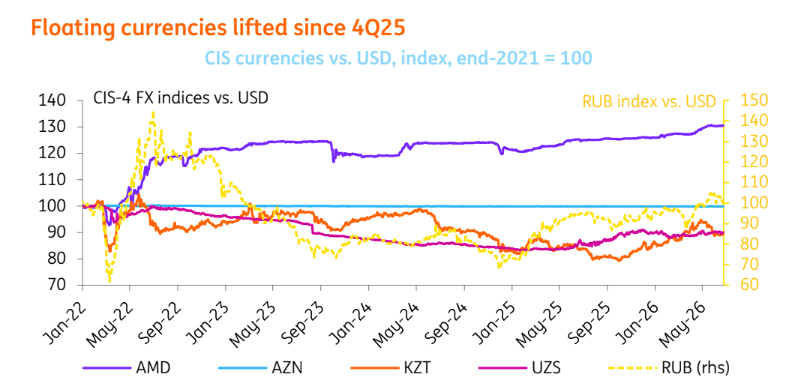
The renewed escalation of tensions in the Middle East since early 2026 has created three principal transmission channels for CIS economies: commodity prices, foreign portfolio investment flows, and imported inflation, including potential trade disruptions.
By June, many of the initial concerns surrounding these channels had not materialized to the extent anticipated. Nevertheless, the underlying risks have not disappeared.
Commodities: Prices and volumes matter equally
Higher oil prices benefit energy exporters such as Azerbaijan and Kazakhstan, strengthening export revenues and government finances. For Armenia and Uzbekistan, by contrast, they increase the cost of imported energy. Yet commodity prices alone cannot explain currency movements. Both Armenia and Uzbekistan have also experienced currency appreciation and declining bond yields.
Uzbekistan provides a particularly revealing example. Gold exports resumed in April following a six-month suspension. During that period, the country was unable to capture the direct export-revenue benefits of rising global gold prices. The resumption of shipments creates additional revenue potential, demonstrating why commodity-market analysis must consider physical export volumes alongside international prices.
A reduction in Middle East tensions would not necessarily restore previous commodity-price expectations. Countries that drew down energy inventories during supply disruptions will eventually need to replenish them, potentially sustaining demand for oil. As of June, the forecast for the average Brent crude oil price in 2026 had been revised upward from $62 to $87 per barrel, with further upside risks remaining.
Capital flows: How durable is foreign investor demand?
Periods of heightened global uncertainty typically prompt investors to reduce exposure to emerging-market assets. By June 2026, however, the anticipated withdrawal of capital had not materialized on the expected scale. Portfolio investment inflows into CIS markets continued. Several country-specific developments helped sustain investor interest.
In Kazakhstan, expectations surrounding a potential connection to Euroclear, which would facilitate foreign investor access to the domestic market, supported sentiment. Planned sovereign and quasi-sovereign debt issuance also contributed to market interest. In Armenia, progress toward normalization with Azerbaijan and expectations of policy continuity reinforced investor confidence. In Uzbekistan, the privatization program and improving sovereign credit-rating prospects provided additional support.
Nevertheless, portfolio capital is inherently sensitive to shifts in global risk appetite. Strong inflows today do not rule out reversals tomorrow. When assessing currency resilience, companies and investors should distinguish between structural sources of foreign-exchange earnings, such as exports, and potentially more volatile sources of financing, such as international portfolio flows.
Inflation: The indirect cost of higher energy prices
Even countries that benefit directly from higher oil prices can experience rising import costs. When trading partners face more expensive energy, those costs can feed through into the prices of manufactured goods and machinery they export.
The geographical composition of trade, particularly imports, is therefore essential to understanding inflation risks across CIS economies. By June, inflationary pressures across the region had proved less severe than initially feared. Several factors helped contain price growth, including stronger local currencies, domestic tariff decisions in Kazakhstan and Uzbekistan, and relatively weak demand in Azerbaijan. However, the continuation of these favorable conditions cannot be taken for granted.
Currency risk: Kazakhstan illustrates the fiscal policy dilemma
Fiscal consolidation and currency stability do not always move in the same direction. Kazakhstan provides a clear illustration.
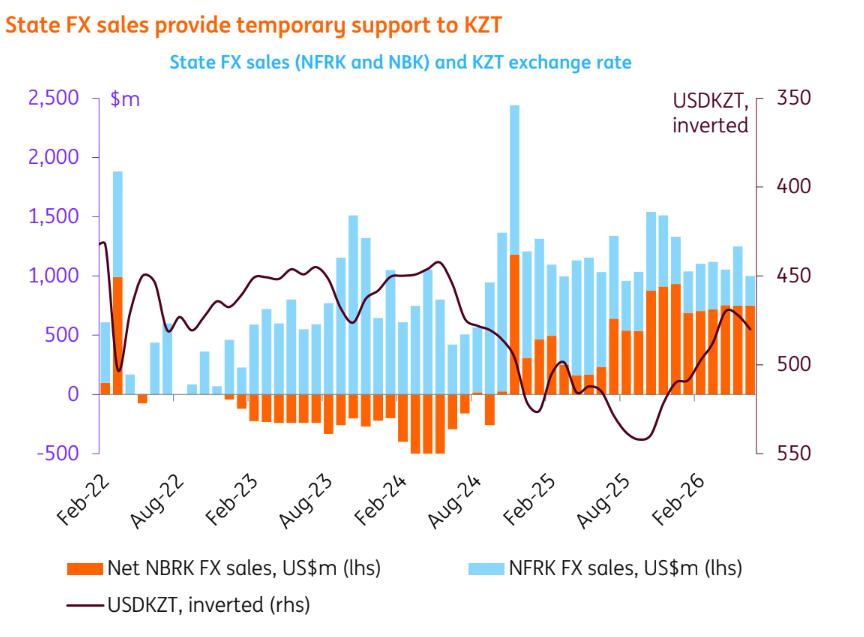
When resources from the National Fund are transferred to finance government expenditure, the conversion of previously accumulated foreign-currency savings into tenge provides support for the domestic currency. As the government’s need for such transfers declines, this source of foreign-exchange support diminishes. Export earnings and capital inflows consequently become more important drivers of currency performance.
Kazakhstan also has an additional fiscal dimension: the official government budget does not capture the full extent of state-supported economic stimulus. Lending through state-owned and state-affiliated entities represents stimulus equivalent to approximately 5% of GDP. This financing can continue to support domestic demand and influence inflation even as the headline fiscal deficit narrows.
The near-term outlook for the tenge remains favorable. Over the longer term, however, Kazakhstan’s persistent current account deficit continues to exert pressure. Addressing this structural vulnerability will require stronger export revenues and more sustainable capital inflows.
Interest rates: Scope for easing does not guarantee rate cuts
Central banks in Kazakhstan and Uzbekistan retain some room to reduce nominal policy rates. This reflects relatively high real interest rates, measured after adjusting for prevailing inflation. Armenia and Azerbaijan, by contrast, have considerably less room to ease monetary policy, as their nominal interest rates are only marginally above inflation.
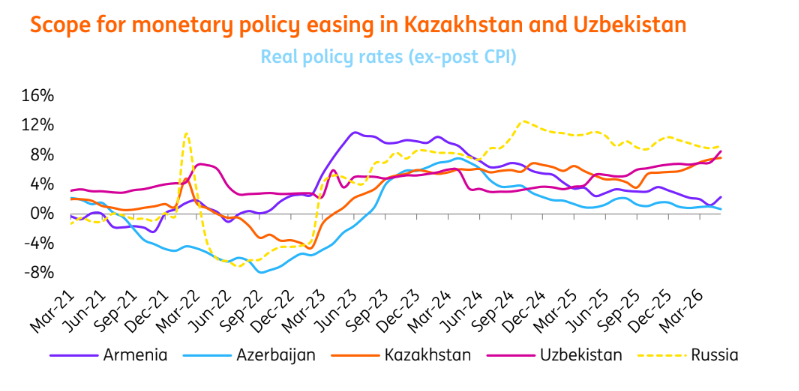
Nevertheless, the existence of policy space does not make monetary easing inevitable. In June, the National Bank of Kazakhstan reduced its policy rate by 100 basis points, or one percentage point, to 17%. Its guidance on further easing remained cautious. Key considerations included potential tariff increases, commodity-price developments, the sustainability of tenge appreciation, and demand supported by government expenditure.
In Uzbekistan, fiscal consolidation, the resumption of gold exports, and portfolio capital inflows contributed to currency appreciation and helped moderate inflation. Relatively high real interest rates also supported foreign investor interest. Even so, the Central Bank of Uzbekistan maintained a cautious stance, and no reduction in the nominal policy rate followed during the summer.
The timing and scale of monetary easing must therefore be assessed within a broader macroeconomic context. Domestic factors, including fiscal policy, administered tariffs, and exchange-rate risks, remain particularly important. External risks must also be considered. Having room to cut rates is not the same as being ready to do so.
Scenario analysis: Quantifying exposure to external shocks
In an uncertain global environment, assessing how an economy responds to changes in external variables can be more informative than relying exclusively on a single baseline forecast. Commodity-price volatility provides a useful example. Consider a hypothetical $10-per-barrel increase in the average annual oil price.
For Azerbaijan and Kazakhstan, the estimated increase in annual export and fiscal revenues would be equivalent to approximately 2–4% of GDP. For Armenia and Uzbekistan, the same price shock would increase energy import costs by approximately 0.5% of GDP.
Food prices represent another important source of external exposure. A hypothetical 10% increase in global food prices produces the following estimates of additional inflation.
Estimated inflation impact of a 10% increase in global food prices
| Country | Additional inflation, percentage points |
| Armenia | 2 pp |
| Azerbaijan | 1,5 pp |
| Kazakhstan | 0,8 pp |
| Uzbekistan | 1,2 процентного пункта |
These are conditional sensitivity estimates, not forecasts that such price increases will necessarily occur. Nor should they be applied directly to individual company cost structures. Consumer price inflation reflects a different basket of goods and services from that of a particular business.
Portfolio investment flows are even less amenable to simple quantitative rules. Assessing their potential impact requires combining an understanding of global investor sentiment with the domestic factors driving investment interest in each market.
From macroeconomic insight to business decisions
The practical challenge for companies is to identify which macroeconomic assumptions are already embedded in their operating plans. The following editorial framework translates the analysis into questions for internal discussions and conversations with business partners. It is not intended to represent separate recommendations from the economist.
| Area to review | Questions to consider | What to document |
| Exchange-rate assumptions | Does our plan depend on the currency remaining strong? What is supporting the exchange rate in this market? | The exchange rate used in the plan and the conditions that would trigger a reassessment. |
| Cost and inflation assumptions | Which purchases are exposed to energy prices, food prices, or supply chains in vulnerable regions? | Exposed cost categories and questions to address with relevant suppliers. |
| Financing expectations | Are we treating future interest-rate cuts as a certainty? | Financing terms confirmed by partners, clearly distinguished from assumptions about central bank policy. |
| Sales and project forecasts | What evidence supports a particular customer’s growth outlook beyond the country’s headline GDP forecast? | Customer-specific data and assumptions that still require validation. |
A useful starting point is to select one strategically important market or business partner. First, identify the assumptions underlying the current plan. Next, assess those assumptions against the macroeconomic factors discussed in this article: commodity prices, capital flows, fiscal policy, inflation, and interest rates. Finally, determine which changes would warrant revisiting the financial projections and assign responsibility for monitoring the relevant indicators.
This approach turns sensitivity analysis into a practical management tool. It helps identify which business plans depend on external conditions and when those plans may need to be reassessed. Macroeconomic analysis, however, should remain a source of context rather than a substitute for company-specific due diligence.
The longer-term question: Structural integration or opportunistic capital flows? Beyond current exchange rates and market valuations lies a more fundamental question about the region’s economic trajectory. We are seeing greater openness to international trade and financial flows. What remains uncertain is whether this reflects a sustained commitment to economic integration or a more opportunistic effort to attract external capital when conditions are favorable.
Which of these assumptions underpins your business strategy for the region?
The True Cost of Funding: Funds Transfer Pricing in Banking: Managing Funding Costs and Product Profitability
When Treasury and business units use different assumptions about the cost of funds, product profitability becomes difficult to measure and accountability less clear. Eskhata Bank's redesigned Funds Transfer Pricing framework provides a consistent approach to internal funding costs, risk allocation and liquidity management, offering practical lessons for banks operating in markets with limited financial data.

Beyond the Financial Model: The Hidden Risks of Misaligned Values
Can an investment project with attractive financial returns face closure because its partners do not share the same values? Madina Ayukhanova, CFO of EA Group Holding, examines a real case from the holding company's experience in which a project passed its financial stress tests but still encountered a management crisis. What risks lie beyond the financial model, and what else should CFOs consider when making investment decisions?