






ESG in Banking: Connecting Finance, Risk and Business Decisions
A bank has published its ESG report, collected the data and set its sustainability targets. But has any of this changed the way it makes financial decisions? Does it help the bank assess borrowers, manage its loan portfolio or secure funding?
For finance leaders, ESG matters on two levels. Banks need to show investors and lenders how environmental, social and governance factors affect their own risk exposure. They also need to consider those factors when assessing customers and making lending decisions.
These questions were explored during a roundtable bringing together representatives from banking, industry and professional advisory services. The discussion featured Yulia Valentini, CFO of Eskhata Bank; Kalizhan Kaliyev, Head of ESG at Altyn Bank; Yulia Lim, Head of Sustainability at Air Astana; Ilya Wulf, Senior Manager, Climate Change and Sustainability Services at Ernst & Young; and Lyazzat Kaibaldiyeva, an independent sustainability, ESG and Non-Financial Reporting consultant.
Their experiences pointed to a common challenge: collecting ESG data is one thing. Using it to assess risks, raise finance and make business decisions is another.
Access to Finance Does Not Necessarily Mean a Lower Interest Rate
ESG considerations can influence a company’s access to funding, but they do not necessarily make that funding cheaper. For finance leaders, the distinction matters: meeting ESG requirements may open up financing opportunities without automatically reducing borrowing costs.
In Bank Eskhata’s experience, ESG factors are already incorporated into scoring assessments. However, meeting those requirements did not automatically translate into lower interest rates for the bank’s end borrowers.
Ilya Vulf cited the EBRD’s Green Economy Financing Facility (GEFF) as an example. According to him, financing through partner banks may be available at below-market interest rates, although he did not specify the size of the difference. Projects must meet the programme’s eligibility criteria, including being covered by its list of green technologies.
Lyazzat Kaibaldiyeva discussed ESG bonds in Kazakhstan primarily as an additional channel for raising capital. In her assessment, these instruments have largely been used by major state-linked organisations and development banks. She also noted that government subsidies had previously encouraged small and medium-sized enterprises to consider bond financing, but interest declined after the subsidies were withdrawn. For many SMEs, conventional bank lending remains a more accessible source of finance.
For finance teams, the practical task is therefore to assess the actual terms of each financing option rather than assume that an ESG label brings financial advantages. This means examining eligibility requirements, permitted uses of funds, the cost of capital and any additional obligations associated with the instrument.
Understanding What a Sustainable Finance Instrument Actually Finances
When choosing a sustainable finance instrument, borrowers and issuers need to understand the commitments it involves. Different instruments may pursue similar sustainability objectives while operating through fundamentally different mechanisms.
Green bonds are used to finance or refinance eligible environmental projects. Social bonds support projects intended to deliver social benefits, while sustainability bonds can combine both environmental and social objectives.
Sustainability-linked instruments operate differently. Their proceeds do not necessarily have to be allocated to specific green or social projects. Instead, the borrower or issuer commits to agreed sustainability performance targets, and the financing terms may change depending on whether those targets are achieved. For example, failure to meet a target may result in higher financing costs if such a mechanism is included in the instrument’s terms.
The distinction has direct implications for financial management. With use-of-proceeds instruments, the priority is to demonstrate that funds have been allocated to eligible activities. With sustainability-linked financing, attention shifts to the reliability of performance indicators, the credibility of targets and the ability to verify the results achieved.
Investors Want to Understand the Financial Implications of ESG
Publishing an ESG report does not answer every question an investor or lender may have. When considering a financing decision, they need to understand not only a company’s sustainability commitments but also the associated risks, their potential financial consequences and the measures being taken to manage them. Even reporting prepared in accordance with recognised standards cannot replace an assessment of the individual company or transaction.
Part of the challenge lies in how organisations select and use ESG indicators. Companies often concentrate on metrics that are relatively easy to collect and calculate, while the connection between those figures and their operations, financial planning or management decisions remains unclear.
Investors need to understand which ESG risks a company considers material, how those risks might affect its business and what action management intends to take. For a bank, this may involve explaining how identified risks influence credit policies, sector priorities and portfolio management. For companies in the real economy, the challenge is to select indicators that reflect the specific characteristics of their industry and the expectations of relevant stakeholders.
Yulia Lim described Air Astana’s approach, which is based on assessing stakeholder expectations and identifying indicators relevant to the aviation industry. In her view, such measures should inform business management rather than serve reporting purposes alone.
She also highlighted the difficulty of meeting previously announced sustainability commitments. Some aviation companies set ambitious emissions reduction targets, only to find that practical opportunities for decarbonisation were more limited than anticipated. As a result, certain industry participants began revisiting their earlier objectives.
This illustrates why ESG commitments need to be assessed in the context of what a company can realistically achieve. Targets should be considered alongside the investment required, the available technologies and the operational constraints facing the business.
From Climate Stress Testing to Credit Risk Management
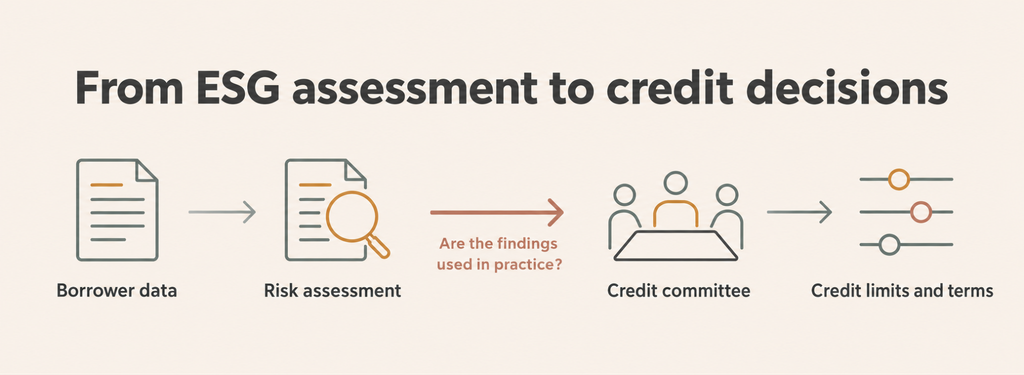
Climate stress testing can help banks assess how different climate scenarios might affect borrowers’ financial positions and the quality of their loan portfolios. Conducting such an assessment, however, does not necessarily mean that its findings are being used in credit or portfolio decisions.
Lyazzat Kaibaldiyeva pointed to differences in banking practice. Some banks already conduct their own climate stress tests, while others still rely mainly on qualitative descriptions of climate risks and their potential consequences. One of the main challenges is moving from identifying risks to estimating their financial impact.
Sector-level data can reveal broader trends and potentially vulnerable segments of a loan portfolio. Assessing an individual borrower requires a more detailed understanding of its business activities, financial position and exposure to relevant risks.
The time horizon presents an additional difficulty. Climate scenarios may extend ten, twenty or thirty years into the future, or even longer, which differs considerably from the periods used in many routine financial and credit assessments. Working with such scenarios requires appropriate methodologies, reliable data and a clear understanding of the assumptions underlying the calculations.
The objective is not simply to incorporate climate stress-test results into another model. Banks need to determine where and how climate risks should be considered within existing processes, including borrower assessments, limit setting, sector concentration analysis and credit portfolio management.
Altyn Bank’s experience illustrates the practical challenges of integrating ESG into lending. According to Kalizhan Kaliyev, ESG factors had not yet been incorporated into the bank’s credit scoring system at the time of the discussion. The team was working to embed them in internal policies and procedures.
For banks at a similar stage, reviewing the existing credit process may be a useful starting point. What ESG information is requested from borrowers? Who assesses which risks are material? How are the findings presented to the credit committee, and under what circumstances could they influence a lending decision?
Answering these questions can reveal gaps between collecting information, assessing risks and actually using the results in credit decisions.
Starting with a Selected Part of the Loan Portfolio
Banks with limited resources do not necessarily need to introduce new ESG risk assessment procedures across their entire loan portfolio at once. Starting with a smaller group of borrowers can provide an opportunity to test whether the proposed approach works in practice before extending it more widely.
One option is to focus initially on customers operating in sectors with greater exposure to environmental, social or governance risks. Another is to begin with large corporate borrowers, for which more information may be available, including public disclosures and ESG ratings. However, the availability of such information does not guarantee that it is complete, reliable or suitable for credit analysis.
A pilot involving a selected group of customers can help establish whether the available information is sufficient to assess material risks, whether the review process is clear and whether the findings are taken into account when lending decisions are made. It can also reveal how effectively the bank communicates its ESG requirements to borrowers.
The priority should not be to assess every possible ESG indicator from the outset, but to identify the factors that are genuinely material to each business. Particular attention should be paid to risks that could affect cash flow, financial stability and the borrower’s ability to meet its obligations.
This approach allows the bank to test both the quality of its data and the effectiveness of its procedures before applying them to a wider portfolio.
ESG Data: Ensuring the Figures Can Be Trusted
Reliable ESG reporting depends not only on selecting appropriate indicators but also on being able to demonstrate where the data comes from and how it has been calculated. These requirements should be considered from the beginning of the data collection process, even where independent assurance is not yet planned.
Lyazzat Kaibaldiyeva described situations in which organisations had published ESG reports for several years but were subsequently unable to substantiate the figures they contained. The problem often stemmed from inadequate documentation and a lack of clear procedures for collecting and recording information.
Energy consumption provides a straightforward example. When reporting how much energy a company uses, it should be possible to identify the underlying data sources, explain how the total was calculated and provide the records supporting the reported figure.
Poor data quality can have consequences beyond the credibility of the report itself. If emissions figures are inaccurate, a company may establish reduction targets against an incorrect baseline and subsequently misjudge the progress it has made.
Organisations therefore need to establish reliable data sources, clear calculation methods and appropriate supporting documentation at an early stage. Doing so reduces the risk of having to revise published information, reassess performance or reconsider targets later.
ESG Needs Authority and a Clear Connection to Business Strategy
The effectiveness of an ESG function depends on more than its position in the organisational structure. Senior management support, appropriate authority and the ability to participate in business decisions are equally important.
At Altyn Bank, the ESG department is overseen by a Deputy Chairman of the Management Board. Kalizhan Kaliyev argued that ESG should have a direct connection to senior leadership because its responsibilities extend into strategy and business management. However, this does not necessarily require a separate ESG committee, as relevant matters can also be addressed through existing governance bodies.
At Air Astana, the sustainability function reports to the company’s chief executive. Yulia Lim considers this arrangement appropriate for her organisation but emphasised that there is no universal model. The most suitable structure depends on the industry, the organisation’s maturity and the environment in which it operates.
Participants also offered different perspectives on how sustainability should be reflected in corporate strategy. Kalizhan Kaliyev favoured integrating sustainability principles into the overall business strategy, while Yulia Lim described Air Astana’s separate sustainability strategy, which requires regular review and updating.
These approaches are not necessarily incompatible. An organisation may maintain a dedicated sustainability strategy while incorporating its objectives into broader business planning. Lyazzat Kaibaldiyeva stressed that the essential requirement is a clear connection between ESG, business strategy, risk management and corporate governance.
Ultimately, the choice of organisational model matters less than whether the ESG function has the authority and influence to shape business decisions and ensure that sustainability objectives remain aligned with commercial priorities.
Five Questions Finance Leaders Should Ask
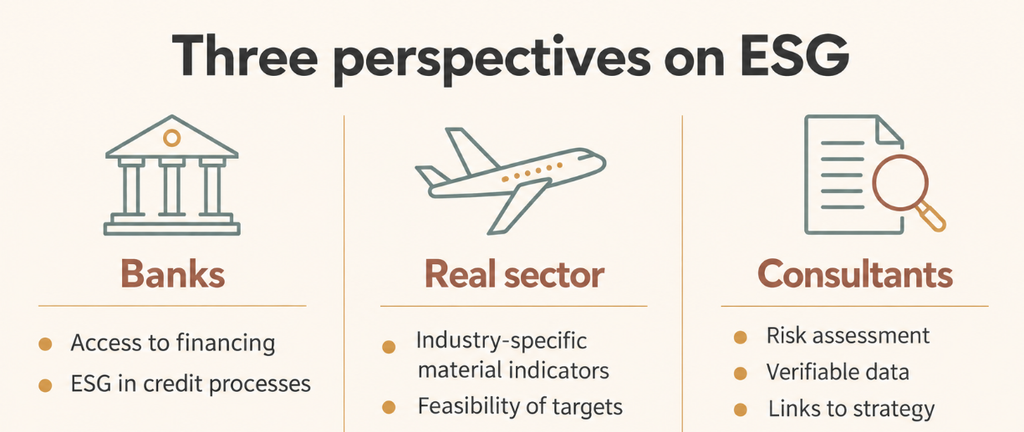
The experiences shared during the roundtable suggest five questions that can help finance leaders assess how effectively ESG is integrated into financial management and decision-making.
- Financing: Which sustainable finance instruments are available to the bank or company, and what are their terms, costs and additional obligations?
- Credit decisions: Are identified ESG risks considered when assessing borrowers and making lending decisions, or do the findings remain confined to reports?
- Priorities: Has the organisation identified the ESG risks that could materially affect financial performance? Could it begin by assessing those risks in a selected part of the loan portfolio?
- Data: Are the sources of key ESG indicators known, are the calculation methods clear, and can the reported figures be verified?
- Accountability: Who is responsible for incorporating ESG factors into risk management, financial planning and strategic decisions?
A useful starting point is to consider what would happen if one of the bank’s ESG indicators changed significantly. Would that change any management decision? If not, it is worth examining what purpose the indicator serves and whether it is genuinely material to the business.
The discussion suggests that ESG maturity should not be judged primarily by the number of indicators disclosed or the existence of a standalone sustainability strategy. What matters more is whether the bank can use ESG information to assess risks, allocate resources and make financial decisions.
For finance leaders, the challenge is to move beyond meeting ESG reporting requirements and make sustainability considerations a meaningful part of how the business is managed.
Editorial Note
This article was prepared by the B2B Events editorial team following a roundtable discussion at the Eurasian Financial Management Forum 2026. The analysis and conclusions reflect our interpretation of the discussion and do not necessarily represent the views of individual participants or their organisations.
AI tools were used to assist with analysing the discussion materials, structuring the information and preparing the article. The final text underwent editorial review, and the B2B Events editorial team takes responsibility for its content and publication.

Financial Planning in Banking: From Forecasts to Decisions
An updated forecast tells a bank what to expect, but not necessarily what to do next. Drawing on a discussion among banking finance and risk leaders, we explore when budgets and strategies need revisiting, how to translate risks into financial consequences and what it takes to make timely decisions, particularly during a crisis.