









Internal Communication as a Driver of Team Performance

Internal communication has a direct impact on how effectively people work together. When communication is clear, employees understand the company’s priorities, coordinate their efforts and take greater ownership of results. When it breaks down, the consequences are visible in wasted time, duplicated work, workplace conflict, lower engagement and higher staff turnover.
Aigul Sandalova, a business trainer and organisational development expert, shares practical guidance on building a workplace in which employees understand one another, communicate with confidence and work effectively towards common goals.
Business Communication Is More Than Sharing Information
The word communication comes from the Latin communicatio, meaning “a message” or “transmission”. In practical terms, communication is the process through which people exchange information and create shared understanding.
In the workplace, that exchange includes more than facts. People also communicate ideas, intentions, expectations and emotions. Effective business communication helps colleagues understand one another, coordinate their actions and focus their efforts on the company’s objectives.
This requires more than listening to the words being spoken. It means paying attention to what the other person is actually trying to communicate.
Teams achieve results through coordinated effort. Even a relatively small misunderstanding can be expensive. An unclear assignment may lead to repeated discussions, duplicated work, missed deadlines or conflict between colleagues. Clear communication reduces this friction before it begins.
Emotional Awareness Shapes Every Conversation
Non-verbal signals play a significant role in communication. Posture, gestures, facial expressions and tone of voice can reinforce a message, weaken it or change its meaning entirely.
An emotion is the body’s response to an internal or external stimulus. Emotions bring tone and meaning to our interactions. They arise whether we want them to or not, which is why learning to recognise and manage them is so important.
The first step is to acknowledge what you are feeling. Awareness of your own emotional state makes it easier to communicate honestly, remain professional and understand how your behaviour may affect others.
Emotions can change throughout the day, although one general state often remains dominant. Consider which of the following best describes how you have felt today:
😔 Sad, lonely or low
😟 Anxious, frightened or worried
😊 Happy, energetic or inspired
😠 Angry, frustrated or outraged
😳 Guilty, embarrassed or hurt
Think about what triggered that state. Was it a particular event, a conversation, another person or something else? You may have been carrying the same feelings for several days. Try to identify what they are connected to.
A short review at the end of each day can help.
Were you motivated and productive? Did conversations go smoothly? Were you able to reach agreement with others and feel positive for most of the day? Write down what contributed to that result. Over time, you can develop your own formula for a productive day and learn how to return to that state even when the morning has not gone well.
If the day felt largely negative, ask yourself honestly why. Was your mood shaped entirely by external circumstances, or did your own actions contribute? Could your behaviour have affected the atmosphere around you? Consider what can be changed and what action you can take.
Some situations cannot be changed. In those cases, the challenge is to accept what has happened and avoid exhausting yourself over circumstances outside your control.
Emotional self-regulation is an essential capability for managers and employees alike. Emotions influence the quality of decisions, the atmosphere within a team and the results people produce. Greater emotional awareness helps employees remain constructive and professional, even under pressure.
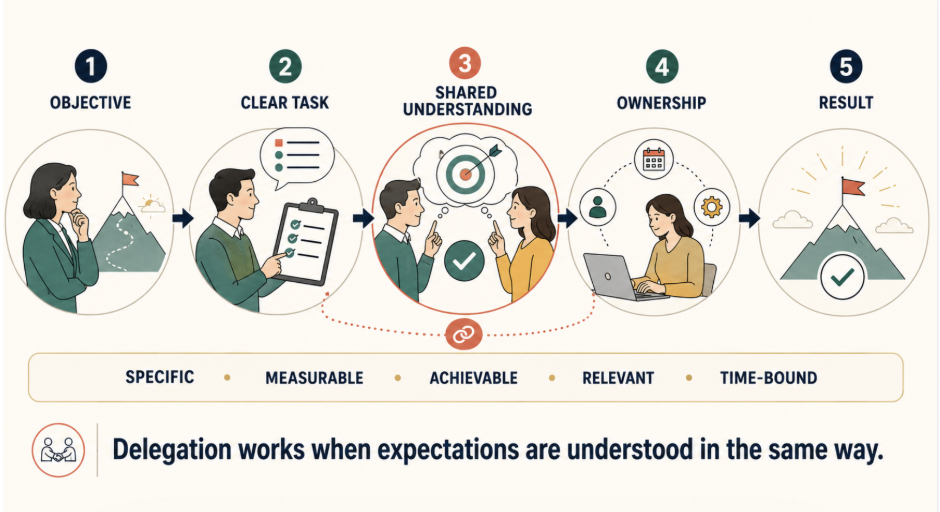
Clear Communication Makes Delegation Work
Communication with employees includes training, onboarding, feedback, business objectives and many other aspects of engagement and performance. Delegation is one of its most important tests.
A task has been communicated successfully only when the employee understands the expected outcome in the same way as the person assigning it. The SMART framework, widely used for goal-setting, offers a useful structure for delegation.
Specific: Describe the task clearly enough to remove ambiguity. Understanding the task yourself does not mean that you have explained it clearly to someone else. If employees regularly misunderstand your instructions, the wording may need to be more precise.
Measurable: Define what the completed result should look like and how it will be assessed. The employee needs to understand the criteria by which the work will be judged.
Achievable: Make sure the employee has the skills, authority, time and resources needed to complete the task. Assigning responsibility without providing the means to deliver creates frustration rather than accountability.
Relevant: Explain why the task matters and how it contributes to a wider objective. Managers and employees may interpret the same assignment differently because they have different levels of experience and access to information. Ask the employee to confirm their understanding. It is much easier to clarify expectations at the beginning than to correct the consequences later.
Time-bound: Agree on the final deadline and, where appropriate, set review points along the way. Interim milestones are especially important when several people are working on the same project. They allow problems to be identified while there is still time to adjust.
Monitoring progress should not become micromanagement. Employees need clarity about the expected result, but they should usually be trusted to choose how to achieve it.
Clear task-setting is the foundation of effective delegation. When managers explain the objective, define the required outcome and agree on timing, employees can approach the work with greater confidence. Good communication removes uncertainty and strengthens accountability.
Delegation also depends on the manager’s ability to understand how another person is likely to respond, create a motivating environment and evaluate the outcome fairly.
Recognition matters as well. Genuine praise for work done well builds confidence and creates positive associations with the workplace. Over time, this can strengthen both engagement and performance.

Communicating Effectively with Management
The ability to maintain a constructive dialogue with management, present an idea and support a position with evidence can have a direct impact on career development.
What you say matters, but so do the timing, tone and context. The following principles can help build professional relationships in which your contribution is heard and valued.
- Keep your commitments. Honour agreements and be reliable and consistent. Your manager should be confident that you will complete the work properly and within the agreed timeframe.
- Communicate proactively. Show initiative and take responsibility. When raising a problem, suggest possible solutions. Provide timely updates on progress, risks and results. Ask questions when receiving an assignment and clarify anything that could affect delivery. If you cannot complete the task as requested, or disagree with the proposed conditions, explain your reasoning. Honest communication builds trust and reduces misunderstanding.
- Be open to feedback. Treat constructive criticism as an opportunity to improve, not as a personal attack. The ability to listen is a sign of professional maturity. It is also useful to understand and adapt to your manager’s communication and management style.
- Maintain self-respect. If criticism becomes unconstructive, calmly bring the discussion back to the facts and the issue at hand. Defend your position respectfully and confidently without allowing unnecessary emotion to take over.
- Respect boundaries. Be mindful of your manager’s time, personal space and working rhythm. Choose an appropriate moment for important conversations. Avoid interrupting them with minor issues, and keep written and spoken communication concise and focused.
Trust sits at the heart of effective internal communication. When people know that you keep your word, it becomes easier to reach agreement with managers, colleagues, employees and clients. In professional relationships, trust is one of the most valuable forms of capital.
Telephone Etiquette in the Workplace
A telephone call remains one of the fastest ways to resolve an issue at work. Basic etiquette helps colleagues exchange information quickly and respectfully without wasting time or creating unnecessary misunderstandings.
The way employees handle calls also reflects the company’s wider professional culture.
The fundamentals of workplace telephone etiquette include:
- Greeting and introduction. Greet the other person, then state your name and role. This saves time and establishes a professional tone. Avoid opening only with “Hello?” or “Speaking”.
- Preparation. Have the necessary information, documents and note-taking materials ready so that the other person is not left waiting. If you are making the call, be clear about its purpose and prepare for the subject in advance. Respect the other person’s time as well as your own. Get to the point promptly. If the issue is complex, it may be more effective to arrange a meeting.
- Timing. Avoid work calls outside normal working hours unless the matter is genuinely urgent. Respect for personal boundaries helps reduce stress and supports employee engagement and loyalty.
- Closing the call. Summarise the discussion and confirm any actions, responsibilities or deadlines before ending the conversation. The caller would normally take the lead in closing the call, although both parties should say goodbye politely. If the conversation has become too long or unproductive, it is acceptable to apologise and explain that you need to attend to another urgent matter.
Even without seeing the other person, it is usually obvious when someone is not paying attention. During a business call, avoid:
- eating, drinking or chewing;
- doing unrelated work, typing continuously or talking to nearby colleagues;
- failing to return a call after promising to do so;
- using work phones for personal calls;
- speaking too loudly or behaving rudely.
Internal communication is not a soft issue that sits outside business performance. It affects the speed of execution, the quality of decisions, employee engagement and the level of trust across the organisation. Companies that communicate clearly spend less time correcting misunderstandings and more time moving work forward.
Leave a positive mark on the people you meet. You cannot control how others behave, but you can always choose how you behave.

How Corporate Governance Failures Create the Conditions for Fraud
Corporate fraud is usually blamed on the individuals involved. But there is another question worth asking: which management decisions allowed the misconduct to begin, spread and remain undetected? Drawing on two anonymised cases, Elina Moshkovich shows how conflicts of interest, poorly designed KPIs and weak control functions can turn isolated abuse into a systemic business risk.

How to Combine TRIZ and Artificial Intelligence
Artificial intelligence can produce dozens of possible solutions in minutes, but speed says little about their quality or practical value. This article examines how TRIZ can bring structure to AI-assisted problem-solving, help companies find technologies beyond their own industry, protect sensitive information and recognise when a system has reached the limits of optimisation.