




Computer Vision in Manufacturing: Applications, Costs and Return on Investment

Even when every component on a production line is inspected, defects can still go unnoticed. Repetitive tasks lead to fatigue, attention declines, and inspectors may interpret quality standards differently. For manufacturers, the consequences include rework, product returns and the cost of handling customer complaints. In some cases, undetected defects can also result in equipment damage.
Computer vision can automate certain visual inspection tasks by analysing product images and identifying predefined defects or deviations. More affordable cameras, on-site data processing and pre-trained AI models are making the technology increasingly accessible. But before investing in a system, manufacturers need to establish which problem it will solve and what costs it could realistically reduce.
Anastasiia Glebova specialises in applying artificial intelligence and computer vision in manufacturing. Her experience includes working with major industrial companies in Finland and delivering projects for international clients, including those in the United States. Her approach starts with a clearly defined business problem: what needs to be detected, what is the cost of a missed defect, and why is computer vision the right technology for the task?
Where Manual Quality Inspection Reaches Its Limits
Three main factors are driving manufacturers’ interest in computer vision. The first is high volumes of repetitive inspection tasks. When checking large quantities of similar products, human inspectors can lose concentration over time. A computer vision system, by contrast, applies the same inspection criteria consistently across shifts.
The second is inconsistent interpretation of quality standards. Consider the inspection of a car’s painted surface. Inspectors may disagree on whether a particular imperfection constitutes a defect, leading to lengthy discussions and delays in releasing the vehicle to the next production stage. A computer vision system can be trained on images that the manufacturer has classified as either defective or acceptable, helping to standardise inspection decisions.
This is particularly valuable when quality assessment relies heavily on employees’ experience. Some defects are difficult to describe precisely in words, and when experienced inspectors leave, their knowledge may be lost. By training models on labelled images, manufacturers can capture some of that expertise and refine the models as quality requirements evolve.
The third factor is the need to inspect every unit produced. Sampling and 100% inspection place very different demands on resources. On one production line manufacturing nuts and bolts for the automotive industry, for example, the inspection process needed to handle 150 components per minute. Computer vision was used to identify surface scratches, dents, cracks and contamination.
However, inspecting every unit does not guarantee that every defect will be detected. Computer vision systems must be configured and validated against actual production conditions and clearly defined acceptance criteria. And while the technology can strengthen quality assurance, it remains one part of a broader quality management approach.
When Computer Vision Is Not the Best Solution
Before investing in computer vision, manufacturers should consider whether the error can be prevented in the first place. For example, redesigning two components so they can only be assembled in the correct way eliminates the possibility of incorrect assembly. This principle is known as error-proofing, or poka-yoke.
Artificial intelligence is not necessarily required for simpler tasks either. Counting boxes as they move along a production line, for instance, can often be handled by conventional sensors — a simpler and more cost-effective solution.
AI-powered computer vision becomes more relevant for complex visual inspections, such as identifying surface defects, assessing multiple characteristics simultaneously or distinguishing between acceptable variations and genuine quality defects.
The business case can be harder to justify in low-volume, high-mix manufacturing. Consider a manufacturer producing 500 electrical cabinets a year across 250 different configurations. Developing and validating a computer vision system becomes more challenging when individual product variants appear only infrequently.
That does not mean computer vision is unsuitable for low-volume production. If a single undetected defect carries significant financial consequences, automated inspection may still be justified. The decision ultimately depends on comparing the total cost of implementation with the savings the system can realistically deliver.
Assessing the Business Case for Computer Vision
A useful starting point is to compare the cost of manual inspection with that of an automated computer vision system. This calculation is relatively straightforward when employees are dedicated exclusively to visual inspection and production volumes are sufficiently high.
However, inspection costs are only part of the equation. A more comprehensive business case should also account for the cost of defective products, rework, customer complaints and returns. A paint defect on a vehicle, for example, may result in a product return and substantial logistics costs.
The consequences of a missed defect can sometimes extend to equipment damage. At one bottle recycling facility, six inspectors were responsible for checking materials entering the processing line. Despite these checks, a large metal object went undetected and entered a shredder, causing the breakdown of equipment worth millions of dollars. The company identified the repetitive nature of the inspection work and worker’s fatigue as possible contributing factors.
In the cases discussed, payback periods started at approximately six months. For high-volume operations with dedicated manual inspection teams, payback was often achieved in less than a year. These figures reflect specific applications, however, and should not be treated as a general benchmark or a guaranteed outcome. Each manufacturer needs to build its business case around its own operating costs, implementation requirements and the expected financial benefits of the proposed solution.
Illustrative Business Case: Where the Savings Come From
Consider an illustrative scenario in which a manufacturer currently spends $21,000 per month on quality-related activities and costs. The potential financial benefits of implementing computer vision are estimated based on expected reductions in specific cost categories.
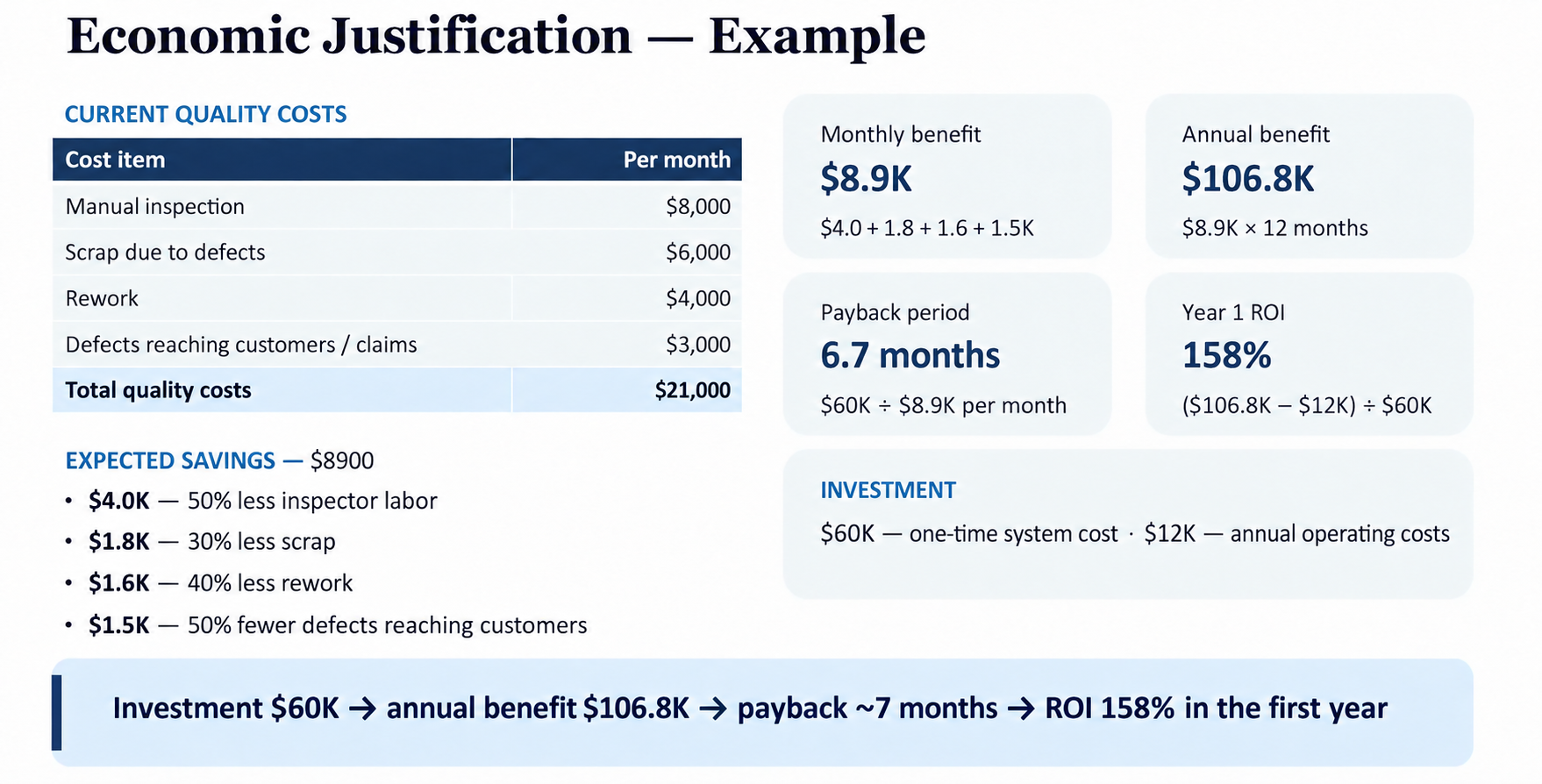
Under these assumptions, the projected annual savings amount to $106,800. The system requires an initial investment of $60,000, with annual operating costs of $12,000.
The metric labelled as first-year ROI in this example is 158%, calculated as ($106,800 − $12,000) / $60,000. This means that the projected annual savings, after operating costs, are equivalent to 158% of the initial investment. It does not mean that the manufacturer would recover its investment and then earn an additional 158% on top of that amount.
These are projected benefits, not results from a completed implementation. The calculation assumes lower manual inspection costs, fewer defects and less rework, as well as a reduction in defective products reaching customers. Achieving these improvements will depend, in part, on maintaining consistent inspection conditions.
Why Image Capture Conditions Matter
A computer vision system has three main components: a camera, a processing unit that analyses the images, and software. The specific hardware configuration depends on the requirements of the production task.
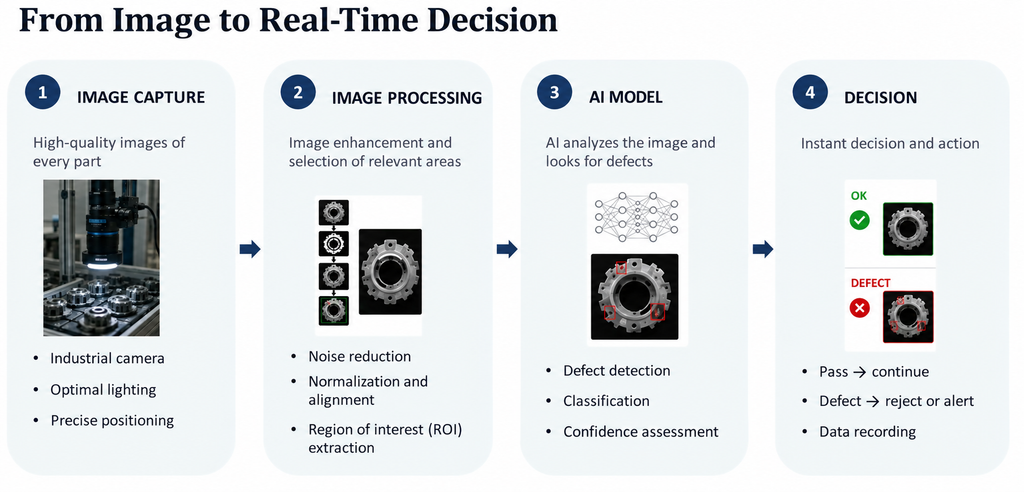
Image processing can take place directly on the production line, without sending data to the cloud. In this configuration, the system can operate without an internet connection.
However, reliable inspection depends on more than the camera and AI model. Consistent lighting and product positioning are essential. Natural light changes throughout the day, making controlled artificial lighting preferable for repeatable image capture. Wherever possible, the distance between the camera and the inspected object should also remain consistent.
AI-based models can often adapt to variations in operating conditions better than traditional rule-based vision systems. Nevertheless, this does not eliminate the need for careful process preparation. The more consistent the image capture conditions, the easier it is to implement the system and achieve reliable results. Testing should take place under actual production conditions, accounting for changes in lighting and other environmental factors.
Some applications also require specialised cameras. In raw material sorting, for example, the type of material cannot always be identified from a conventional image. In such cases, the system’s inspection capabilities depend not only on the software but also on the imaging technology selected.
Detecting a Defect Is Only the First Step
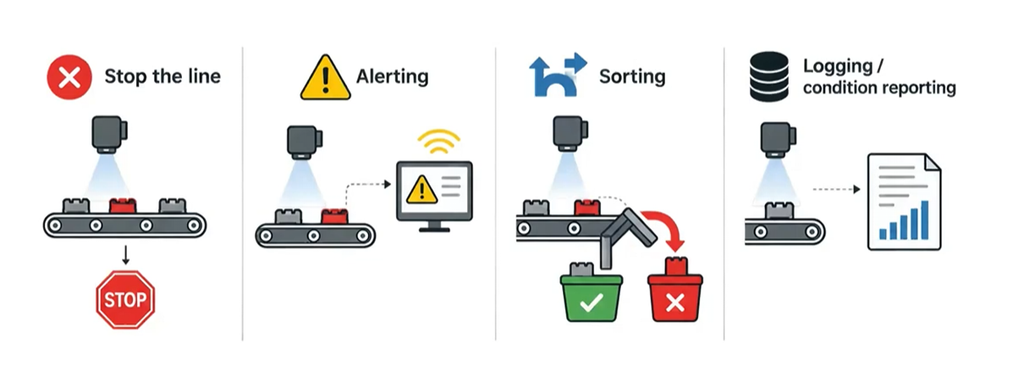
Once an image has been processed, a computer vision system can identify and classify defects and record the inspection results. But manufacturers also need to define what happens next.
Depending on the production process, several responses are possible:
- Stop the production line so an operator can inspect the defect and decide how to proceed.
- Alert a quality inspector to a detected deviation that requires attention.
- Automatically reject or separate defective products from the production flow.
- Generate an inspection report for an individual product to support further assessment or rework.
Fully replacing human inspectors is not always necessary. Computer vision can support their work by highlighting potential defects while leaving the final decision to the inspector.
Another approach is to refer cases to manual inspection when the model’s confidence is too low. For example, a manufacturer might set a rule requiring human review whenever the model’s confidence score falls below 60%. This is an illustrative threshold, not a universal standard for industrial inspection.
In applications with particularly stringent quality requirements, manufacturers may also adopt a more conservative rejection policy. This can mean rejecting some products that are actually acceptable in order to reduce the risk of defective items passing inspection. Such an approach requires a clear process for reviewing and handling rejected products.
From Defect Detection to Defect Prevention
Computer vision can also be used to monitor the tools that manufacture a product, rather than inspecting only the finished product. In one practical example, a system monitored the condition of a tooling insert, with the aim of detecting signs of deterioration and triggering its replacement before it began producing defective parts.
This shifts the focus of inspection. Instead of checking only the finished component, manufacturers can monitor a potential source of defects before those defects occur.
However, detecting defects and identifying their root causes are two distinct tasks. Manufacturers often begin by automating defect detection and then seek to understand why those defects occur. A computer vision system can collect inspection data, including the frequency and types of defects detected. Process improvement teams can then use these insights to investigate underlying causes and identify opportunities to improve production processes.
Starting Small: How to Structure a Computer Vision Pilot
A practical approach is to start with one production line, one product and a clearly defined set of defects. The initial objective is to establish whether the system can reliably detect the relevant deviations and generate an alert. Fully automated sorting or rejection can be considered once these capabilities have been validated.
Implementation challenges often arise when the scope of a project is underestimated or requirements expand during development. Manufacturers may decide to detect additional defect types or introduce more complex inspection rules, increasing the time and resources needed to complete the project.
A structured implementation process can help manage these challenges:
- Define the problem. Identify which defects need to be detected, the financial consequences of missing them, and whether the objective is to replace manual inspection or support existing inspectors.
- Assess the technology fit. Determine whether computer vision is the most appropriate solution or whether the problem could be addressed more effectively through product redesign or conventional sensors.
- Keep the pilot focused. Select one production line and product, define the relevant defects and establish what action should follow detection.
- Test and refine the model. Validate performance under actual production conditions and refine the criteria for acceptable variations and defects.
- Plan for scaling. Once the pilot has demonstrated satisfactory results, consider extending the system to other applications while continuing to monitor model performance.
There is no standard implementation timeline. A relatively simple application, such as detecting stains in a laundry facility, may take less than a week to implement. More complex classification and automation requirements can extend development to several weeks or months.
A comprehensive vehicle quality inspection system involving numerous measurements may take around six months to implement. Even after deployment, models may require further adjustments, particularly when quality standards or inspection requirements change.
Who Takes Ownership After Deployment?
A computer vision system needs a designated internal owner responsible for monitoring its performance and ensuring that the model is updated when necessary. In some applications, pre-trained models make it possible to get started without a large proprietary image dataset. More specialised defects, however, may require additional training using relevant examples, including synthetically generated images.
The extent of this work depends on the types of defects and the manufacturer’s acceptance criteria. A pre-trained model does not guarantee a ready-to-use solution for every production environment.
The system must also evolve as quality requirements change. The principle is similar to training a human inspector: when inspection standards are updated, those responsible for applying them need to understand the new criteria.
In practice, ownership may sit within production, process engineering or a technical team responsible for manufacturing processes and technologies. Once the system is operational, its performance needs to be monitored and the model refined when necessary.
Automation also changes the role of employees. Rather than inspecting every component, they may take on other responsibilities and review products flagged by the system as potentially defective. How employees respond to these changes will depend in part on how the manufacturer manages the transition and communicates their evolving responsibilities.
Automated inspection gives manufacturers a more consistent way to identify defects and respond to them. But it also raises a more challenging question: Who is responsible for improving the production process when the system repeatedly detects the same defects?
Editor’s Note
This article was prepared by B2B Events. The analysis and conclusions reflect our interpretation and the speaker’s position and do not necessarily represent the views of individual participants or their organizations.
Artificial intelligence tools were used to analyze the discussion materials, structure the information, and prepare the article. The final text has been edited, and the B2B Events editorial team is responsible for its content and publication.
Cost Allocation Is an Internal Agreement, Not Just a Formula
Why does an economically sound cost allocation model still create friction between departments? Georgy Zemitan argues that allocation is not simply a financial calculation. It is an internal agreement that must balance the interests of business units, service functions and finance.

Cost of Funding: Why a Low Interest Rate Is Not Enough
Keeping Projects on Track as Funding Costs Rise When borrowing becomes more expensive and a company cannot pass the additional costs on to customers, declining margins can threaten projects that are already under way. Finance teams need to reconsider not only the cost of raising funds but also the combination of funding sources they use. […]