






Cost Allocation Is an Internal Agreement, Not Just a Formula

Why do cost allocation rules continue to cause disputes even when the calculations appear sound?
Indirect costs affect finance, business units and support functions in different ways. Each party has its own priorities and its own view of what constitutes a fair result. Georgy Zemitan, a cost management consultant, explains why cost allocation should be treated not only as a financial methodology, but also as an internal agreement that establishes clear rules for everyone involved.
Why Cost Allocation Creates Friction
Every cost allocation model affects several groups at once.
The functions where costs originate want the cost of their services to be distributed fairly among internal users. At the same time, they may be reluctant to invest significant time in developing the methodology. Profit Centers have a natural interest in limiting the costs allocated to them because those costs reduce their reported results. The methodology owner, usually the finance function, is responsible for keeping the model objective and management reporting reliable.
The issue is therefore larger than finding the right formula. One question cannot be answered by mathematics alone: which rules will the people affected by them consider fair?
That is why allocation needs to work as an internal agreement. When participants have different objectives, the methodology must reflect decisions that the organization has discussed, understood and accepted.
Why one cost can have several valid allocation drivers
A common misconception is that every cost has one economically correct allocation base.
In practice, several answers may be defensible.
The cost of an IT system, for example, could be allocated according to the number of logins, data requests, reports generated, licenses assigned or active users. The company could also use an expert estimate from the IT function. Each driver may reasonably reflect resource consumption, but each will produce a different result.
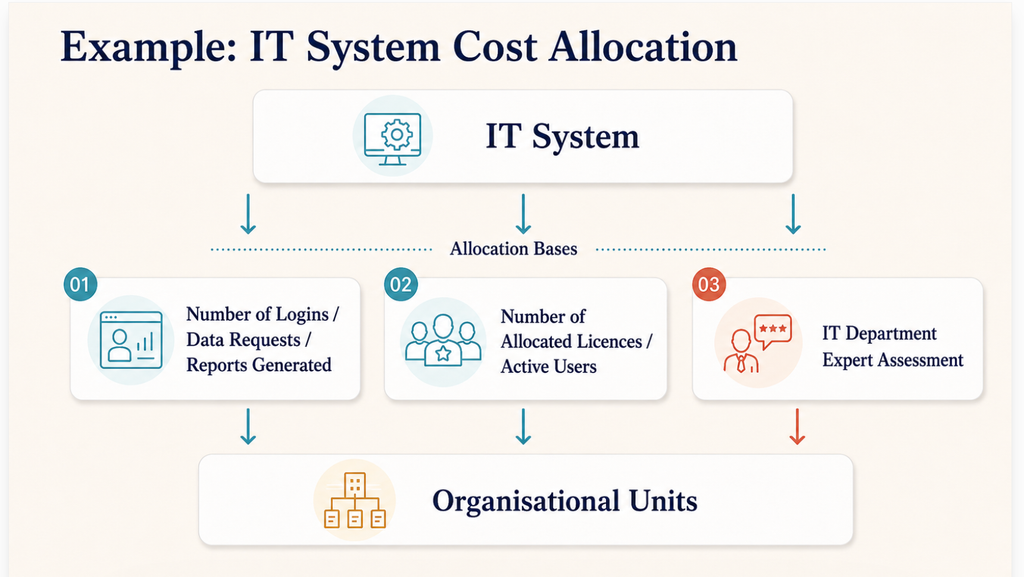
The choice depends on more than economic logic. The company also needs to consider whether the required data exist, whether they can be produced regularly at the right level of detail, how much work is involved and whether greater precision is worth the additional cost.
Sometimes the necessary information is simply not captured by existing systems. In other cases, collecting it would require far more effort than the resulting improvement in accuracy could justify.
The selected driver therefore forms part of the company’s internal agreement on cost allocation. The aim is not to find a theoretically perfect measure. It is to choose one that provides a sensible balance between accuracy, transparency and the cost of maintaining the model.
Finance Owns More Than the Calculation
If cost allocation is viewed purely as a calculation exercise, the role of finance appears relatively narrow: select the allocation bases and configure the algorithms.
In reality, developing the methodology involves several different disciplines.
The economic component identifies credible bases for allocating costs. The mathematical component ensures that the full amount moves correctly from its source to the final recipients. The technology component determines whether the calculations can be automated and completed within an acceptable timeframe.
Even when all three are in place, one part of the job remains: governance.
Finance has to balance competing interests and secure agreement on a common methodology. This makes it the owner of the model, responsible not only for the accuracy of the calculations, but also for whether the methodology can function across the organization.
How to Make the Methodology Work in Practice
A documented cost allocation methodology is not necessarily an accepted one.
Finance must design both the model and the process through which allocation decisions are made.
First, it needs enough authority to act as a credible arbiter and make final decisions on the approaches used. Without that authority, the methodology may be reopened whenever an individual department dislikes the outcome.
Second, senior management should support the methodology from the outset. The organization also needs a clear route for resolving disagreements. When decision rights and escalation procedures are unclear, even relatively minor questions can delay the process.
The incentive system requires particular care. If allocated indirect costs directly affect business leaders’ bonuses, discussions about drivers and allocation bases will inevitably become more contentious.
Where possible, uncontrollable indirect costs should be excluded from incentive calculations. If that is not feasible, bonuses should reflect only those costs whose consumption the manager can genuinely influence and whose allocation driver is clear enough to withstand challenge.
Cost Allocation and Incentives: What Can a Manager Actually Control?
A manager’s incentive compensation should be affected only by the cost of activities whose consumption falls within that manager’s control.
Otherwise, the manager is being held accountable for expenses they have no practical ability to change.
Indirect costs and corporate overhead can still be allocated to calculate the full cost of a product or business unit. But full-cost analysis and performance evaluation serve different purposes. The same figures should not automatically be used for both.
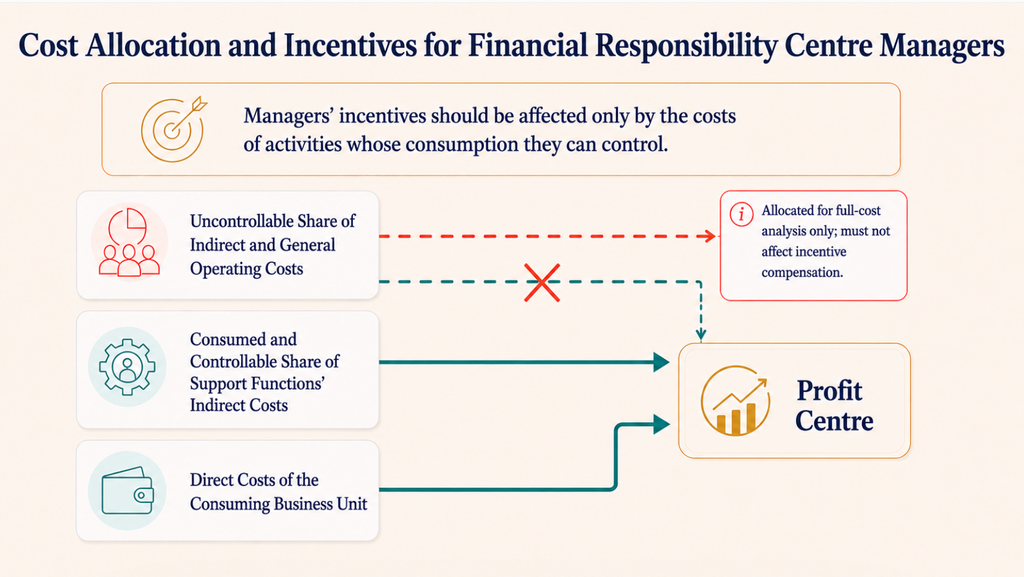
This distinction does not weaken the allocation model. It makes the model more useful by separating two questions: what does the activity cost the company, and which part of that cost can the individual manager influence?
Why Cost Allocation Methodology Needs Regular Review
Even a well-designed allocation model will eventually become outdated.
Organizational structures change. New departments appear, existing teams take on different responsibilities and the cost objects receiving allocations evolve. Once the methodology is in use, participants will also identify gaps and suggest improvements.
The model therefore needs regular review, but not every type of change should follow the same process.
Changes to the organizational structure or departmental responsibilities can be incorporated at the same frequency as the allocation calculation. Finance can manage these updates with input from the functions where costs originate and notify the affected Profit Centers.
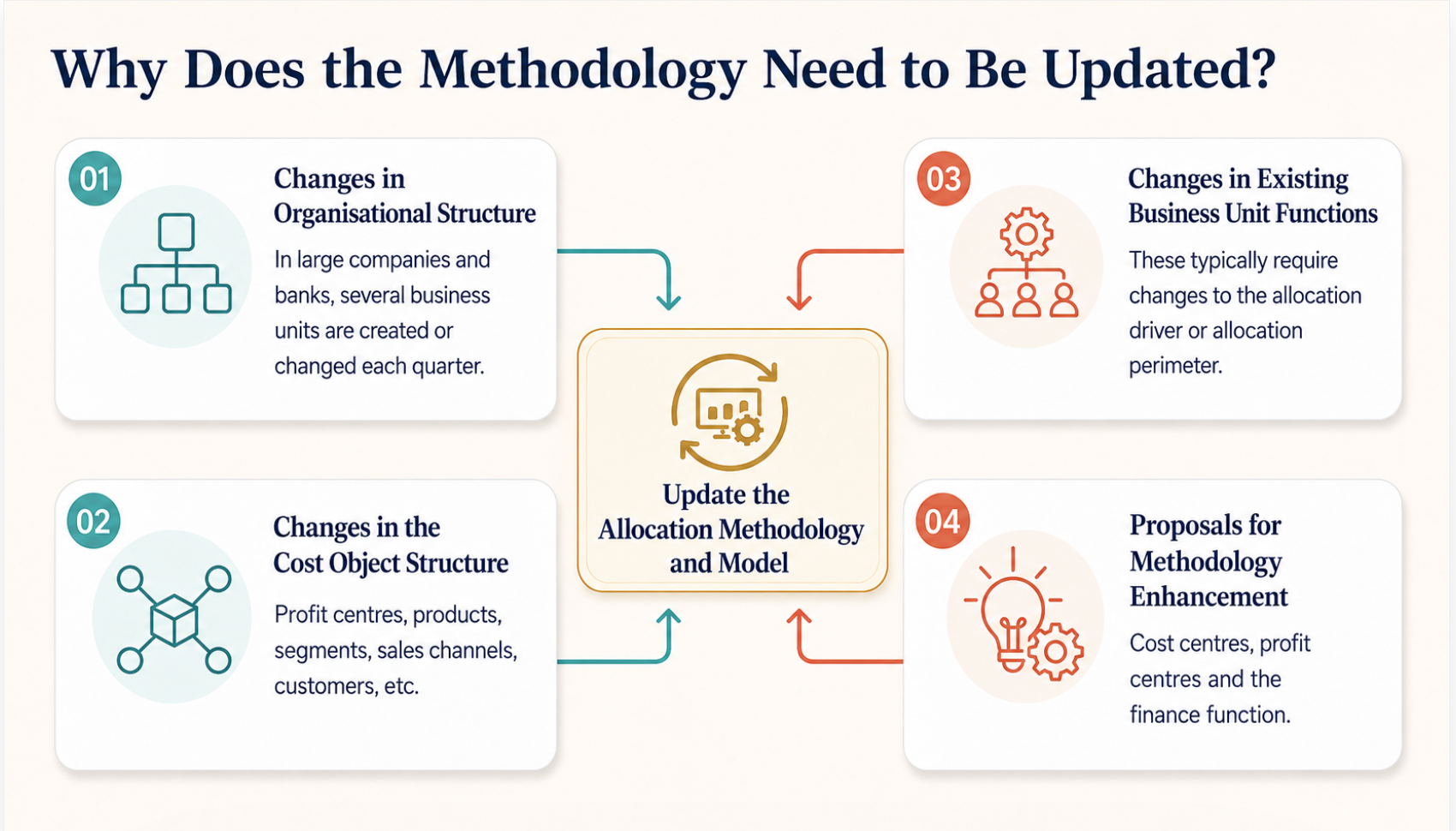
Changes to recipient cost objects are better aligned with the budgeting cycle. Broader proposals to revise the methodology can be reviewed separately, preferably once a year. This avoids constant changes to the rules while ensuring that unresolved issues do not accumulate indefinitely.
An allocation committee can provide a formal forum for these decisions.
The committee should include a finance representative accountable for the outcome, representatives of Profit Centers authorized to agree allocation rules, representatives of the functions where costs originate and an IT representative who can assess whether proposed changes are feasible given the available data and system capabilities.
Questions to Ask When Reviewing Cost Allocation
Finance can begin a practical review of the methodology with six questions:
- Does the company have one established process for resolving disputed allocation issues, or does every change lead to lengthy negotiations?
- Were the allocation bases selected because they reflect economic logic, or mainly because the data were easy to obtain?
- Is the work required to collect each driver proportionate to the improvement in accuracy?
- Do allocated costs affect the bonuses of managers who cannot control the underlying level of consumption?
- When was the methodology last reviewed, and does it reflect changes in the organizational structure, departmental responsibilities and recipient cost objects?
- Is there a formal forum for reviewing these questions, or are they addressed only when a new conflict arises?
The answers show whether the company has only a calculation model or a workable governance process around it.
Searching for a single correct cost allocation methodology is often the wrong objective. Several approaches may be economically valid. The real test is whether the company can agree on rules that people understand, that can be applied consistently and that preserve confidence in management reporting.

ESG in Banking: Connecting Finance, Risk and Business Decisions
ESG can open up new funding opportunities, but it does not automatically mean cheaper finance. For banks, the bigger question is how environmental, social and governance factors affect risk and portfolio decisions. We explore why reporting alone is not enough, where banks can start integrating ESG into credit processes, and how better data can support business strategy.

Computer Vision in Manufacturing: Applications, Costs and Return on Investment
Computer vision enables manufacturers to inspect products against consistent quality standards, but its financial impact depends on the application and production environment. We explore the costs to consider, how to assess return on investment and why the first pilot should focus on a single production line. We also examine where automation can support human inspectors and which questions remain unanswered, even when the financial projections look promising.