






AI in the Finance Function: Faster Doesn’t Always Mean Cheaper
AI has reduced a calculation that once took a full day to just a few minutes. Is that enough to call the implementation a success? For a CFO, the answer is not so straightforward. Faster processes still need to deliver tangible business value, and the results need to be verified.
Where does AI genuinely help finance teams? Why does it not always deliver the expected cost savings? And which decisions should remain in human hands? These were among the questions explored during the panel discussion, The Role of Finance Teams in an Era of Rapid AI Development, at the Financial Management Forum.
The discussion brought together Madina Ayukhanova, CFO of EA Group Holding; Sabigat Rakhmetov, Chief Financial Officer and Management Board Member at Kcell; Bauyrzhan Kosbasarov, Management Board Member and CFO of Freedom Life Kazakhstan; and Viktor Shpringel, Deputy Chairman of the Management Board at Asman Bank, Kyrgyzstan.
What lessons can be drawn from their experiences, and what should finance teams consider when introducing AI into their operations?
Why AI Implementation Does Not Always Deliver Cost Savings
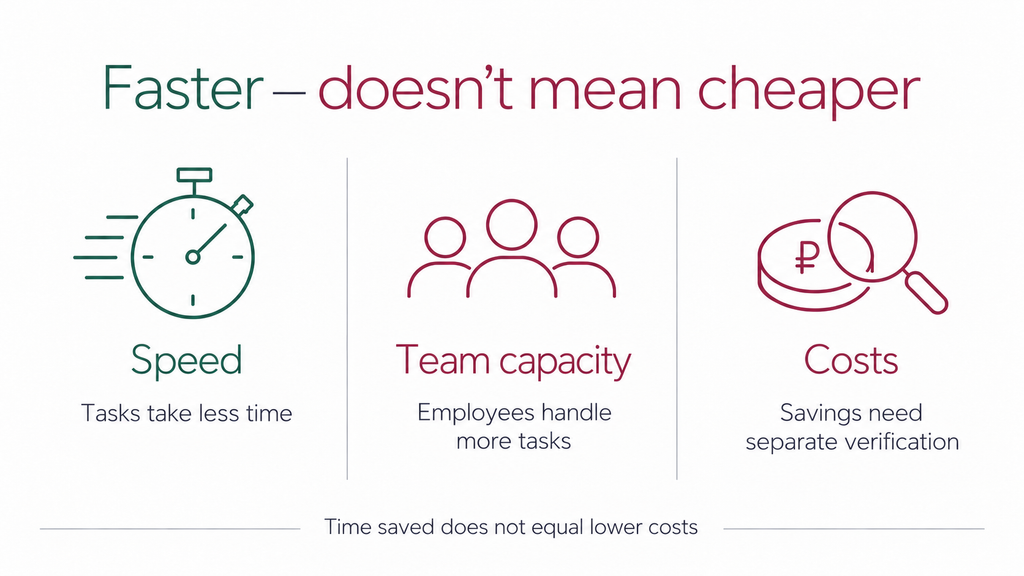
Reducing the time required to complete a task does not necessarily translate into lower costs. Kcell’s experience illustrates why it is important to distinguish between operational improvements and measurable financial benefits when evaluating investments in AI.
The company introduced AI agents to handle customer enquiries. An agent identifies the nature of a request, accesses the relevant internal system and generates a response based on the information retrieved.
Another AI agent helps employees navigate internal corporate policies and procedures. Rather than searching through documents or asking colleagues for guidance, employees can use the system to find out how materials should be approved and what steps they need to follow.
However, improvements in individual processes did not lead to the anticipated reduction in headcount. Moreover, developing new products required the company to commit additional resources.
AI therefore helped simplify certain operations and reduce the time spent on routine tasks, but it did not automatically reduce costs. Employees can redirect the time saved towards other responsibilities, while the development of new business areas may require further investment.
For CFOs, the distinction between three outcomes is particularly important: faster processes, higher team productivity and actual cost reductions. These outcomes are related, but they are not interchangeable.
To assess the impact of implementation, organisations need to establish baseline performance metrics before introducing AI and compare them with the results achieved afterwards. Beyond processing time, relevant measures may include the volume of tasks completed, error rates, cost per transaction and the additional expense of maintaining the solution.
This approach helps finance teams evaluate not only whether AI has improved a process, but also whether those improvements have delivered meaningful operational and financial benefits.
Where to Start with AI in the Finance Function
When selecting processes for AI implementation, organisations need to consider not only how labour-intensive they are, but also how readily the results can be measured. The most obvious candidates are time-consuming, repetitive tasks where the impact of automation can be assessed.
At EA Group Holding, one such process was the scoring of investment projects. Previously, a small venture investment team carried out these assessments manually, spending considerable time evaluating potential investments. According to the company, introducing technology-based solutions helped accelerate the process and improve the quality of its work.
For investment teams, however, it is important to distinguish between two outcomes: reducing the time needed to assess projects and improving the quality of the assessments themselves. The first can be measured immediately after implementation, while demonstrating the second requires additional evaluation criteria.
At Freedom Life, the impact of automation was particularly striking. According to the company, calculating reserves for a single insurance product previously took approximately 20–25 hours. After implementing a Python-based solution integrated with an AI agent, the calculation time fell to around 15 minutes.
Automating routine tasks enabled employees to work on several products simultaneously, obtain the necessary figures more quickly and use them to support operational and strategic decision-making. However, at the time of the discussion, the company had not yet completed its assessment of the actuarial team’s future resource requirements.
Both examples demonstrate that the benefits of AI implementation extend beyond reducing the time required to complete individual tasks. For EA Group Holding, the priorities are the speed and quality of investment project assessments. For Freedom Life, they include faster calculations and greater capacity within the actuarial team.
To assess the overall impact, however, organisations still need to establish how these improvements affect employee productivity, the quality of outputs and the company’s operating costs.
Data Quality: What Remains the Finance Team’s Responsibility
Automation does not remove the finance team’s responsibility for the quality of input data or the reliability of the results. AI can take over some of the routine work involved in collecting and processing information, but finance professionals still need to understand which data is being used, how reliable it is and whether the resulting calculations and conclusions can be trusted.
Errors can arise not only from the underlying data, but also from AI-generated outputs. One example discussed during the panel involved a report prepared with AI that cited legislation which was no longer in force. Although the document appeared convincing, it contained errors that only someone with the relevant professional expertise would have been able to identify.
This example illustrates why the time required to verify AI-generated outputs must be included when assessing efficiency gains. If a tool produces a document in minutes but a specialist then spends considerable time checking and correcting errors, the actual time savings may be significantly smaller than anticipated.
For finance teams, this points to a gradual shift in the nature of their work. As routine activities become increasingly automated, greater importance is placed on the ability to define tasks clearly, assess the quality of input data, validate results and determine whether those results are reliable enough to inform business decisions.
Which Decisions Can Be Delegated to AI?
Delegating a task to AI should not mean removing accountability for the process. It is important to establish from the outset what the system can do independently, where human review is required and who has the authority to make the final decision.
One practical approach is to divide tasks into three categories:
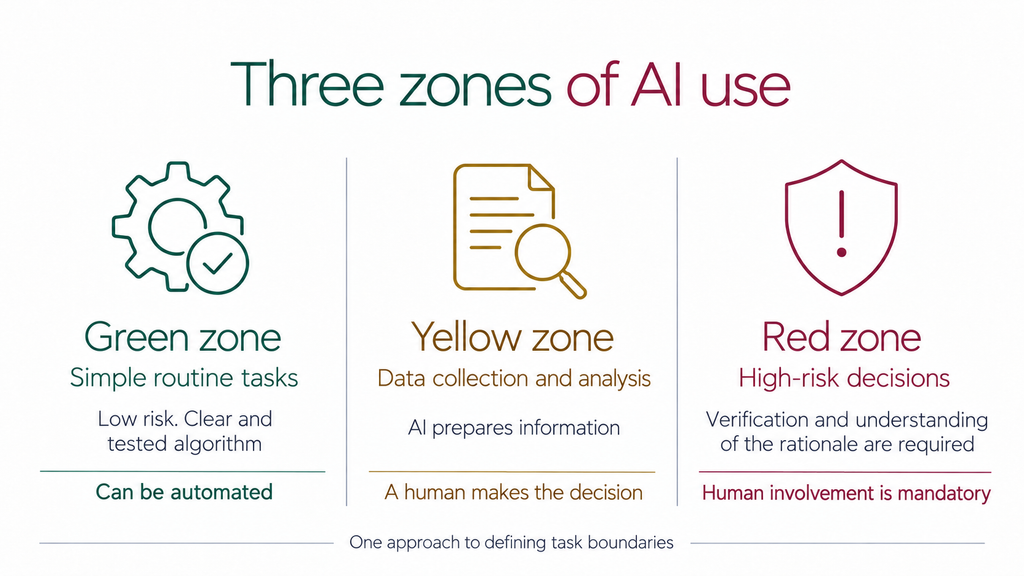
This framework provides a starting point for discussing individual AI projects. It helps define the limits of the system’s autonomy and identify where human oversight is needed.
These boundaries are particularly important in the finance function, where a calculation or recommendation may inform decisions with consequences extending far beyond the individual task.
Handling Confidential Data
The approach to AI implementation depends on the type of information the system will process. This is particularly important for finance teams, which routinely work with internal documents, financial data and customer information.
At Freedom Life, AI agents are deployed within the company’s internal IT environment. The approach described involves microservices designed for specific tasks, solution testing and information security measures.
Kcell also began deploying AI solutions internally after employees started using publicly available AI tools. For its legal department, the company implemented a solution based on DeepSeek, giving it access to internal documents and corporate policies.
The experiences of both companies demonstrate that choosing an AI solution involves more than selecting the technology itself. Organisations must also consider how data access is managed and how the system’s performance is tested and validated. Deploying AI within a company’s internal infrastructure is one element of this approach, not a guarantee of security in itself.
Finance Professionals Are Becoming Active Participants in Automation
The experiences shared during the discussion suggest that finance professionals can do more than use ready-made AI solutions. They can also take an active role in developing tools to automate their own work.
At Freedom Life, employees initially became familiar with the technology through everyday use of ChatGPT. Over time, they began experimenting with writing code and building AI agents. This hands-on experience helps them better understand what automation can achieve, define requirements for new solutions and collaborate more effectively with developers.
Kcell also encourages employees to explore vibe coding — using AI to generate software code from natural-language instructions. Finance professionals who understand their own workflows can identify tasks that could be simplified and experiment with building small tools to automate them.
However, understanding a financial process and being able to build a functioning tool do not necessarily guarantee the accuracy of its outputs. This is particularly important for applications involving calculations, financial reporting and analysis.
Building a working prototype is only part of the process. Before introducing a tool into routine financial operations, organisations need to validate its calculations, establish procedures for updating it and assign responsibility for ongoing maintenance. These safeguards are especially important when the outputs affect financial reporting or management decisions.
As a result, alongside data literacy, AI skills and the ability to develop simple tools, finance professionals increasingly need the judgement to critically evaluate automated outputs.
For finance leaders, the challenge is not simply to develop their teams’ digital capabilities. It is also to establish clear rules for using internally developed solutions: who validates the calculations, who authorises a tool’s integration into existing workflows and who is responsible for maintaining it over time.
What to Assess Before Launching an AI Project
Before investing in AI, finance teams need to establish what the business expects to achieve and how the success of implementation will be measured. This means addressing several key questions:
- Which process are we looking to improve, and what metrics will we use to measure success?
- What is the total cost of implementing, integrating, maintaining and overseeing the solution?
- What data will the system use, and who is responsible for its quality?
- At which stages is human review required, and who is accountable for the final outcome?
- How will employees use the time freed up by automation, and what value will this create for the business?
For CFOs, the fundamental question is not how many tasks AI has automated, but what value that automation has created for the business. Faster processes and reduced workloads matter, but neither automatically translates into cost savings. The financial impact must be assessed in the context of implementation and ongoing maintenance costs, changes in team productivity and the quality of decision-making.
The role of the finance function is not only to evaluate the return on investment in AI, but also to ensure appropriate oversight of how the technology is used across business processes and how it influences decisions.
Editorial Note
This article was prepared by the B2B Events editorial team following a roundtable discussion at the Eurasian Financial Management Forum 2026. The analysis and conclusions reflect our interpretation of the discussion and do not necessarily represent the views of individual participants or their organisations.
AI tools were used to help analyse the discussion materials, organise the content and prepare the article. The final version was reviewed by our editorial team, which takes full responsibility for the published content.

Social Engineering Instead of Hacking: How Banking Fraud Is Evolving
Banks are strengthening security across their digital channels, yet fraudsters are increasingly targeting customers rather than banking systems. Drawing on insights from Gökhan Dumrul, Head of Fraud Risk Management at QNB Türkiye, we examine how fraud schemes are evolving, why traditional transaction monitoring is no longer enough, and how banks can strengthen security without compromising the customer experience.

Financial Planning in Banking: From Forecasts to Decisions
An updated forecast tells a bank what to expect, but not necessarily what to do next. Drawing on a discussion among banking finance and risk leaders, we explore when budgets and strategies need revisiting, how to translate risks into financial consequences and what it takes to make timely decisions, particularly during a crisis.