





CLTV in Banking: Linking Customer Behaviour to Profitability

Banks are good at measuring what has already happened. Financial reporting shows how much they have earned, which products generated the profit and which lines made the largest contribution. Finance teams have a well-established toolkit for answering these questions.
The harder question is what will drive tomorrow’s results.
Markets are moving quickly, and so is customer behaviour. Forecasts built around aggregated figures can therefore take a bank only so far. Even a carefully prepared budget may not explain which customers, products and patterns of behaviour will ultimately generate future profit.
Customer Lifetime Value, or CLTV, offers another perspective. It estimates the value a customer is likely to create over the course of their relationship with the bank. Rimma Patakhova, Chief Financial Officer of Bereke Bank, shared how the bank uses CLTV alongside the P&L, rather than treating it as a substitute.
P&L and CLTV answer different questions
There is little value in setting these two tools against each other. A P&L statement provides a reliable view of financial performance that has already been achieved. It allows the bank to assess the profitability of a product, portfolio or individual income stream, and to understand what produced the reported result.
CLTV changes the unit of analysis. Instead of looking primarily at a product, it looks at the customer and the full relationship they have with the bank: the products they use, the transactions they make, the income they generate, the cost of acquiring them and the length of time they are likely to remain active.
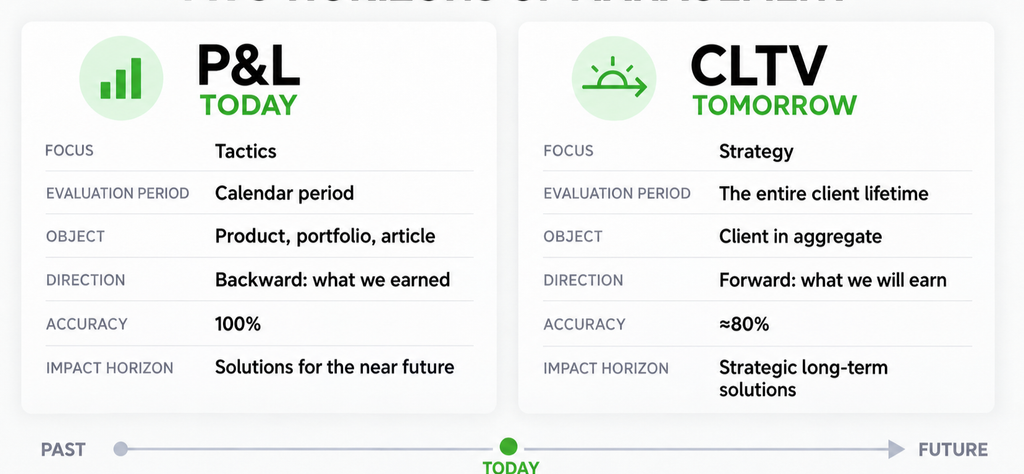
The two tools also support decisions over different time horizons. P&L analysis is largely concerned with the economics of the business today. CLTV is more useful when management wants to understand the longer-term consequences of decisions being made now.
That does not mean simply moving familiar financial indicators from the product level to the customer level. If analysis still depends on averages across the entire customer base or a broad segment, many of the most important behavioural differences remain hidden.
Why the “average customer” rarely helps with real decisions
Average transaction values, balances, revenues and fees all have a place in management reporting. They become less useful when the bank needs to decide which customers to acquire, who should receive the next product offer and where the retention budget is best spent.
Bereke Bank reached a straightforward conclusion: for practical decision-making, there is no such thing as an average customer. The mass-market segment demonstrates this particularly clearly.
Viewed as a single population, the segment follows a familiar pattern. The share of active customers gradually falls over time. But once the same customers are separated according to the products they use, that single curve breaks into several very different ones.
The bank examined three groups:
- Customers with both a deposit and a card
- Customers with a deposit only
- Customers with a card only
Activity declined at different rates across the three groups. Their economics also differed. They maintained different balances, held different proportions of non-interest-bearing funds, generated different levels of foreign-exchange income and showed different potential for credit cross-selling.
In management reporting, they had all appeared to belong to one mass-market segment. Economically, they represented several distinct types of business.
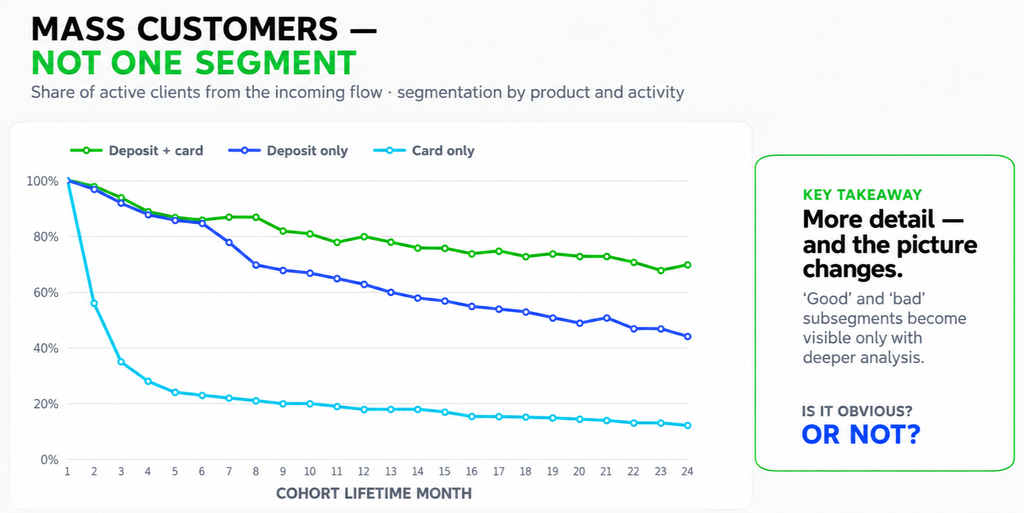
CLTV helps the bank move from an averaged view of its customer base to a more precise assessment of individual groups. It can better understand which customers are truly valuable, which behaviours drive their profitability and which segments should receive resources.
Calculating CLTV: the formula is easier than the inputs
The model itself rests on a handful of familiar components: income generated by the customer, the expected duration of the relationship, the discounted value of future cash flows and customer acquisition cost, or CAC.
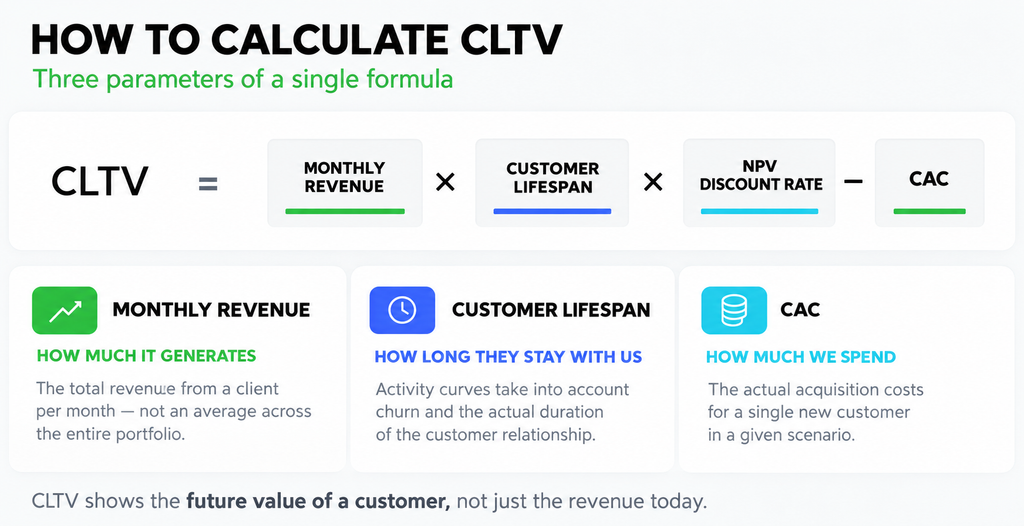
The difficulty lies less in the formula than in defining credible inputs.
The first question is how much the customer actually contributes to the bank.
Finance teams are relatively well placed to answer this because most customer activity leaves a record in the bank’s systems. Income can be assembled across lending, customer funds, foreign-exchange transactions, cards, payments, transfers and loyalty programmes.
The second question is how long the customer is likely to remain active.
A basic estimate can be derived from churn. If churn is 20 per cent, for example, a customer lifespan of roughly five years may be used as an initial assumption. A more revealing approach is to examine individual cohorts: when customers joined and how their behaviour changed after one month, three months, six months and beyond.
The third question is how much the bank spent to acquire the customer.
This part is more difficult. Revenue can usually be connected to an individual customer more readily than many operating costs. Bereke Bank is still refining the way it allocates costs at customer level. For now, CAC is used primarily to measure acquisition expenditure, while the methodology for assigning the full cost of servicing each customer continues to be developed.
Why it makes little sense to wait for perfect data
Bereke Bank did not postpone its CLTV work until every possible data point was available. Where the available information was sufficient to support a decision, the team began using it.
The bank identified six categories covering roughly 80 per cent of total income:
- Income from loans
- Interest income generated by customer funds
- Foreign-exchange income
- Card-related income and expenses
- Transfers and payments
- Benefits and loyalty programmes
The remaining items may be infrequent, irregular or only loosely connected to customer behaviour. Leaving them out of the first model does not necessarily prevent the bank from seeing the patterns that matter most.
Rather than waiting for an ideal data mart, Bereke Bank set itself the practical target of producing an MVP within three months. Speed mattered particularly in its circumstances. Following a period shaped by sanctions, the bank had effectively been rebuilding parts of its service offering and customer base.
Most of the analysis used data from 2024 and 2025. Two years of history proved sufficient to construct cohort curves, launch a CLTV calculator and begin identifying meaningful differences between customer groups.
Two years of data is not a universal benchmark. The important point is different: even an incomplete history may be enough to start the analysis and make better-informed decisions.
From this point, the value comes less from the volume of accumulated data and more from the depth of analysis. The next step is a more detailed analysis of customer behaviour by transactional scenarios.
Transactional behaviour changes how customers are segmented
The product that first brings a customer into the bank tells only part of the story.
What happens afterwards is usually more informative. Does the customer leave money in the account? Do they exchange currencies, use their card or make international transfers? Do they take another product? How regularly do they transact?
At this level of detail, conventional product segments are gradually supplemented by behavioural microsegments. Two customers may hold the same type of deposit but represent very different economics for the bank.
One may use several services, maintain balances and transact regularly. Another may have joined solely because of an attractive deposit rate and be ready to move as soon as a competitor offers better terms.
The product is the same, but the behaviour is different. It follows that the retention approach should not be identical either.
This also raises a more basic question: what does the bank mean by an active customer? An open contract does not always indicate a genuine relationship. Someone who has made no transactions for a long period and keeps only a nominal balance should not necessarily be counted in the same way as a customer who uses the bank regularly.
When a new product changes more than revenue
The launch of a new foreign-exchange platform offers another useful example.
Its impact would have been difficult to isolate through conventional analysis. Higher foreign-exchange activity might have resulted from the platform, but it might equally have reflected wider market conditions. The bank therefore compared two cohorts of newly acquired customers: those who joined before the launch and those who joined afterwards.
The average deposit size changed very little. The composition of those deposits did change. Among the newer cohort, the proportion of foreign-currency deposits was approximately 1.5 times as high.
Foreign-exchange turnover per customer also increased by a factor of 1.5, while foreign-exchange income rose by a factor of 1.3. The CLTV calculation for customers acquired after the launch showed further differences: fee income was 22 per cent higher, the contribution from customer funding increased by 28 per cent and lending income rose by 5 per cent.
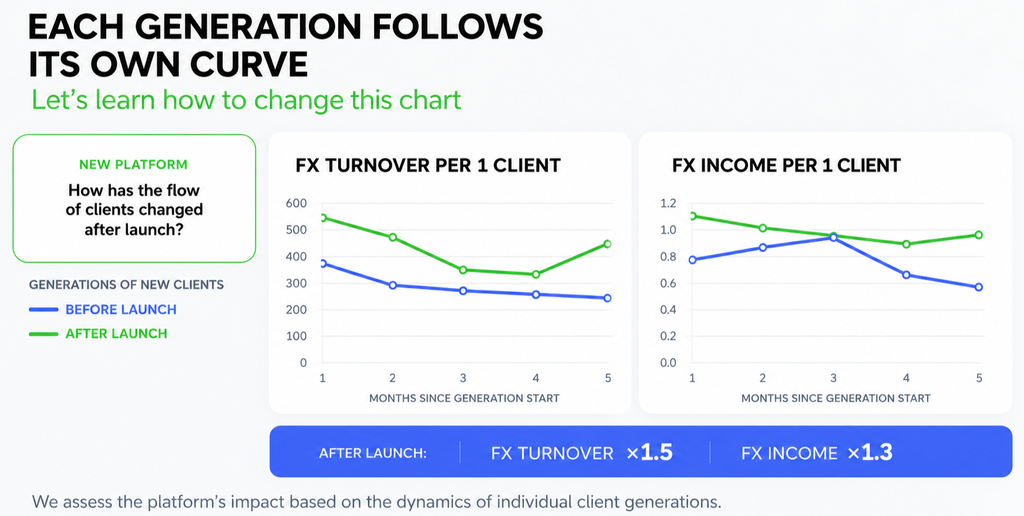
The cohort comparison picked up something that would have disappeared inside an average. After the platform was introduced, the bank began attracting customers with a different financial and transactional profile.
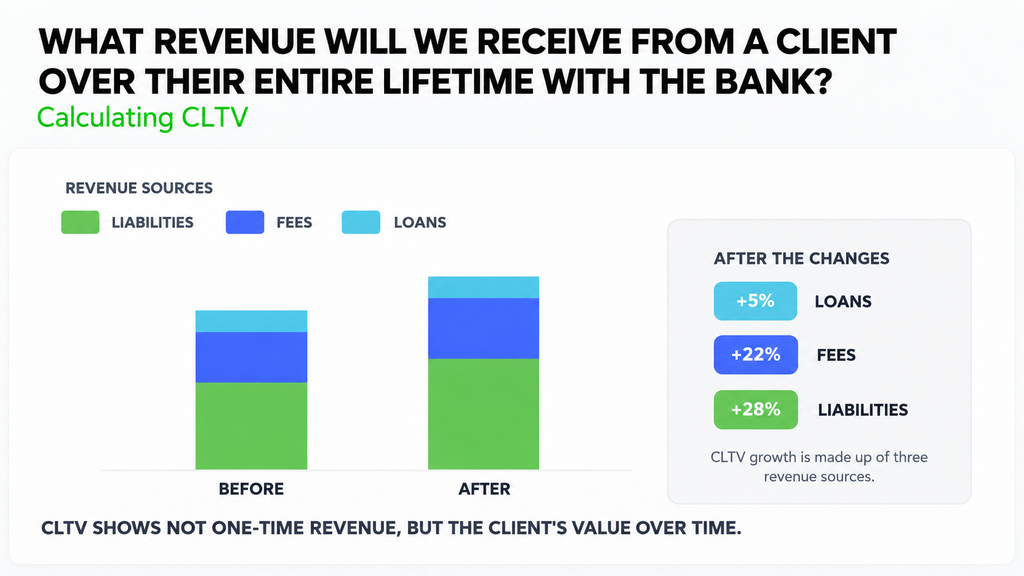
This complicates the usual view of cause and effect. Banks do not merely adapt products to the behaviour of their existing customers. A new product can alter the type of customer the bank attracts and encourage new patterns of behaviour.
How CLTV informs acquisition, retention and cross-selling
Once the differences between customer groups can be seen in financial terms, priorities become easier to set.
In the mass-market example, customers who held both a deposit and a card had the most attractive overall profile. Bereke Bank therefore regards this group as a priority for acquisition and retention.
Customers who hold only a card may be of interest for further relationship development, including through the cross-selling of credit products.
Deposit-only customers require a different assessment. A customer who holds only a deposit, hardly uses any other services and joined solely because of a high deposit rate may require a very different approach to acquisition and retention costs.
This is a more selective approach than sending the same campaign to the entire customer base.
The more precisely the bank can describe a customer profile, the easier it becomes to judge who is likely to need the next product. Offers become more relevant, while the bank can avoid spending resources on communications with groups that are unlikely to deliver the desired result.
The model cannot sit inside finance alone
Bereke Bank’s finance function leads the CLTV work, but the resulting decisions are not made by finance in isolation.
The analysis is discussed with business teams, marketing and, where necessary, IT. Finance can identify changes in the numbers and compare them with product launches or campaigns. Business teams contribute context that may not be visible in the data itself.
This matters particularly in banks organised around individual product lines.
The heads of cards, deposits or acquisition channels may each have their own performance targets. Customers do not experience the bank through that organisational structure. One person may hold a card, deposit and loan while also making transfers and foreign-exchange transactions.
A decision that looks attractive within one product line may not be the best decision for the bank as a whole. CLTV provides a way to bring the discussion back to the total economics of the customer relationship rather than the interests of individual products.
What comes next: microsegments, machine learning and customer experience
As the volume of available data increases, manual analysis inevitably reaches its limits.
Bereke Bank is considering the further development of behavioural microsegments and the use of machine-learning models. The aim of these models is to predict CLTV not only for a group, but also for an individual customer. В русском нет ни longer-term, ни eventually:
The analysis must also become easier for business users to work with. Large spreadsheets may contain the necessary information, but they do not always make it usable. Managers need dashboards, customer-journey funnels and alerts that draw attention to significant changes.
An even more interesting question lies outside the financial model.
A customer may have a high CLTV and still find the bank difficult to deal with. The next step is therefore to compare customer profitability with the actual customer experience and identify which service improvements strengthen the relationship.
The relevant measure is no longer only how much the bank earns from the customer. It is also how sustainable that relationship is for both sides.
What banks can take from this approach
A bank does not need a perfect CLTV model before it can begin. It can start by identifying key customer groups, examining how their behaviour and profitability differ, and connecting those findings with products and acquisition channels.
The results can then be used in decisions about retention, cross-selling and service development. As more data becomes available, the model can be refined.
What matters is that CLTV does not become another analytical report that is produced, presented and then set aside. Its value lies in helping the bank review customer priorities in time and make more precise business decisions.

What Makes a Smart Factory Genuinely Smart?
A factory can install robots, deploy MES and collect real-time data without becoming genuinely smart. Gulshan Kumar of Samsung Electronics India explains where Smart Factory programmes tend to stall and what manufacturers need to move from isolated automation to an integrated production system.

How Banks Manage Liquidity When the Rules Change Every Week
Why does liquidity become a test of governance during prolonged instability? Selcan Özen (FRM), Head of ALM within Market Risk at Yapı Kredi Bank, shows how liquidity flexibility is built before a crisis through procedures, scenarios, escalation rules and the habit of operating as one decision-making system. Her experience also highlights what must change when the external environment moves faster than normal management cycles.