
How do companies achieve tangible efficiency gains without new equipment or large-scale capital investments? What helps them move from individual initiatives to systemic change? These questions are addressed by Oleg Zakharov, Director of Operational Excellence at ERG, who shares hands-on experience of which elements of a production system actually work — and how these approaches […]

In the age of AI and end-to-end automation, banks risk losing a less measurable but critically important source of competitive advantage — trust and the quality of client relationships. How can RFPs be used as a structured signal of future client expectations? Where should the human remain in the process? And how can co-creation be embedded into product development through the H.E.A.R.T. framework?

How can we assess the resilience of CIS economies against a backdrop of global uncertainty without trying to predict the unpredictable? The practical approach is to break external pressure down into three channels—oil, gold, and secondary effects via trading partners—and identify where it is most likely to surface: in the budget, the current account, inflation, or the exchange rate. Using Armenia, Azerbaijan, Kazakhstan, and Uzbekistan as examples, this framework highlights which domestic fault lines amplify or cushion external shocks—and which indicators provide early warning signals of a turning point.

Exchange-rate volatility in Turkey after 2018 has become not an episodic shock but a persistent factor linked to the dynamics of banking margins. Once this relationship is measured and the influence of local and global factors is separated, it becomes a practical tool. The estimated sensitivity of margins to volatility can then be used as a reference parameter for Funds Transfer Pricing (FTP).

Why, in periods of high FX volatility, selecting a hedging instrument is not enough—and how to build a structured FX-risk management system. Which metrics to use for daily monitoring, how to match instruments to specific risk types and liquidity constraints, and what management lessons can be drawn from hedging failures at major banks.

For companies planning production, sourcing, exports, or investment in Turkey in 2025–2026, one question dominates: is the country entering a period of sustainable stabilization, or is the current calm merely temporary? According to Şevin Ekinci, 2026 may provide the answer. She explains which domestic indicators will determine whether the normalization holds, how the global economic environment is shifting, and why two specific risks could quickly reverse the trajectory.

Why the shift to 24/7 and instant settlement breaks not technology first, but the operating model itself: where liquidity actually sits, who has the full picture, how value dates work — and what happens if the payment rails have to be stopped.

Why the “core” of non-maturity deposits cannot be estimated by inertia: sharp rate movements, the growing gap between historical models and current behaviour, and what banks must challenge in their assumptions.

Why ESG has moved beyond reporting and become a question of banks’ resilience: where supervisors will focus on capital, liquidity, and funding — and what this changes for treasury.
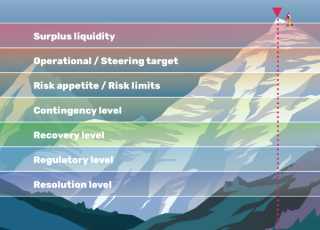
How do you define the “right” level of liquidity when a high ratio alone does not guarantee optimality? We explore a practical framework: separating liquidity into a risk buffer and a managed strategic resource, building a ladder of target levels, and using FTP to keep liquidity within an effective operating corridor.