









Customer Centricity in the Age of Automation: Where Technology Stops Serving the Need

Financial technologies are evolving faster than organisations can redesign the way they interact with clients. As a result, it has become surprisingly easy to win on automation — and quietly lose on something else: the quality of human interaction. Yet it is precisely this interaction that underpins trust and long-term relevance.
Ekaterina Kozhevatova, Head of Centralised Sales at Commerzbank, shared a practical logic for keeping the focus on real client needs when everything pushes organisations to prioritise technology. She explained where to look for signals of future expectations — and how to turn customer centricity from a slogan into an operating mechanism.
Customer Centricity in a Digitised Banking Landscape
The banking industry is being swept by successive waves of new technologies: artificial intelligence, natural language processing (NLP), machine learning, digital assistants and avatars, blockchain and distributed ledger technology (DLT), digital wallets, tokens and currencies, open banking, real-time payments, embedded finance. All of this genuinely expands client capabilities and accelerates processes.
But there is a flip side. The more we automate, the less live interaction remains — and the easier it becomes to lose empathy and genuine relationships with clients. This is what we see as a hidden risk: less human connection leads to less relevance, and ultimately to pressure on profitability.
The point is not to slow down digitalisation or reject technology. Technology and expertise are essential. But the key strategic advantage lies in human interaction. As digital transformation accelerates, the focus on efficiency and automation is natural. What differentiates strong players, however, is not how many processes they have digitised, but how deeply they are able to build and sustain client relationships.
When Innovation Becomes a Product — Not a Solution
To understand why the market does not always reward what is technologically superior, it is worth recalling the story of Segway.
When it launched in 2000, Segway was a high-profile technological breakthrough — a strong engineering solution surrounded by enormous hype. There was no shortage of innovation. Yet the project failed on the human dimension: understanding end users and real-world context.
A few facts illustrate why:
- the product was developed in secrecy, with minimal feedback and no meaningful market testing;
- at launch, it cost around USD 5,000;
- it proved impractical in real use and misaligned with urban infrastructure — too bulky for pavements, too slow for roads, and banned in several cities;
- there was no clear target market: for most people, walking, cycling or public transport were cheaper and more convenient.
The result: twenty years of attempts to “take off” and around 140,000 units sold worldwide.
The lesson is simple: even the most advanced technology does not succeed if it fails to solve a real problem for real people — and if it is not created together with them.
For B2B, this is even more critical. Designing solutions from the inside — starting with architecture, roadmaps and feature sets — can produce an impressive product that simply does not integrate into the client’s daily workflow. In that sense, Segway remains a reminder: technology without context and need does not become a solution.
Where to Find Signals of Future Demand
In our work with large corporate clients, we repeatedly encounter a valuable but often underestimated source of insight: Requests for Proposal (RFPs) and tenders.
Why do we see them as a strong signal?
- large clients typically invest in expertise and external advisors;
- their requirements reflect not only current pain points, but also what they consider important over a multi-year horizon;
- these are already formalised expectations: what must work, which features are critical, and what outcome is expected.
From inside the bank, this creates a rare opportunity to capture real client expectations. Only then does it make sense to engage product and technology teams in a meaningful discussion: can we move in this direction together with the client, how fast, and what needs to change in our approach?
At the same time, we look beyond traditional competitors to fintech players who are not banks in a formal sense, yet increasingly capture parts of the client’s core banking experience. If someone has learned to deliver a critical process faster, simpler and more conveniently, this inevitably reshapes expectations of banks as well.
When Yesterday’s Competitive Advantage Stops Working
Client identification (KYC) is a good example of how the playing field is shifting. For a long time, banks could rely on mature processes, reliability and regulatory compliance as a competitive edge. Today, new players leverage AI and automation in a way that makes speed incomparable.
In practice, the gap can be multiples: KYC at banks often takes days, while digital players complete it in hours — sometimes minutes. Once a client has experienced a five-minute onboarding journey, they will inevitably question why the same process takes days elsewhere.
This is where managing expectations becomes critical — and where the human element of interaction matters most: explaining, guiding and jointly redesigning the process with the client.
Technology at the Centre — or the Client?
The most common managerial imbalance emerges when processes are built around technology, and the client is then expected to adapt.
Technology is comfortable to manage. It is measurable: timelines, budgets, functionality, architecture, digitalisation KPIs. Client needs are harder: they are contextual, diverse and sometimes contradictory. As a result, they are often pushed to the periphery — producing elegant platforms that change little in the daily reality of a treasurer or CFO.
Why Stepping Outside the Standard Playbook Sometimes Matters
A practical example comes from working with an RFP. The request came from a strategically important client and was highly complex from a technology perspective. Given our existing capabilities, we were unlikely to even make the shortlist. The standard response would have been a polite decline or a formal explanation of limitations.
We chose a different path. Instead of saying “no,” we turned the client’s vision into a bank-scale initiative — effectively an innovation and implementation project. The result was the joint creation of a new technological solution.
This helped close part of the innovation gap and, more importantly, built a strategic partnership grounded in human trust.
For us, this became a practical marker: sometimes the only way to remain competitive is to make the client part of the development process. And this becomes far easier when it is treated not as an exception, but as the norm.
H.E.A.R.T.: Turning Clients into Co-Creators
To turn the idea of “client at the centre” into practice, we rely on the H.E.A.R.T. framework — a pragmatic model built around four elements: listening deeply, co-creating, hybrid service models, and feedback.
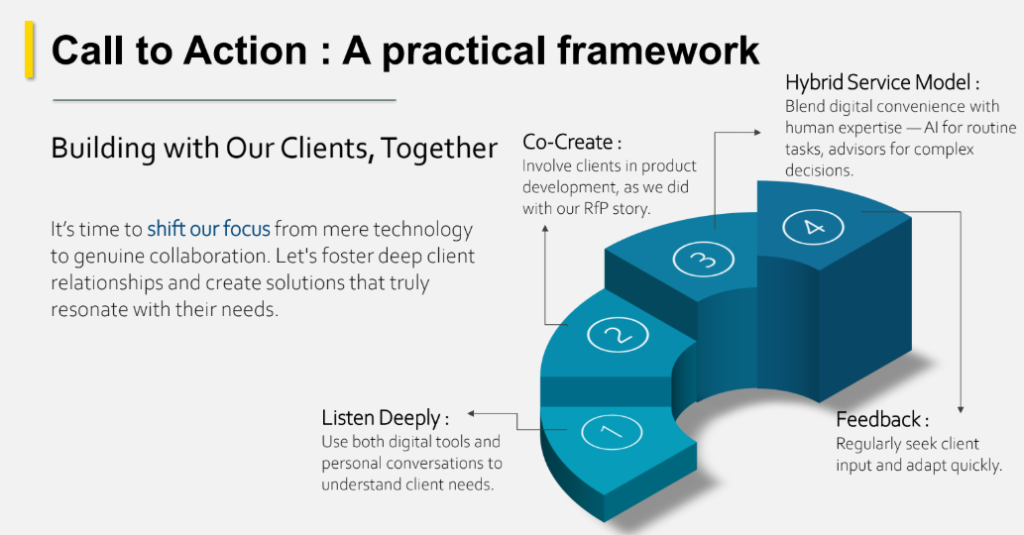
The practical components of the framework:
1) Listen deeply
We combine digital tools with direct conversations to truly understand client needs. Without this, product teams will inevitably optimise what is convenient — not what is necessary.
2) Co-create
Clients are actively involved in development, as in the RFP case described above. Co-creation significantly reduces the risk of a “Segway effect.”
3) Hybrid service model
We blend digital convenience with human expertise: AI for routine tasks, consultants for complex decisions. This allows speed without eroding trust and accountability — precisely where clients expect professional judgement and support.
4) Feedback
We collect client input regularly and adapt quickly. Annual planning cycles no longer hold; continuous recalibration is essential.
Key Takeaways
- Regularly test what truly sits at the centre of your development efforts: technology or the client.
- Treat RFPs and tenders as a structured source of insight into future client expectations.
- Protect trust points from blind automation: if you remove the human from a process, understand in advance what you lose — and how you compensate for it.
- Reduce internal asymmetry of client knowledge so that insights from different teams form a coherent picture.
- Look beyond your traditional competitive set and benchmark against the best client experience in the market.
We do not oppose digitalisation to the human factor. Our point is different: as automation increases, human connection becomes not less — but more important. Because it is human connection that turns technology into a solution, and a solution into sustained value for the client.

Reading CIS Economies in an Era of Uncertainty
How can we assess the resilience of CIS economies against a backdrop of global uncertainty without trying to predict the unpredictable? The practical approach is to break external pressure down into three channels—oil, gold, and secondary effects via trading partners—and identify where it is most likely to surface: in the budget, the current account, inflation, or the exchange rate. Using Armenia, Azerbaijan, Kazakhstan, and Uzbekistan as examples, this framework highlights which domestic fault lines amplify or cushion external shocks—and which indicators provide early warning signals of a turning point.

Three Pillars of Manufacturing Efficiency: What Companies Need for Sustainable Growth
How do companies achieve tangible efficiency gains without new equipment or large-scale capital investments? What helps them move from individual initiatives to systemic change? These questions are addressed by Oleg Zakharov, Director of Operational Excellence at ERG, who shares hands-on experience of which elements of a production system actually work — and how these approaches […]