









Fraud in fintech: the price of convenience

Fraud in fintech tends to grow alongside the convenience of digital services. The easier it is to open an account, pass onboarding and complete a transaction, the more likely it is that the same speed and simplicity will be exploited not only by legitimate customers. It is now easy to win on seamless experience-while quietly losing on resilience, customer trust and the ability to control downside risk.
As Vladimir Brodski, board member and Chief Risk Officer at Vivid Money, explained, fraud has long moved beyond the remit of a single function. For fintech businesses, it is a question of growth, reputation, partner relationships and the quality of managerial decisions. Seen this way, antifraud is not built around a single control, but around the balance between convenience, speed, control and the cost of error.
Fraud is not one problem-but several
A common mistake is to treat fraud as a single category of risk. In reality, it consists of distinct scenarios with different frequencies, loss profiles and consequences for the business.
At a minimum, these include first-party fraud, fraud against customers, acquiring fraud, credit fraud and internal fraud. Some occur frequently but with relatively limited losses. Others are rare, yet capable of triggering severe financial or regulatory consequences.
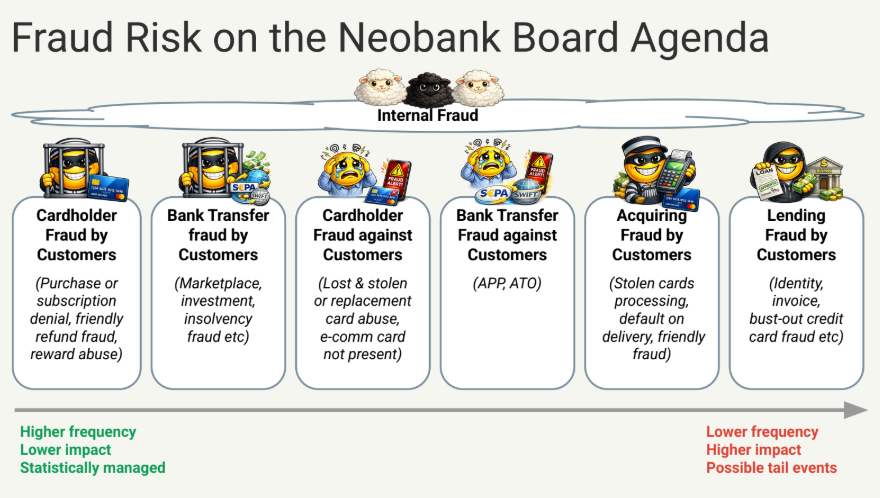
For management, the implication is straightforward: there is no one-size-fits-all approach. In some cases, the priority is to contain direct losses. In others, to preserve customer trust. In a third, to avoid regulatory or partner fallout. Treating all fraud as one category leads to blunt decisions-and weak outcomes.
What the company actually loses
The consequences of fraud fall into four broad categories: loss of customers, loss of capital, loss of partners and, in extreme cases, loss of licence.
Customer loss is particularly acute in fintech. As incidents accumulate, trust erodes. Fewer users open accounts, more leave, and engagement weakens. For growth-driven companies, this is one of the most damaging scenarios.
Capital loss extends well beyond reimbursements. It includes losses on fraudulent lending, investigation costs, additional layers of control, as well as pressure on capital and cost of risk.
Partner loss can be especially painful for smaller firms. If partners conclude that excessive fraud flows through a platform, they may tighten monitoring, restrict operations, increase pricing-or reconsider the relationship altogether.
What the company actually loses
The consequences of fraud fall into four broad categories: loss of customers, loss of capital, loss of partners and, in extreme cases, loss of licence.
Customer loss is particularly acute in fintech. As incidents accumulate, trust erodes. Fewer users open accounts, more leave, and engagement weakens. For growth-driven companies, this is one of the most damaging scenarios.
Capital loss extends well beyond reimbursements. It includes losses on fraudulent lending, investigation costs, additional layers of control, as well as pressure on capital and cost of risk.
Partner loss can be especially painful for smaller firms. If partners conclude that excessive fraud flows through a platform, they may tighten monitoring, restrict operations, increase pricing-or reconsider the relationship altogether.
Loss of licence remains a tail risk, but one that cannot be ignored. Where controls are deemed insufficient, this can result in operational restrictions, additional capital requirements, fines and, in severe cases, licence withdrawal.
The core question: what exactly are you optimising?
Fraud ultimately comes down to trade-offs. Customers expect frictionless onboarding and fast access to services. Yet every additional check, delay or verification step degrades the user journey, reduces conversion and can slow growth.
Acceptable risk, therefore, is not just a security question-it is a business decision. A company that prioritises speed and simplicity inevitably accepts higher embedded fraud risk, along with more complaints, more suspicious activity and greater external scrutiny.
It is not possible to make a product fully frictionless, controls fully strict and losses negligible at the same time. In practice, firms choose a balance. And that balance shifts depending on the company’s maturity, growth model and risk appetite.
Why firms pay-even when the customer is at fault
One of the key insights is this: companies incur losses not only because fraud occurs, but because they cannot demonstrate that they provided adequate protection.
A firm may detect suspicious signals but fail to block an account in time. It may overlook an unusual transaction chain or fail to evidence that the customer was warned, informed and protected. In such cases, liability often remains-at least in part-with the institution.
It is not enough to argue that the customer shared credentials or confirmed a payment. The company must show that reasonable and timely safeguards were in place. Without that, the likelihood of compensation increases materially.
Reputation can outweigh direct losses
Fraud against customers is particularly damaging in fintech-not only because of financial losses, but because of its visibility. Once such cases reach the public domain, they begin to weigh on growth. Customers may reconsider the role of the provider, reduce balances or treat the service as secondary rather than primary.
This creates a difficult trade-off. Overly generous compensation erodes margins. Excessively rigid positions risk reputational damage-and, with it, future revenue. Compensation policy is therefore not purely legal; it is part of broader business logic.
In some cases, preserving trust may cost more than a single payout-but less than prolonged negative coverage, disputes and reputational damage. This is not a universal rule, but a management decision grounded in long-term consequences.
What works in practice
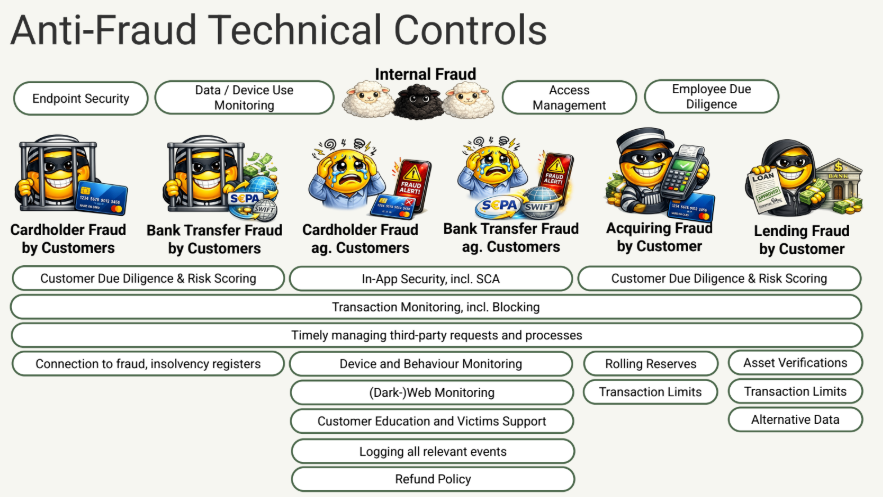
Effective antifraud is not a single control, but a layered system.
1. Entry controls.
Customer verification at onboarding: documents, biometrics, phone, email, device, IP address, behavioural signals and external registries. This also includes identifying remote-access tools and indirect risk indicators.
2. In-product controls.
Authentication for sensitive actions (for example, biometrics on new devices or large transactions), card restrictions, limits and cooling-off periods for changes, as well as the ability to block specific transactions or counterparties.
3. Monitoring.
Not only analysing what has already happened, but identifying issues early-or at least reacting in time. This includes transaction monitoring, behavioural analytics, device intelligence, third-party alerts and integration with fraud and bankruptcy registries.
Equally important is the ability to log all material events. If a firm cannot demonstrate what happened-what warnings were issued and what actions were taken-it weakens its position.
4. Internal fraud controls.
Access management, employee screening, monitoring of data and device usage, as well as endpoint protection. For fast-growing companies, this is particularly sensitive, as rapid hiring and limited resources can quickly create vulnerabilities.
What management needs to see
Fraud cannot be left at the operational level. At executive level, at least five elements must be clear:
- acceptable risk levels;
- governance over new products and changes;
- performance metrics for financial crime processes;
- escalation and reporting mechanisms;
- independent oversight from second and third lines of defence.
In practice, every new product and every material change should be assessed not only through a commercial lens, but also through fraud risk. Without this, companies often discover too late that growth has been built on fragile processes.
Management reporting should include clear indicators: fraud levels and losses relative to thresholds, response times for suspicious accounts, rule performance (e.g. false positives), backlog volumes, major incidents, customer complaints, litigations, and control testing results. This is input for decision-making-not just information.
Risk appetite evolves with maturity
Approaches to fraud evolve as companies mature.
Start-ups typically operate under tight constraints: limited capital, limited experience and loosely formalised processes. Much is built on the go, and a full control framework is often simply unaffordable.
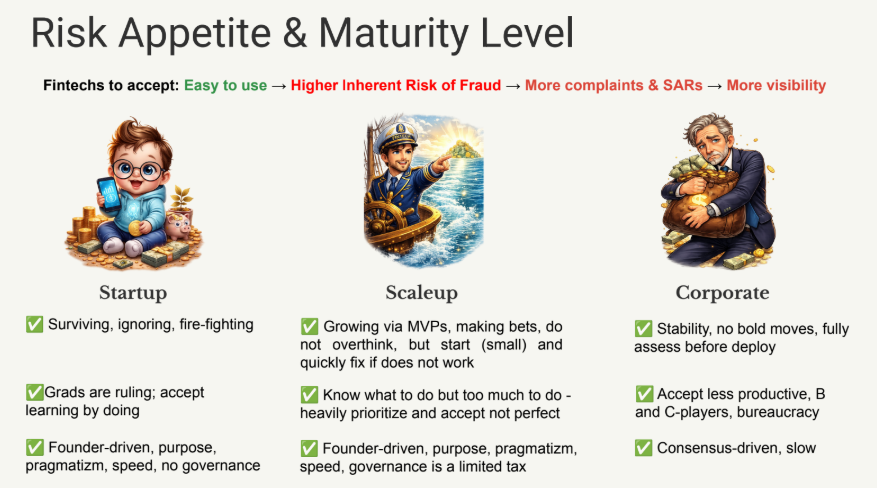
Growth-stage firms take a different approach. They understand what needs to be built, but cannot address everything at once. Prioritisation becomes critical: rapid deployment, continuous adjustment and acceptance that the system is not yet complete.
Mature organisations tend to lower their risk appetite. They prioritise stability, assess changes more rigorously before launch, rely more heavily on governance and procedures, and are generally more conservative. This reduces flexibility-but often improves resilience.
AI in antifraud: useful, but not a silver bullet
Artificial intelligence is not a standalone solution to fraud. Its value emerges where data, processes and clearly defined problems already exist.
In practice, it can support transaction monitoring, identity verification, behavioural analysis, detection of synthetic or forged documents, alert triage, case routing, complaint analysis and pattern recognition. It can also assist in assessing fraud risks in new products and changes.
But implementation should not begin with tools. It should begin with data: ensuring quality, accessibility and the codification of internal expertise. Without that foundation, AI adds complexity rather than control.
Conclusion
Fraud in fintech is not a narrow security issue. It is a question of business model design, management quality and organisational maturity.
The objective is not to eliminate risk entirely. It is to understand which losses are critical, where acceptable boundaries lie, which controls genuinely protect the business-and which simply add friction.
Approached in this way, antifraud ceases to be a supporting function. It becomes part of control, resilience and long-term growth.

Bank Cost Allocation: Five Methodology Questions That Shape Profitability
Which costs genuinely belong to the bank as a whole? Should branch idle time be charged to products? And what changes when Treasury or the problem asset management unit is treated as a Profit Center rather than a Cost Center? Georgy Zemitan examines five methodology choices that shape cost allocation and profitability analysis in banking.

Risk Management as Part of Decision-Making
Policies, risk registers and risk committees do not necessarily mean that a company is managing risk. The system begins to add value when it helps to take better decision before a mistake becomes irreversible. This article looks at how to connect risk with business objectives, involve the risk function earlier and turn indicators into management action.