






The True Cost of Funding: Funds Transfer Pricing in Banking: Managing Funding Costs and Product Profitability

How Funds Transfer Pricing can help banks establish the true cost of funding, clarify risk ownership and make better-informed decisions about product profitability.
A bank can report attractive margins at the product level while overlooking the true cost of the funding behind them. When Treasury and business units work with different assumptions, profitability becomes difficult to measure, risks are inconsistently allocated and pricing decisions can become a source of internal conflict.
Funds Transfer Pricing (FTP) provides a framework for addressing these challenges. By establishing a consistent internal price for funding, banks can distinguish between the financial contribution of individual business units and the costs and risks managed centrally.
At the Eurasian Financial Management Forum in Almaty, Julia Valentini, CFO of Eskhata Bank in Tajikistan, explained how the bank redesigned its FTP framework to strengthen financial transparency, improve risk allocation and support more informed business decisions.
The experience is particularly relevant for banks operating in markets where reliable yield curves, liquid money markets and established pricing benchmarks cannot always be taken for granted.
When Business and Treasury Disagree on Profitability
Consider a familiar scenario. A business unit identifies a market opportunity, develops a new lending product and presents a compelling financial case at a strategy meeting. The projected margins look attractive. Yet when the actual profit and loss figures become available, the product falls short of expectations.
Different interpretations quickly emerge. Retail Banking argues that Treasury’s internal funding rates are eroding its margins. Corporate Banking points to the low-cost current account balances it attracts and expects cheaper funding in return. Treasury, meanwhile, maintains that every funding source carries a cost determined by market conditions and the bank’s liquidity position.
Each function may have a defensible view of the economics. But without a common methodology, the bank still struggles to answer two fundamental questions: Is the product genuinely profitable? And who is accountable for each component of its financial performance?
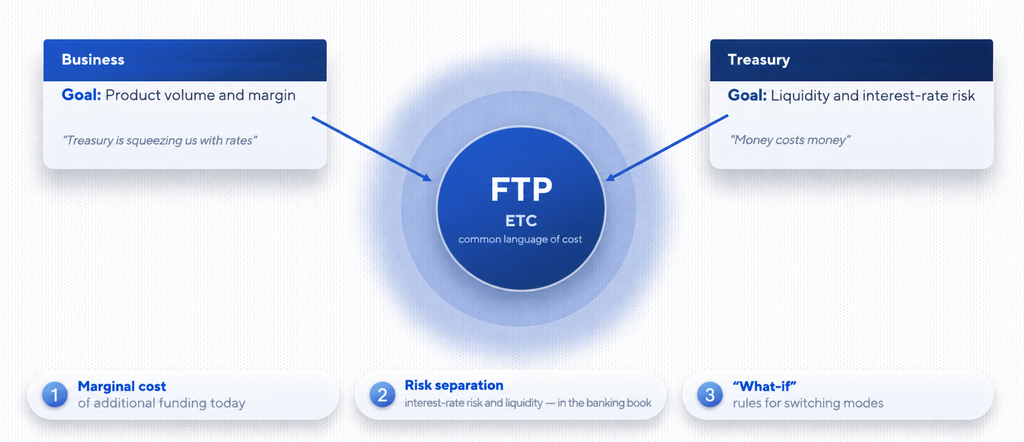
At Eskhata Bank, redesigning FTP became a way to establish that common framework. Consistent transfer rates allow the bank to assess internal funding costs using shared principles and allocate net interest income across the relevant centres of responsibility.
The Internal Bank: Creating a Common Framework for Funding Costs
At the heart of Eskhata Bank’s FTP framework is a centralised funding function, referred to as the internal bank. Business units that attract funds transfer them into a central internal funding pool. Units that deploy funds obtain financing through the same mechanism. These internal transactions are priced using a consistent set of Funds Transfer Pricing rates.
The framework reallocates net interest income across business units, making the contribution of different activities and funding sources more transparent.
At Eskhata Bank, any financial result remaining within the internal bank is deliberately not redistributed to business lines. Instead, it serves as a diagnostic indicator: the larger the residual result, the stronger the case for reviewing how the transfer rates have been calibrated.
Equally important is the allocation of risk responsibilities. Under the FTP framework, responsibility for managing interest rate and liquidity risks is assigned to the internal bank, while business units remain accountable for credit, operational and legal risks.
This separation creates clearer accountability. Business units can be evaluated on the risks and commercial decisions within their control, rather than on changes in funding conditions managed centrally.
Pricing Today’s Funding Rather Than Yesterday’s
One of the most important methodological decisions was to base transfer rates on the current cost of market-sensitive funding sources, including interbank borrowing, term deposits, long-term funding and bond issuance. The objective is to approximate the bank’s current marginal cost of funding rather than rely on the historical average cost of its liabilities. The underlying question is straightforward: What would it cost the bank to raise one additional somoni or dollar today?
The average cost of the existing funding portfolio cannot fully answer that question. It reflects decisions made in the past. When market rates decline, the average cost of liabilities may remain elevated because the portfolio still contains funding raised at higher rates. Lending businesses may consequently struggle to reduce their prices and risk losing customers to competitors. Pricing based on current funding conditions provides a more timely market signal.
Another principle is equally important: the transfer rate is established when a transaction is originated and remains fixed unless the relevant transaction parameters change.
This allows the economics of a transaction to be assessed against the funding conditions prevailing at the time of origination, rather than being continuously distorted by changes in the historical cost of the bank’s liability portfolio.
What Determines the Funds Transfer Price?
At Eskhata Bank, the FTP rate consists of four components, each serving a distinct purpose.
1. Base rate – a market benchmark reflecting the relevant currency and maturity.
2. Liquidity spread – the difference between the bank’s cost of raising reference funding liabilities and the corresponding benchmark rate for the same currency and maturity.
3. Management adjustment – an adjustment reflecting the bank’s current and projected liquidity position.
4. Option component – the value of options embedded in customer products, including early loan repayment, additional deposit contributions and partial deposit withdrawals.
Breaking the transfer rate into these components makes funding costs more transparent. It also helps management distinguish between market-driven costs and factors the bank can influence. For Tajikistan, the findings are particularly revealing. According to Eskhata Bank’s estimates, the liquidity spread accounts for approximately 80–90% of the cost of funds.
Another important consideration is the all-in cost of funding. The advertised deposit rate tells only part of the story. The full cost also includes mandatory reserve requirements, deposit insurance and a minimum margin to cover operating expenses. Recalculating funding costs on an all-in basis proved to be one of the project’s most revealing exercises. The previous methodology had not always allocated product margins accurately, and some deposit products were effectively operating at close to cost.
Building a Yield Curve in a Market with Limited Data
Most FTP methodologies are designed with developed financial markets in mind, where reliable yield curves are readily available. Tajikistan presents a different challenge. Market benchmarks are missing for certain maturities. Transactions occur irregularly, and individual data points can move sharply because of temporary liquidity conditions rather than changes in the broader economic outlook. Government bonds with maturities beyond one year are issued infrequently.
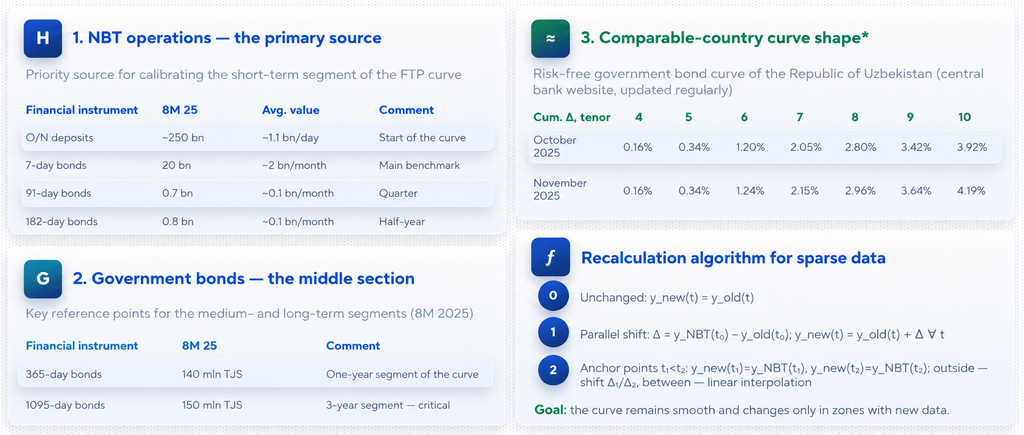
There is also no established foreign exchange swap market. This rules out the conventional approach of deriving a somoni yield curve from the US dollar curve using interest rate parity. Simply importing an off-the-shelf model was therefore not a viable solution. Eskhata Bank developed a synthetic somoni yield curve using three segments.
The short end draws on National Bank of Tajikistan instruments and rates, including the refinancing rate, overnight deposits and short-term central bank securities.
The middle segment uses Ministry of Finance government bonds, with calibration to account for market volatility.
The long end starts from the last available point on the Tajik market curve and extends it using changes in yields between maturities observed on Uzbekistan’s risk-free government bond curve.
The distinction is important. Eskhata Bank does not import Uzbekistan’s absolute interest rate levels. Instead, it uses the shape of the curve – how yields change as maturities increase. The starting level remains anchored in Tajikistan’s domestic market. If Uzbekistan ceases to be a suitable reference market, the bank has alternative approaches available: extending the curve flat from the last observable point or adjusting its slope using expert judgement.
The methodology is also designed to limit unnecessary volatility. New market observations are incorporated into the relevant sections of the curve while preserving a smooth term structure. For US dollar and euro funding, the process is more straightforward, with established SOFR OIS and ESTR OIS curves available as benchmarks.
The synthetic curve is not intended to replicate a market that does not yet exist. Its purpose is to provide a consistent and defensible pricing framework where reliable market observations remain limited.
Using FTP to Guide Liquidity Management
An effective FTP framework should do more than calculate funding costs. It should also influence business behaviour. At Eskhata Bank, this is achieved through the management adjustment, which is linked to the forecast level of the regulatory current liquidity ratio, K2-1.
The regulatory minimum is 30%, rising to 50% for systemically important banks. Eskhata Bank operates with a higher internal target of more than 60%, reflecting its own risk appetite.
The adjustment creates incentives that respond to the bank’s liquidity position. When forecast liquidity falls below the target, the adjustment increases. Attracting stable liabilities becomes more rewarding, while extending new loans becomes more expensive.
When liquidity exceeds the target, the adjustment declines, encouraging the business to deploy surplus funds more productively. Rather than relying on urgent meetings or across-the-board changes in pricing, the bank can use FTP to send targeted economic signals to its business units.
Four Operating Modes for Different Liquidity Conditions
A distinctive feature of Eskhata Bank’s approach is how it translates deviations from the liquidity target into pricing adjustments. The relationship follows an S-shaped curve. Its shape determines how quickly and strongly transfer prices respond to changes in liquidity. The bank has defined four operating modes.
- Disciplined — early intervention, gradual adjustment
Pricing responds relatively early to changes in liquidity, but adjustments remain smooth. Business units receive consistent signals without sudden shocks. - Trading — flexibility within a defined comfort zone
The bank allows greater flexibility while liquidity remains comfortably within target levels. As the position approaches a critical threshold, the pricing response becomes significantly stronger. - Crisis Mode — prioritising liquidity preservation
The framework prioritises maintaining liquidity buffers, with no pricing concessions that could undermine the bank’s position. This mode is reserved for exceptional circumstances. - Aggressive Growth — maximising the productive use of funds
When liquidity is abundant, pricing provides strong incentives for business expansion. When liquidity becomes constrained, the framework responds rapidly to discourage further deployment.
The operating mode is selected by the Asset and Liability Committee (ALCO). Eskhata Bank currently uses the Disciplined approach.
The underlying management principle is to establish the bank’s response to different liquidity scenarios before those conditions materialise. When circumstances change, management can switch to a previously defined and approved operating mode rather than redesigning its response under pressure.
From FTP Methodology to Management Infrastructure
Designing the FTP methodology was only part of the challenge. Making it operational requires reliable data, consistent calculation algorithms and integration with management reporting.
At Eskhata Bank, the scope is extensive: 99.9% of the balance sheet is covered by the FTP framework. For loans, the methodology accounts for contractual maturity and early repayment behaviour. For deposits, it considers effective maturity, additional contributions and partial withdrawals. Current accounts require a different approach: modelling how long customer balances are likely to remain with the bank in practice. The framework also covers securities, repurchase agreements, interbank transactions and external funding.
Capital and fixed assets are deliberately excluded from FTP. The distinction reflects the different economic characteristics of capital and funding liabilities. While the cost of market-sensitive funding changes in response to interest rates and market conditions, capital does not behave in the same way. Capital remains relevant to product profitability, but it is assessed through other financial measures.
With the methodology established, the bank is now focused on automation. Current priorities include reducing data latency, integrating additional information sources and moving calculation algorithms into an automated environment. The next objective is to calculate financial performance at the individual transaction level and establish a stronger foundation for advanced modelling, including AI-enabled analytics.
The project has also generated benefits beyond funding allocation. Developing a reliable FTP framework required the bank to build a deeper understanding of customer behaviour: how long funds remain on deposit, how frequently borrowers repay early and how stable different types of account balances are. These insights now have applications beyond Treasury, strengthening the bank’s broader customer analytics capabilities.
Beyond Funding Costs: Better Financial Decisions
The experience of Eskhata Bank illustrates how Funds Transfer Pricing can evolve from a technical calculation methodology into a broader financial management framework. Its value lies not in making funding cheaper, but in making funding costs more transparent, allocating risk responsibilities more clearly and creating consistent economic incentives across the organisation. For banks operating in markets with limited pricing data, the challenge is particularly complex. Reliable FTP requires not only a sound methodology, but also practical approaches to missing market benchmarks, customer behaviour modelling and liquidity management.
Eskhata Bank’s approach demonstrates how these constraints can be addressed through a combination of synthetic yield curves, risk-based pricing adjustments and a centralised funding framework.
Ultimately, the objective is to give Treasury and business units a common economic basis for decision-making. When both sides understand how funding costs are determined and which risks they are responsible for, discussions can move beyond disputes over internal rates towards a more productive question:
How can the bank price its products more effectively, allocate resources more efficiently and improve profitability across the organisation?

How Banks Manage Liquidity When the Rules Change Every Week
Why does liquidity become a test of governance during prolonged instability? Selcan Özen (FRM), Head of ALM within Market Risk at Yapı Kredi Bank, shows how liquidity flexibility is built before a crisis through procedures, scenarios, escalation rules and the habit of operating as one decision-making system. Her experience also highlights what must change when the external environment moves faster than normal management cycles.

CIS Economic Outlook 2026–27: Risks, Resilience, and Implications for Business
Economic growth and currency appreciation do not necessarily translate into a more predictable business environment. Dmitry Dolgin examines the forces shaping Armenia, Azerbaijan, Kazakhstan, and Uzbekistan, the vulnerabilities that remain, and what companies should consider when assessing their regional exposure and business plans. В статье - прогнозы на 2026–2027 годы и вопросы для проверки рабочих планов.