








Bank Cost Allocation: Five Methodology Questions That Shape Profitability

How much does a banking product or business line really earn when a significant share of its costs arises elsewhere in the organization? The answer depends not only on the costs themselves, but also on how the bank identifies their beneficiaries and structures its allocation methodology.
Georgy Zemitan, a cost management expert with more than 20 years of experience in major banks and consulting, identifies five questions that need to be addressed when designing such a methodology. The answers determine how costs are allocated across business units and products, and ultimately what level of profitability the bank reports.
Question 1. Which Costs Are Genuinely Bank-wide?
Some functions and costs support the bank as a whole but are not consumed directly by any particular business line or department. These can be grouped into a separate pool of bank-wide costs.
The pool may include executive management, the Management Board, the Board of Directors, accounting, internal audit, internal control, compliance, strategic risk management and corporate administration. It may also cover external audit fees, membership fees, credit rating costs and corporate brand advertising. Not every function or expense item has an obvious classification. In many cases, the right treatment depends on the substance of the cost.
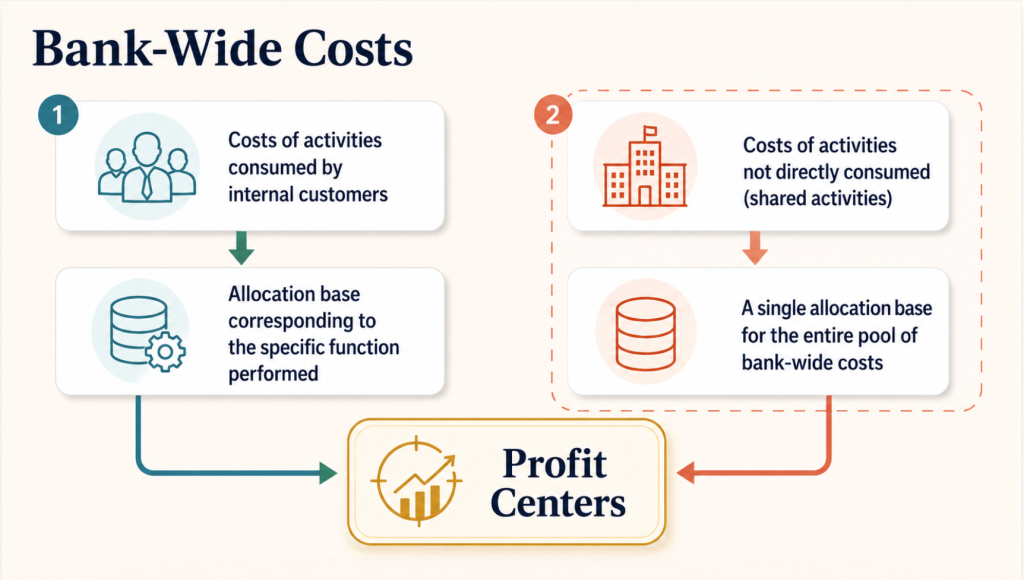
The defining feature of this pool is the absence of a direct beneficiary whose consumption of the service can be measured. One option is therefore to allocate bank-wide costs to Profit Centers in a single step using one common allocation base.
Possible bases include direct costs, direct and indirect costs, profit before or after selected allocations, risk-weighted assets, or a composite measure.
The choice can materially change the final picture. If bank-wide costs are allocated in proportion to expenses, the relative cost structure of the recipient units remains unchanged, while their relative profitability shifts. If they are allocated in proportion to profit, the profit ratio is preserved, but the relative cost structure changes.
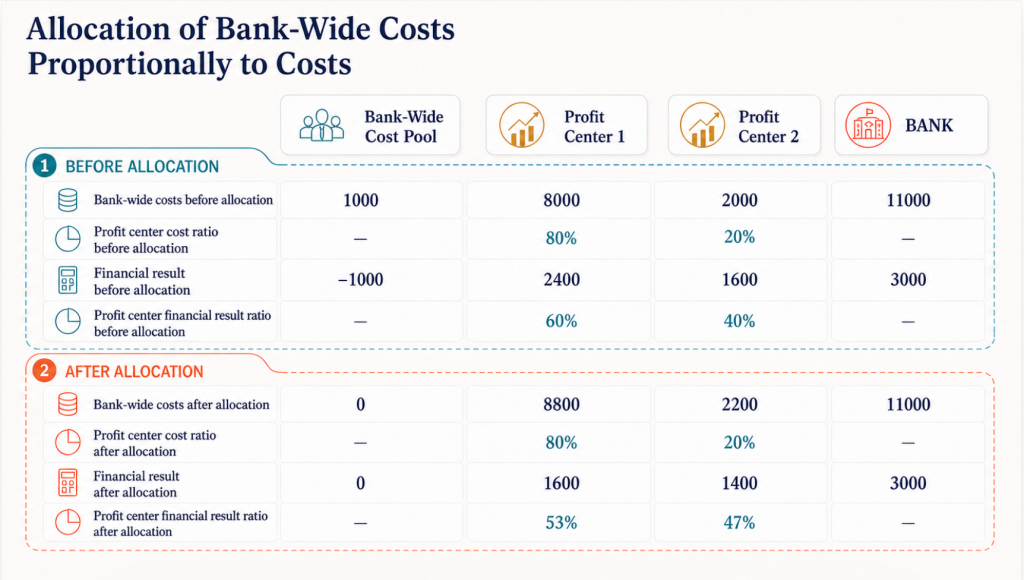
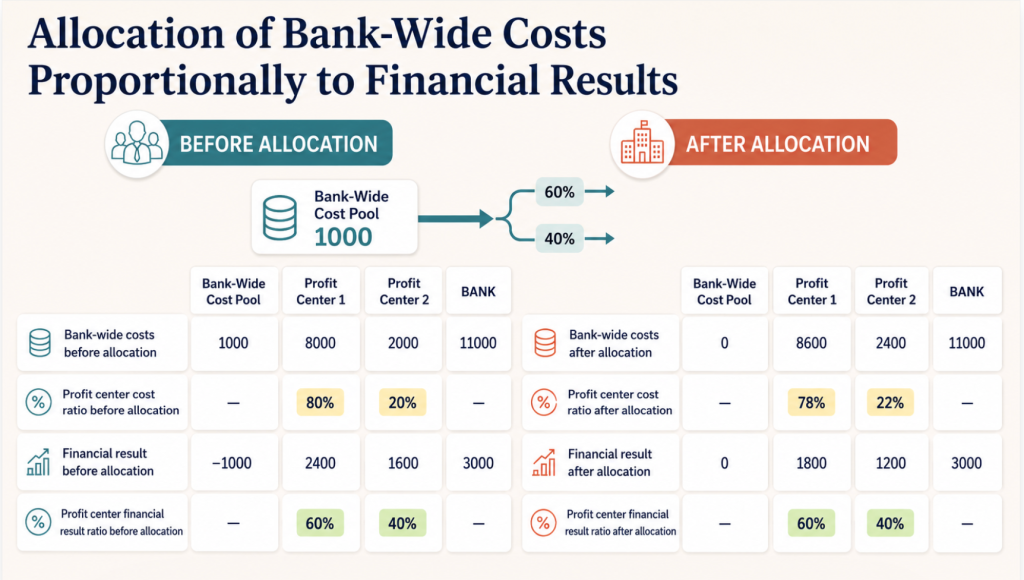
There is no universally correct allocation base. The key question is which relationship the bank wants to preserve after bank-wide costs have been allocated.
Question 2. How Should the Branch Network Be Treated?
A branch network creates a different methodological challenge. A branch may be both a standalone unit whose financial performance the bank wants to assess and a distribution channel through which several business lines sell and service their products.
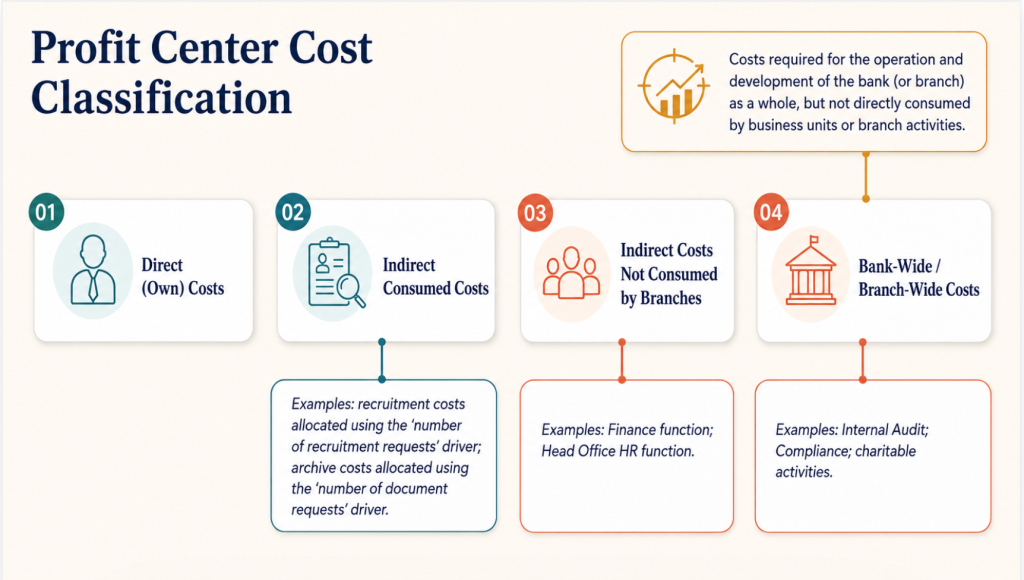
It is therefore not enough to combine all branch costs and allocate them onward. The methodology should distinguish between several categories:
- the branch’s own direct costs;
- the cost of services provided by other departments and consumed by the branch;
- indirect costs that the branch does not consume directly;
- bank-wide or network-wide overhead.
Specific cost drivers can be used for internal services consumed by branches. Recruitment costs, for example, can be allocated according to the number of recruitment requests. Archive costs can be allocated according to the number of document retrieval requests.
Before designing the calculations, however, the bank must decide what role the branch plays in its management accounting model. Is it a final object whose profitability is assessed directly, or an intermediate object whose costs are subsequently allocated to products and business lines?
That decision determines the entire allocation chain that follows.
Question 3. Should Treasury and Problem Assets Be Treated as Costs or as Businesses with Their Own Profitability?
Not every banking function fits neatly into the distinction between revenue-generating businesses and support functions.
Treasury is a clear example. It can be treated as a Cost Center whose expenses are eventually allocated to other units, or as a Profit Center with its own financial performance.
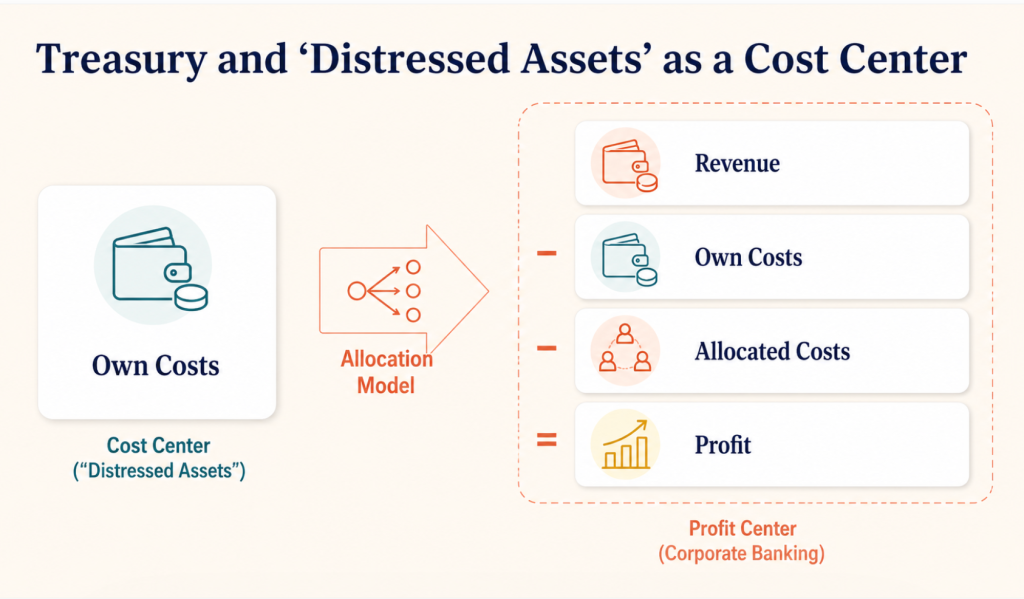
The same choice arises for the problem asset management unit.
If it remains a Cost Center, its expenses need to be allocated. If it becomes a Profit Center, the accounting model itself must change.
In the second model, the bank needs formal rules for transferring problem portfolios to the unit. It must also change the way provisions are recognized, stop allocating the unit’s costs to the original business lines and introduce performance measures linked to the unit’s own financial result.
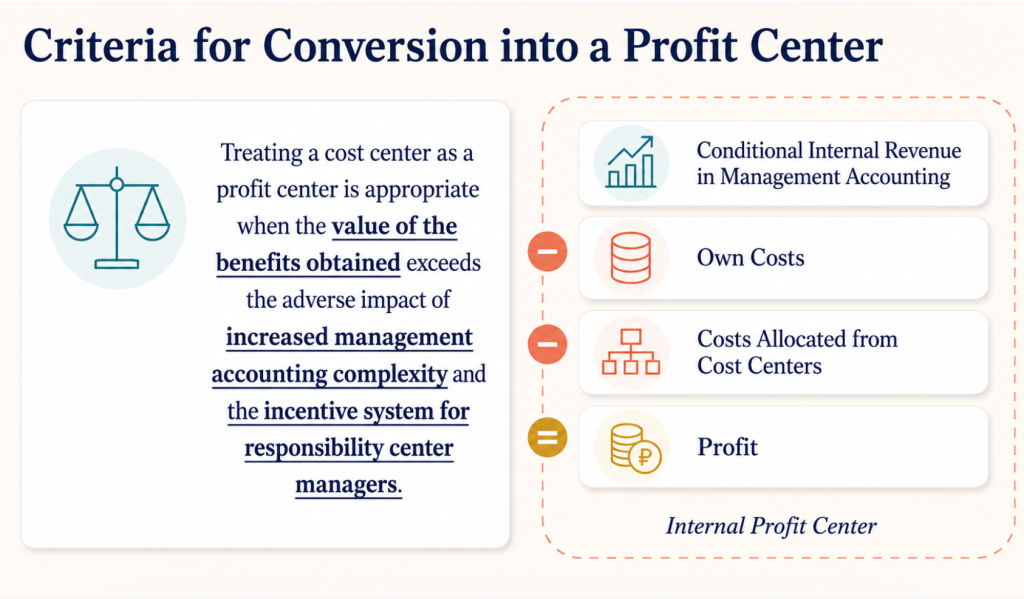
A unit cannot become a Profit Center simply because its classification has been changed in a reference table. The decision requires corresponding changes to the bank’s management accounting rules.
Question 4. How Can Interest-based and Fee-based Products Be Compared?
For interest-based products, natural allocation drivers include the number and value of originations and the size of the portfolio. For fee-based products, the relevant measures are usually the number and value of transactions.
When a department supports only one type of product, selecting an allocation base is relatively straightforward. The challenge arises when the same function supports both interest-based and fee-based products.
A loan portfolio, for example, cannot be compared directly with the number of fee-generating transactions. The measures describe different types of activity.
The effort required to perform each activity can provide a common basis. If the bank has standard processing times for product origination and servicing, the number of transactions can be multiplied by the relevant time standard. Where no such standards exist, an expert estimate of employee time may be used.
Question 5. What Does It Really Cost to Originate a Product?
Product profitability analysis needs to distinguish between origination costs and servicing costs. Origination costs arise once and are attributed to the month in which the product is issued. Servicing costs continue throughout the product’s life.
For some functions, this distinction is relatively clear. Underwriting and risk activities are primarily associated with origination. Operations, financial crime compliance and problem asset management are more closely linked to servicing. Other costs cannot be divided so easily. IT systems, for example, support both product origination and ongoing servicing.
Front-office costs raise a separate question. To allocate employee time across products, the bank can use standard processing times. The number of completed transactions is multiplied by the standard time required for each activity.
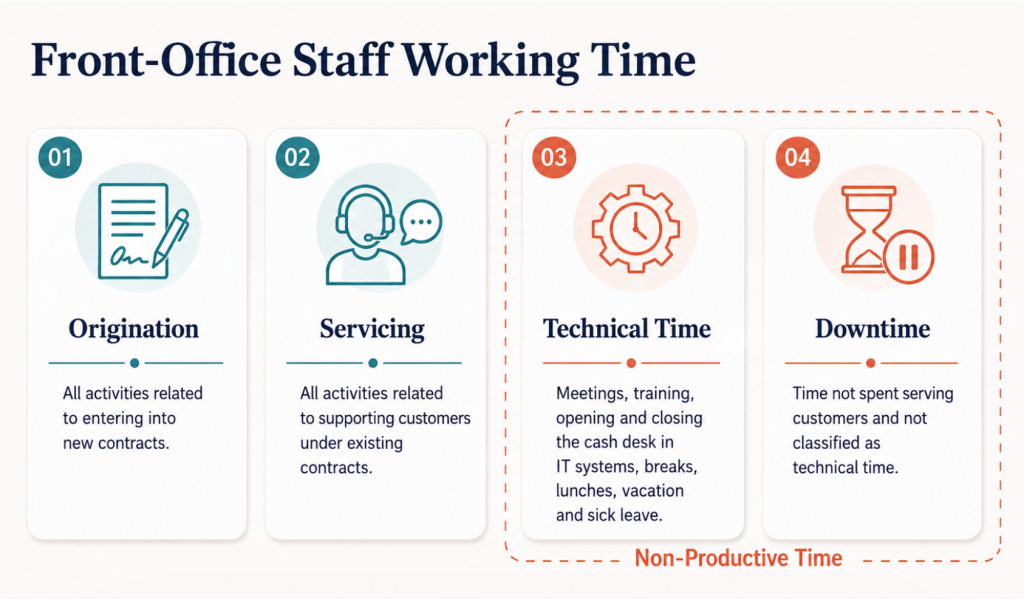
Not all working time, however, is spent directly on product-related transactions. Technical time and unavoidable idle time should be considered separately.
Technical time includes meetings, training, breaks, meals, annual leave, sick leave, opening and closing system sessions, and other unavoidable parts of the working day. This time should generally be allocated to products and business units because it forms part of the cost of maintaining the front-office workforce.
The treatment of unavoidable idle time is less straightforward. This is the time during which an employee is available to process transactions but no customers are present. The bank continues to incur the employee cost, but the idle time may reflect the way the branch network is organized rather than demand for a particular product. Allocating it entirely to products can reduce their calculated profitability because of costs that those products did not directly cause.
Each bank should therefore define the treatment of unavoidable idle time explicitly in its methodology. At a minimum, product cost analysis should distinguish among origination costs, servicing costs and front-office time that is not directly attributable to product-related transactions.
IT Requires a Separate Allocation Logic
The high share of technology spending is another defining feature of banking.
IT costs pass through several layers. They begin with infrastructure and depreciation, move to individual systems and services, and are then allocated to departments, products and other final cost objects.
Product-level analysis is particularly difficult. A single system may support several processes and products and may be used for both origination and servicing. If a bank wants to understand costs at product level, allocating the IT budget to a department is not enough.
The methodology needs to identify which systems and IT services support each function and establish how their costs flow through to the products and other final objects that use them.
What to Review in Your Bank Cost Allocation Model
A practical review can begin with the following questions:
- Are genuinely bank-wide costs separated from costs with an identifiable beneficiary?
- Is it clear what the chosen bank-wide allocation base preserves: the cost structure, relative profitability or another measure?
- Has the bank defined the role of each branch in the model and determined where its costs ultimately flow?
- Does the accounting treatment of Treasury and problem assets reflect how their performance is actually managed?
- Is there a comparable allocation base for departments that support both interest-based and fee-based products?
- Are origination and servicing costs calculated separately?
- Has the methodology defined how technical time and unavoidable employee idle time should be treated?
- Can IT costs be traced from infrastructure and systems to the products and functions that use them?
If a bank cost allocation model has been in place for several years, these are the areas worth revisiting first. The numbers themselves may not need to change. The rules that determine how the bank understands the profitability of its products and business units might.

Operational Efficiency in China: Turning a Business Tour into a Management Project
A visit to one of China’s leading manufacturers can easily become little more than an impressive factory tour. Executives see robotic production lines and digital dashboards, take photographs and then return to the same problems and ways of working. For a business tour to deliver real value, the focus needs to be on the processes, performance measures and management decisions behind the technology.

Fraud in fintech: the price of convenience
Fraud in fintech is no longer just a security concern. It shapes growth, trust and regulatory scrutiny. This article explores the trade-offs between convenience and control, what works in practice, and how risk strategy evolves as companies mature.