Ideas don’t end when the event does.
We’ve started working on a series of articles inspired by our forums and webinars — where insights, discussions, and real business experience continue to evolve.
We’ll share reflections, expert opinions, and practical takeaways from leaders across banking, manufacturing, and other industries — for those who value learning, progress, and measurable results.
If you’d like to share your expertise or contribute an article, we’d be happy to connect and discuss collaboration.
Stay tuned!


Exchange-rate volatility in Turkey after 2018 has become not an episodic shock but a persistent factor linked to the dynamics of banking margins. Once this relationship is measured and the influence of local and global factors is separated, it becomes a practical tool. The estimated sensitivity of margins to volatility can then be used as a reference parameter for Funds Transfer Pricing (FTP).
Why, in periods of high FX volatility, selecting a hedging instrument is not enough—and how to build a structured FX-risk management system. Which metrics to use for daily monitoring, how to match instruments to specific risk types and liquidity constraints, and what management lessons can be drawn from hedging failures at major banks.
For companies planning production, sourcing, exports, or investment in Turkey in 2025–2026, one question dominates: is the country entering a period of sustainable stabilization, or is the current calm merely temporary? According to Şevin Ekinci, 2026 may provide the answer. She explains which domestic indicators will determine whether the normalization holds, how the global economic environment is shifting, and why two specific risks could quickly reverse the trajectory.

Why the shift to 24/7 and instant settlement breaks not technology first, but the operating model itself: where liquidity actually sits, who has the full picture, how value dates work — and what happens if the payment rails have to be stopped.

Why the “core” of non-maturity deposits cannot be estimated by inertia: sharp rate movements, the growing gap between historical models and current behaviour, and what banks must challenge in their assumptions.

Why ESG has moved beyond reporting and become a question of banks’ resilience: where supervisors will focus on capital, liquidity, and funding — and what this changes for treasury.
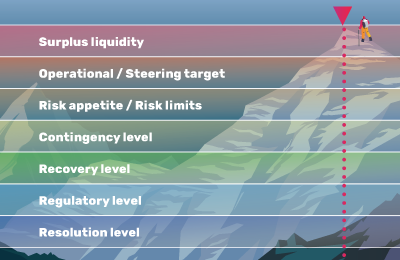
How do you define the “right” level of liquidity when a high ratio alone does not guarantee optimality? We explore a practical framework: separating liquidity into a risk buffer and a managed strategic resource, building a ladder of target levels, and using FTP to keep liquidity within an effective operating corridor.

How fair value, the effective interest rate (EIR), and expected credit losses (ECL) interact under IFRS 9; why off-market transactions must be unbundled into fair-value compon
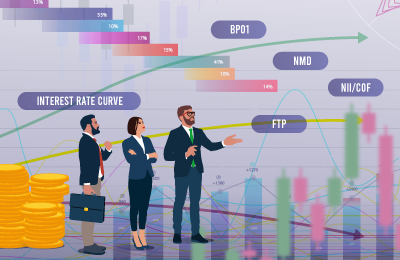
Treasury. Interest rate risk (IRR). FTP. BP01. NII and NIM. Cost of Funds (CoF). Refixing risk (rate reset dates). P/L and Risk Limits. Swaps and shift fixings. Balance sheet management.

Islamic banking in treasury: how to operate without interest while still using a full toolkit for client financing, liquidity management, investment portfolios, and foreign-exchange risk. Using the example of a Kazakhstani Islamic bank, we examine real products—from Murabaha and Ijara to Sukuk and Wakalah/Mudarabah investment deposits.

How can companies fight fraud without killing conversion and sales? An industry expert shares hands-on experience—from basic rules to advanced models, from manual checks to resilient anti-fraud systems that not only reduce risk but actively improve customer experience and revenue.

The future of the investment sector lies at the intersection of global trends, domestic macro-stability and technological innovation. Ali Alaskarov explains how the cost of capital is changing, why markets need a new liquidity architecture, and how Azerbaijan is building a next-generation financial ecosystem.