









Anti-fraud under resource constraints: how to identify risk convergence points

Fraud is becoming both more sophisticated and faster. Mid-sized banks, meanwhile, rarely have the luxury of large teams, excess budgets, or the time to review everything indiscriminately. Yet the level of protection required is no lower: losses, vulnerabilities, and pressure from fraudsters are very real.
Tiko Mchedlishvili outlines how to build anti-fraud under these constraints. The logic is straightforward: don’t try to cover everything, don’t drown in signals – focus on what actually threatens the business. This article looks at priorities, practical measures, and how to build resilience even with limited resources.
Do not try to control everything
Trying to control everything is a losing strategy. Systems get overloaded, and teams end up spending time on secondary signals rather than real risk. Instead, the focus should be on the broader picture – identifying what genuinely stands out from normal behaviour.
This is what separates noise from risk. Not every suspicious event matters. Many deviations are harmless; a small number drive real losses. Those are the scenarios that deserve attention.
Prioritization matters more than full coverage
When resources are limited, prioritization becomes the system. The focus should be on protecting the most critical elements: payment infrastructure, high-value clients, newly opened accounts, and transfer corridors where sharp anomalies emerge. This is far more effective than trying to control every transaction equally.
Particular attention should go to transfer directions and transaction types showing unusual growth. A sudden spike in volumes between specific countries, banks, or categories is a red flag. In these cases, it is essential to follow the full path of funds – not just individual transactions.
Look for convergence points, not isolated events
One of the most effective principles is to stop looking at transactions in isolation and start looking for convergence. Fraud schemes can remain invisible when viewed one operation at a time. But when multiple unrelated accounts begin behaving in the same way – and sending money to the same destination – that’s where the real signal is.
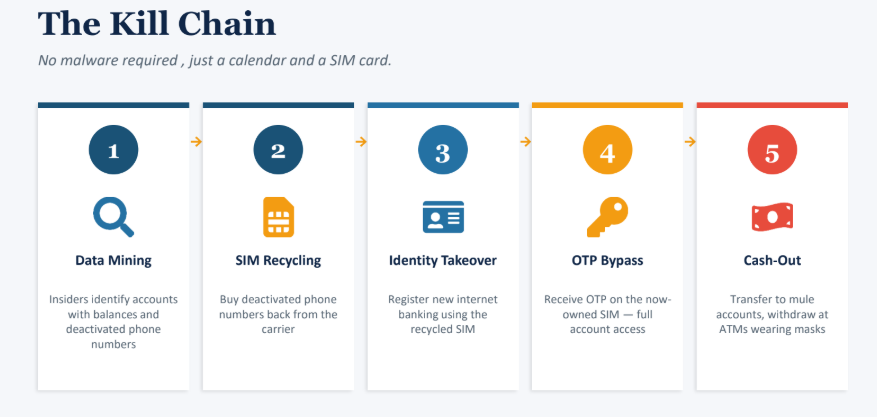
In practice, link analysis often reveals more than transaction-level checks. If multiple accounts are operated from the same device, connect through the same address, follow similar behavioural patterns, or send funds to a single beneficiary, this exposes the scheme as a whole. The more fraudsters scale, the harder it becomes to hide shared entry and exit points.
Risk often emerges from a combination of weaknesses
Fraud rarely exploits a single major flaw. More often, it emerges from a combination of smaller weaknesses.
Overly convenient remote onboarding, delays in data updates, and a lack of rules linking related transactions may each seem manageable in isolation. Together, they create a viable path for account takeover and fund extraction.
Convenience needs to be treated with caution where it undermines control. For certain clients and scenarios, the digital journey should remain restricted until additional verification is completed. Remote onboarding alone is not always sufficient to grant full access – limiting functionality first and expanding it after confirmation is often the safer approach.
Dormant accounts require dedicated control
The same logic applies to dormant accounts. If an account has been inactive for a long period, its sudden return to activity should not be treated as routine. A stricter activation process – manual review, additional verification factors – is justified. In such cases, a simple confirmation code is often not enough.
This becomes particularly important where external data updates are delayed or where clients interact with the bank infrequently. Dormant accounts are a natural target for fraud.
Do not spend scarce experts on routine
Skilled analysts are one of the scarcest resources. Their time should not be spent on repetitive checks and weak signals.
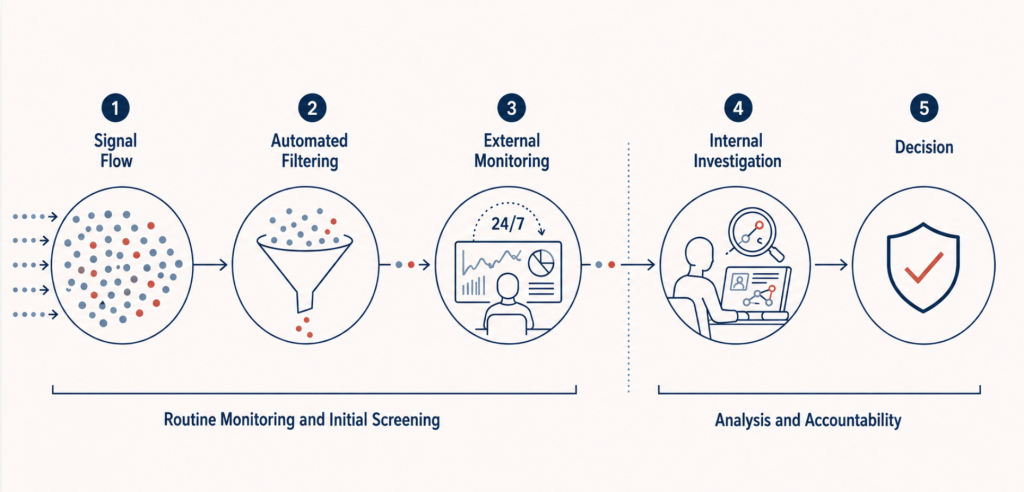
Part of the workload can be moved to an external layer: 24/7 monitoring, initial alert filtering, and technical data processing. But the division of roles is critical. Monitoring can be outsourced; judgment cannot. External teams can filter noise, but investigation, interpretation, and decision-making must remain in-house.
Semi-automated networks outperform manual review
The goal is not just to build individual checks, but to create semi-automated systems that continuously collect and connect signals. Analysts should step in only when genuinely meaningful cases emerge.
Automation here is about efficiency, not replacement: removing repetitive actions, speeding up data preparation, and freeing up expert time for situations that require judgment.
Protection is also about people
Not all fraud signals appear in systems. Frontline employees – sales, support, security – often spot issues earlier.
That makes it essential for people across the organisation to understand basic anti-fraud logic and recognise unusual behaviour or suspicious requests. This is especially important in environments where trust and personal relationships play a significant role.
Internal fraud and process circumvention rarely rely on technical breaches. More often, they rely on human flexibility – requests to speed things up, ignore a rule, or “help out.” In practice, these small compromises are often where the real losses begin.
Organizational barriers are as important as technical controls
Training alone is not enough – structural safeguards matter just as much. Critical actions should never depend on a single individual. If one employee can approve a high-risk transaction alone, that creates unnecessary exposure.
Where the cost of error is high, a second pair of eyes and clear approval processes are essential.
Simple internal “traps” can also be effective. These low-cost mechanisms help detect unusual interest in data or operations. If something irrelevant to normal workflows attracts attention, it becomes a signal worth investigating. Such measures don’t replace core controls – but they strengthen them.
Regular signal clean-up is essential
With limited resources, anti-fraud should not be more complex – it should be more precise.
It’s not about controlling everything equally. It’s about understanding where losses actually occur, which patterns repeat, where money flows converge, and which processes are too easy to bypass.
That requires regularly reviewing alerts. Which signals actually help – and which just consume time? If a signal consistently produces false positives, it overloads the system. It should be refined, simplified, or removed altogether.
Key Takeaways and what can be implemented in practice
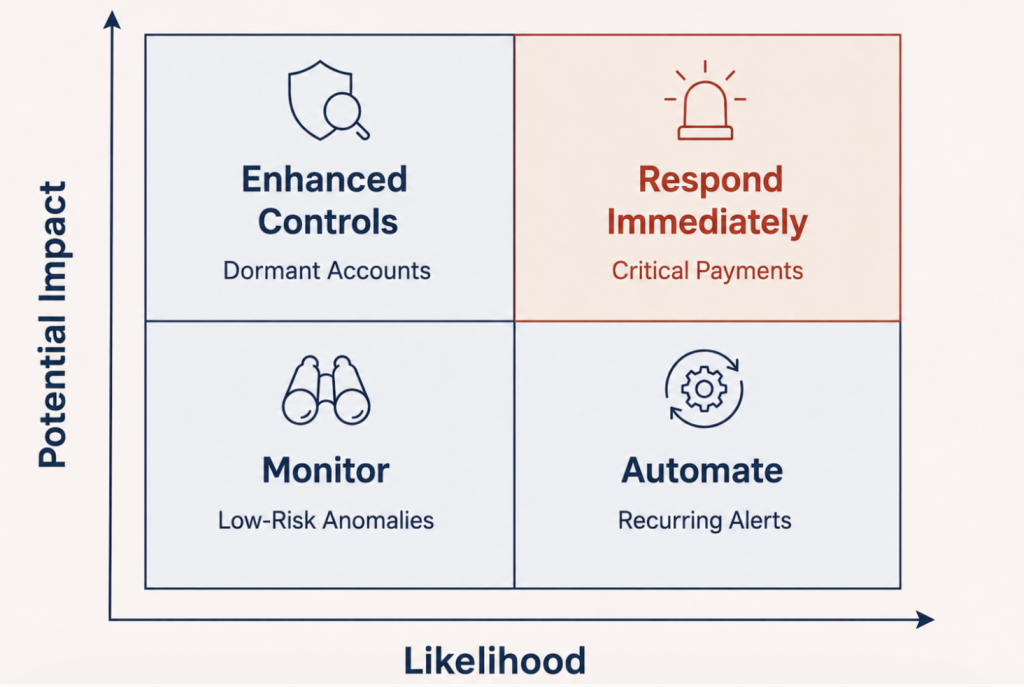
Start with prioritization. Instead of spreading controls evenly, focus on the areas of highest potential loss: core payment flows, new accounts, dormant accounts, and transfer corridors with sudden spikes in activity.
Next, assess whether the system captures relationships between events. If multiple clients use the same device, address, or beneficiary, these links should automatically trigger further checks.
It is also worth reviewing where convenience has already become a risk. If remote onboarding or account reactivation is too frictionless, additional verification or manual review should be introduced for specific scenarios.
Another step is to reduce the burden on analysts – outsourcing 24/7 monitoring and initial filtering, while keeping investigations and decision-making in-house.
Finally, look beyond systems. Anti-fraud also depends on people and structure: awareness in business units, clear approval processes, employee training, and simple internal controls can all deliver meaningful impact without heavy investment.

How Anti-Fraud Is Evolving and Why the Market Must Act Together
Why modern fraud can no longer be treated as a problem for individual banks to solve. Fraud schemes increasingly exploit human behaviour, scale rapidly across borders and harness new technologies as effectively as financial institutions themselves. What this means for anti-fraud, why the market needs faster ways to share intelligence, and how the challenge is viewed by banks, regulators, industry associations and technology partners.

How Corporate Governance Failures Create the Conditions for Fraud
Corporate fraud is usually blamed on the individuals involved. But there is another question worth asking: which management decisions allowed the misconduct to begin, spread and remain undetected? Drawing on two anonymised cases, Elina Moshkovich shows how conflicts of interest, poorly designed KPIs and weak control functions can turn isolated abuse into a systemic business risk.