









How to Manage Your Time and Energy: Proven Techniques for Better Productivity

In a world of constant deadlines and endless to-do lists, keeping up with everything has become a new form of self-respect. The more tasks we manage to fit into our schedule, the more accomplished we feel — yet the less time we have left for ourselves.
The real question isn’t how to squeeze more into 24 hours, but how to manage yourself within those hours.
Aigul Sandalova, business trainer and expert in organizational development and time management, shared practical techniques that help leaders stay productive without burning out — from setting priorities and delegating effectively to building personal discipline and a “results-over-problems” mindset.
Time Management = Self-Management
When it feels like there’s not enough time, the issue is rarely the time itself. It moves the same way for everyone — the difference is that some people manage it, while others let it manage them.
Real time management doesn’t start with a planner or rigid rules. It starts with inner order. When your mind is crowded with tasks, doubts, and other people’s priorities, it’s impossible to be efficient — no matter how neatly your lists are written. Awareness is what turns busyness into results.
A simple way to check how well you manage your time is to notice how you feel when leaving work.
If tiredness comes with satisfaction — you were in control of your day.
If it comes with irritation — the day was in control of you.
Time management is, at its core, the management of attention and energy. It’s the ability to pause at the right moment, say “no” to the secondary, stay focused, and not confuse movement with progress. Once you master this, productivity stops being a fight against the calendar and becomes part of a mature attitude toward yourself and your work.
Personal Organization and Planning
Every time-management system begins with clarity — knowing what exactly needs to be done and when. Not a vague “work on the project,” but specific actions scheduled by day, week, or month. Without this clarity, no method or app will help.
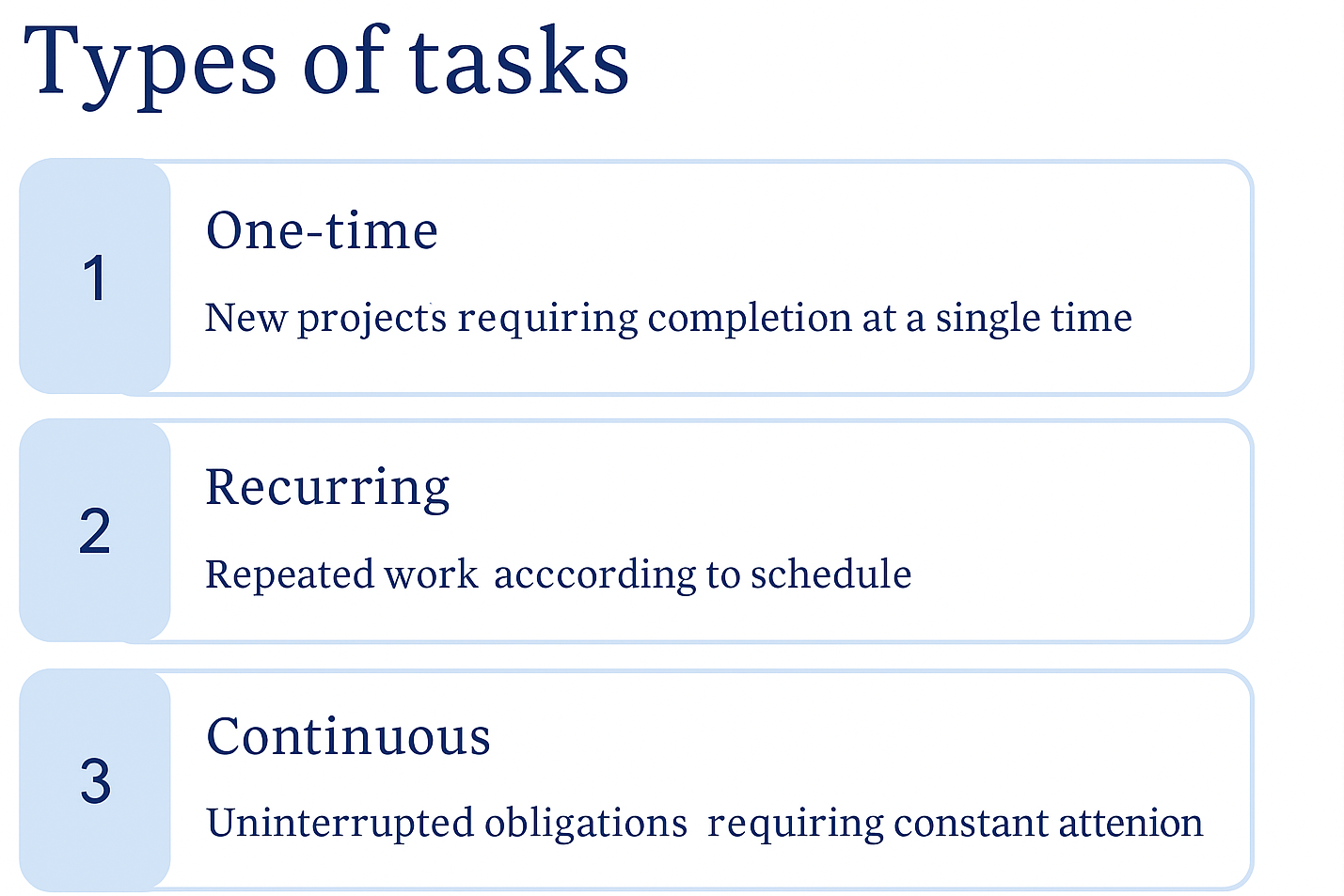
Work tasks can roughly be divided into one-time, recurring, and ongoing.
This simple distinction helps you see where your attention really goes: to strategic goals or to the stream of small things that seem to take “just five minutes” but somehow consume entire hours.
A weekly plan is the best way to regain control. A simple desk planner that shows all the days at a glance reveals reality without illusions: here’s Monday, here’s Friday — and everything in between that truly fits into a week, not into wishful thinking. Once tasks are written down on paper, they stop spinning in your head and free up mental space for focus.
Everyone has their own working rhythm. Some people are at their best in the morning; others hit their stride later in the day. The key is to align your schedule with your own energy — not to chase someone else’s idea of what “productive” should look like.
Time management isn’t about controlling time — it’s about aligning yourself with reality.
Time Thieves
The most fascinating part of time management is observing where time actually goes. We can carefully plan our day, set priorities, and use every productivity tool available — only to realize that half the evening has vanished into emails or endless message threads.
The main thieves of productivity are always nearby. A phone flashing with notifications. A colleague who drops by “just for five minutes.” Browser tabs that never seem to close. None of these things feel serious on their own — until you add them up and see that two hours of your workday have disappeared without a trace.
Another key factor is order. A workspace where everything has its place disciplines you as well as a personal assistant. The same goes for your digital space: a clean inbox, organized files, and muted notifications restore your sense of control faster than any time-management method.
Time doesn’t just slip away — it’s stolen by habits. Remove even one distracting habit for a single day, and you’ll realize there’s enough time after all — you just used to share it with unnecessary noise.
Priorities and the Eisenhower Matrix
One of the most common illusions at work is believing that everything is important and everything is urgent. When there are no clear priorities, it feels like you’re constantly busy — yet by the end of the day, it’s hard to explain what you actually accomplished.
The Eisenhower Matrix is a simple yet ruthless tool. It divides tasks into four categories:
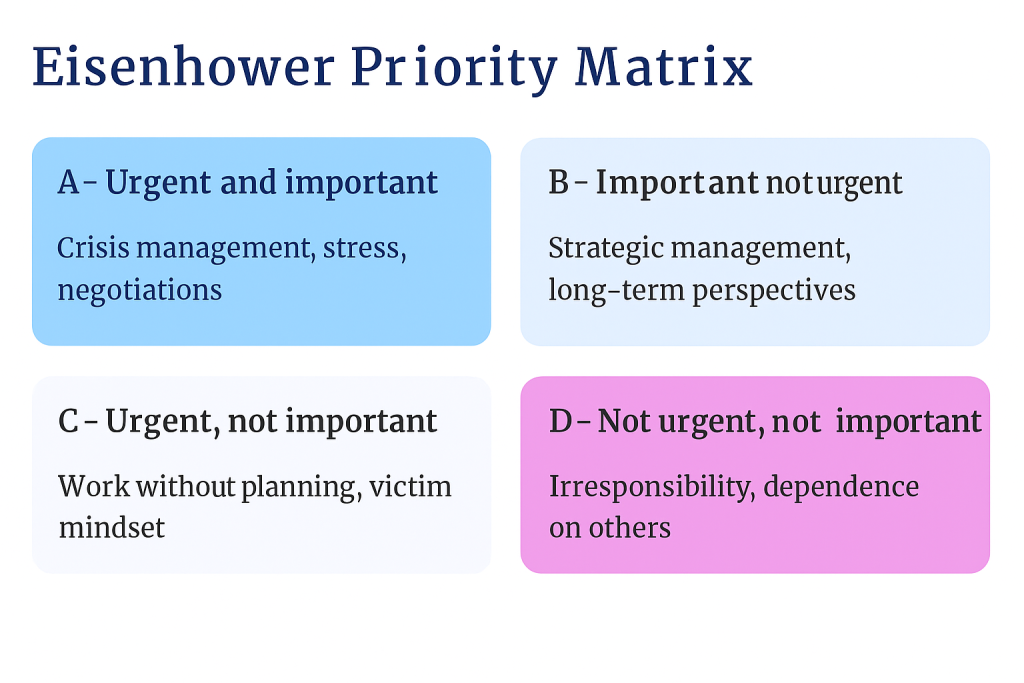
- Urgent and important
- Important but not urgent
- Urgent but not important
- Neither urgent nor important.
Most people live in the first quadrant — constant stress, endless deadlines, and the nagging feeling that you’re running late even for your own life.
But true effectiveness lives in the second quadrant — where things are important but not urgent. That’s the space for strategic thinking, growth, and systemic change. There’s only one way to get there: stop reacting and start planning.
Urgency will always demand your attention. It’s loud, insistent — like a phone that rings precisely when you’re finally focused. Importance, on the other hand, is quiet. It’s easy to overlook, yet it’s what determines where you’ll be a year from now.
Delegation and Control
Delegation is often seen as a way to lighten your own workload. In reality, it’s not a tool for relief — it’s a tool for responsibility. When a leader delegates a task, they’re not passing off a duty; they’re expressing trust. And the precision with which that task is defined determines the outcome.
Every act of delegation rests on three pillars:
a clear task,
a clear deadline, and
consistent feedback.
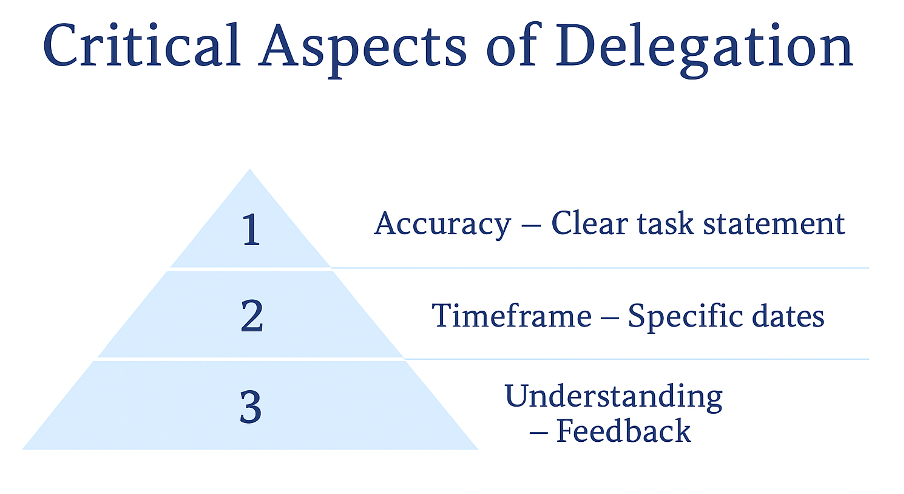
If even one of these elements is missing, partnership turns into chaos. Saying “get it done by Friday” isn’t the same as explaining what exactly needs to be ready and in what form.
Control, in this sense, isn’t about mistrust — it’s about respect for shared work.Delegate everything you can — but always follow up. Checkpoints, interim versions, and quick discussions along the way aren’t bureaucracy; they’re prevention.
Delegation isn’t about walking away from work — it’s about creating a space where everyone knows their responsibilities. When that happens, responsibility stops feeling heavy — it’s simply shared wisely.
Communication as a Tool of Efficiency
When everyone speaks their own “language,” even the smartest strategies stop working. Effective teamwork is built on three simple things: clarity of tasks, clear deadlines, and consistent feedback. Everything else is just details.
When a person clearly understands what needs to be done and by when — and feels free to ask for clarification — the process moves forward. But if even one link in that chain breaks, misunderstandings appear, turning into wasted hours and unnecessary stress.
There’s another rule that’s rarely practiced: keep your word.
When a leader delivers on promises, they create a sense of predictability — a key ingredient of a stable team. You can forgive a mistake, but you can’t work productively in an environment where words mean nothing.
In effective teams, communication isn’t built on hierarchy but on respect. When everyone feels their contribution matters — and knows they’ll be heard — even complex tasks get solved without conflict or rush. And in teams where people speak honestly and on time, time itself stops being wasted.
From Problems to Opportunities
Problems are part of any job. How we respond to them defines us just as much as our professional skills.
You can get stuck in the usual questions — Who’s to blame? Why did this happen? What’s the consequence?
Or you can ask different ones: What result do we need? What can I do? How can we prevent this next time?
When you shift your focus from blame to solutions, stress naturally fades. A mind occupied with accusations can’t think critically, but a mind looking for answers stays clear and creative, even under pressure.
Any problem can be reframed as an action: What can I do right now to change this situation?
Once you write down a few steps, tension decreases — because the problem gains structure and boundaries.
A problem is always a signal — not of disaster, but of growth. When you learn to see challenges as a resource, not a threat, work stops feeling like a constant struggle and becomes a process of development.
Balance and Reset
Work consumes energy — and without recovery, no time-management system will save you. You can’t be productive when your body and mind are running on empty.
In time management, it’s essential to remember: breaks aren’t weakness — they’re part of the process. No matter how full your day is, make space for short pauses. A walk after lunch, a change of task, or a quiet cup of coffee — these are your moments of reset. After them, thoughts fall back into line instead of tangling into knots.
Some people prefer short breaks every hour; others work best when they pause only after completing a task. The key is not to drown in a nonstop flow where your sense of time disappears.
Recharging doesn’t require hours. Sometimes, all it takes is standing up, stretching, or walking a few steps to restore your body’s energy and your mind’s clarity. It’s in these short moments that your most valuable resource — attention — is renewed. And that’s what truly makes your day productive.
Time Management as Life Management
Time is the most democratic resource — everyone has the same amount, yet the results are never the same. The difference isn’t in the number of hours, but in how we fill them.
When your workday is built with intention, you finish it with a sense of completion. You leave not drained, but satisfied — because you did what truly mattered. And in that moment, space opens up for everything else: family, rest, and your own ideas.
Planning is a form of self-respect. If you don’t manage your time, someone else inevitably will — and their priorities will fill your entire schedule. Organization doesn’t restrict you; it does the opposite. It frees you — from mental clutter, from constant urgency, and from the feeling of always being behind. It gives you the calm focus to move toward your own goals.
The key is not just to know the tools, but to start using at least one. Any system only works when it becomes part of your everyday life. Take the first step — and you’ll see that managing time is truly possible.
And maybe, at some point, you’ll realize that it’s no longer about time management at all — it’s about managing your life.

The Investment Market After the Era of Cheap Money: Who Is Ready for the New Financial Landscape?
The future of the investment sector lies at the intersection of global trends, domestic macro-stability and technological innovation. Ali Alaskarov explains how the cost of capital is changing, why markets need a new liquidity architecture, and how Azerbaijan is building a next-generation financial ecosystem.